
Legal status
Is MOTS-c legal in the US? FDA status and the 2026 HHS policy
NuuVive Journal · · 5 min read

Short answer
MOTS-c is not an FDA-approved drug. However, under an October 2026 HHS interim policy, the FDA exercises enforcement discretion allowing state-licensed pharmacies to compound MOTS-c with a valid prescription, provided strict manufacturing and reporting conditions are met. Outside of this pharmacy pathway, MOTS-c is legally sold strictly as an unapproved chemical for laboratory research use only.
Key takeaways
- MOTS-c is a 16-amino-acid mitochondrial-derived peptide first identified in 2015.
- It is not an FDA-approved drug for any condition.
- An October 2026 HHS policy allows state-licensed pharmacies to compound MOTS-c under strict conditions, though this does not constitute FDA approval.
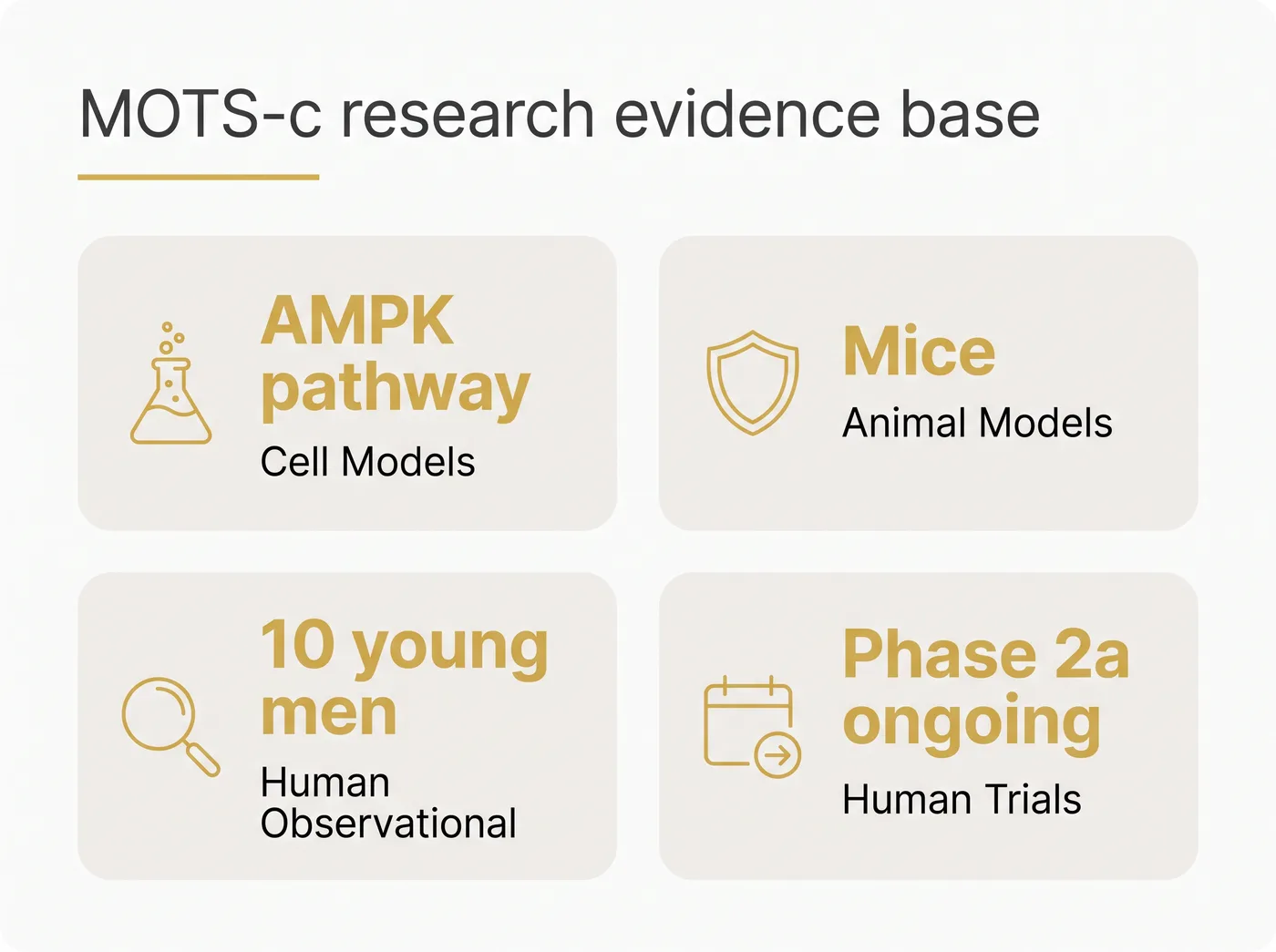
- Research is largely limited to cell and mouse models, with one Phase 2a human trial currently underway.
- There is currently no published clinical trial data evaluating synthesized MOTS-c in humans.
What MOTS-c actually is
Ask the internet about a mitochondrial peptide and you will quickly find yourself wading through a swamp of marketing buzzwords. Strip away the noise, and you are left with a 16-amino-acid sequence and a file of regulatory documents. If you want to know what the compound is, you have to look at its structural biology.
MOTS-c is a mitochondrial-derived peptide, or MDP. Most peptides and proteins in research are encoded by the DNA sitting in the nucleus of a cell. MOTS-c is different. It is encoded by the mitochondrial genome, specifically from a short open reading frame within the 12S ribosomal RNA region known as the MT-RNR1 gene 9. After it is translated in the cytosol, it acts as a retrograde signalling molecule, meaning it sends chemical messages backward from the mitochondria to the cell nucleus 10.
The peptide was first identified and described in March 2015 by a research team at the University of Southern California Davis School of Gerontology. It has a precise amino acid sequence of MRWQEMGYIFYPRKLR and a molecular weight of 2174.6 g/mol. In the years since its discovery, it has become a central focus for laboratories studying cellular energetics alongside other compounds investigated in metabolic research, such as NAD+.
The research so far: from mice to early trials
When you read about MOTS-c online, the timeline of its evidence base is often blurred. Laboratory studies have evaluated MOTS-c for its role in cellular energetics, glucose handling, and the AMPK pathway. In animal models, researchers have investigated its systemic effects in mice, including young, middle-aged, old, and high-fat diet-induced models. These preclinical trials measured markers like insulin sensitivity, glucose tolerance, visceral fat accumulation, and endurance during physical performance running tests.
Human evidence is a different story. One small observational study tracked the naturally occurring endogenous levels of MOTS-c in the skeletal muscle and blood circulation of 10 young men following exercise. As for synthetic MOTS-c, it is currently being evaluated in a registered Phase 2a clinical trial known as the MOTS-MET trial. This ongoing study aims to enrol 120 adult participants with prediabetes and overweight or obesity to measure insulin sensitivity over a 12-week period.
An engineered synthetic analogue of MOTS-c, known as CB4211, did undergo Phase 1a/1b clinical testing in 88 participants for non-alcoholic steatohepatitis and obesity. However, this is a modified compound with a distinct structural profile, not the native MOTS-c sequence.
The FDA status and the 2026 HHS compounding policy
MOTS-c is not an FDA-approved drug. It has not passed the formal agency review process for commercial marketing. For years, it existed in a regulatory grey area, sold purely as a research chemical while compounding pharmacies occasionally prepared it under state rules. On October 28, 2026, the regulatory situation shifted dramatically.
The HHS and the FDA published an interim policy regarding 503A compounding using certain peptide bulk drug substances 4. This document stated that the FDA does not intend to pursue enforcement action against state-licensed pharmacies or physicians that compound medications using six specific peptides, one of which is MOTS-c 3. To see how this exact same regulatory shift affects another compound on that list, check out the legal status of Semax.
To qualify for this enforcement discretion, compounders must fulfil strict conditions 6. The formulation must contain only a single active pharmaceutical ingredient. It must use bulk substances from FDA-registered and CGMP-compliant manufacturers accompanied by valid certificates of analysis. It requires a valid patient-specific prescription and mandatory product-quality reporting to the FDA's MedWatch program.
This is enforcement discretion, not approval. The interim policy does not formally add MOTS-c to the permanent 503A bulks list. The policy is subject to withdrawal if safety signals emerge, and state boards of pharmacy retain the authority to restrict the practice locally. A temporary pass from the FDA is a very different thing from a clinical stamp of approval. If you want to see how these compounding rules affect another peptide, read about the legal status of KPV.
Reading the MOTS-c lab report
When a compound sits outside the standard pharmaceutical supply chain, the burden of verification falls on the buyer. For independent laboratories sourcing MOTS-c for assay testing, the Certificate of Analysis (COA) is the only document that matters. Marketing claims cost nothing; a chromatogram is a race where every impurity has to cross the finish line in public.
A valid COA for MOTS-c must confirm two things: purity and identity. Purity is measured by High-Performance Liquid Chromatography (HPLC), which separates the target peptide from synthesis byproducts. Identity is confirmed by mass spectrometry, which must verify the exact molecular weight of 2174.6 g/mol. If a vendor provides a purity percentage without the accompanying mass spectrometry graph, the report is incomplete.
Always look for a third-party testing facility named on the document, and check the date. A batch tested three years ago tells you nothing about the vial shipped today. For the current price, stock levels, and independent third-party laboratory results, you can view NuuVive's MOTS-c.
Questions
Can MOTS-c be patented?
Because MOTS-c is a naturally occurring peptide sequence encoded by the mitochondrial genome, the native 16-amino-acid structure itself cannot be patented as an invention. Pharmaceutical companies typically patent engineered analogues or specific delivery mechanisms instead.
Does the 2026 HHS policy make MOTS-c an approved drug?
No. The 2026 HHS interim policy exercises enforcement discretion, meaning the FDA temporarily permits compounding pharmacies to prepare it under strict conditions. It does not constitute FDA approval for safety or efficacy.
What is CB4211?
CB4211 is a synthetic, engineered analogue of MOTS-c. It was modified to have different pharmacokinetic properties and underwent early-phase human trials for liver conditions, but it is a distinct chemical entity from native MOTS-c.
Sources
- HHS Issues Interim Enforcement Discretion Policy for Compounding of 6 Peptides | Insights | Holland & Knight. hklaw.com
- Federal Register :: Enforcement Discretion Policy Regarding 503A Compounding Using Certain Peptide Bulk Drug Substances. Federal Register
- federalregister.gov. Federal Register
- pubchem.ncbi.nlm.nih.gov. National Library of Medicine
- pubmed.ncbi.nlm.nih.gov. National Library of Medicine