
Compounds explained
Sermorelin vs tesamorelin: what is the difference?
NuuVive Journal · · 5 min read

Short answer
Sermorelin is a truncated 29-amino-acid peptide that was historically studied as a diagnostic tool for pediatric growth hormone deficiency. Tesamorelin is a modified full-length 44-amino-acid peptide with a trans-3-hexenoic acid addition that prevents rapid breakdown, and it was approved for adult patients with HIV-associated lipodystrophy. While both act on the same receptor, tesamorelin has a significantly longer half-life.
Key takeaways
- Sermorelin is a shortened 29-amino-acid version of human GHRH, while tesamorelin is the full 44-amino-acid sequence with a protective modification.
- Tesamorelin's N-terminal modification gives it a longer biological half-life than sermorelin.
- Sermorelin was originally developed and studied for growth hormone deficiency in children.
- Tesamorelin is an approved medication studied in phase 3 human trials for HIV-associated visceral fat accumulation.
- Neither compound is covered by the 2026 HHS peptide compounding policy, as both rely on their status as ingredients in FDA-approved drugs.
The shared starting point: GHRH
When you read about these two compounds online, they are often lumped together in a vague category of 'growth hormone releasers.' If you dig into the chemistry, you will see why: both are synthetic analogues of endogenous human growth hormone-releasing hormone (GHRH).
Endogenous GHRH is a 44-amino-acid peptide produced in the hypothalamus. It acts as the switch that signals the pituitary gland to secrete growth hormone. However, natural GHRH is a fragile molecule that is quickly cleaved by enzymes in the bloodstream. For a research chemist, the challenge was always how to build a version that could survive long enough to be useful in clinical settings.
Sermorelin and tesamorelin represent two completely different engineering solutions to that problem. One went for speed and brevity by stripping the molecule down to its bare essentials. The other kept the whole structure and bolted on a chemical shield.
Sermorelin: the minimalist approach
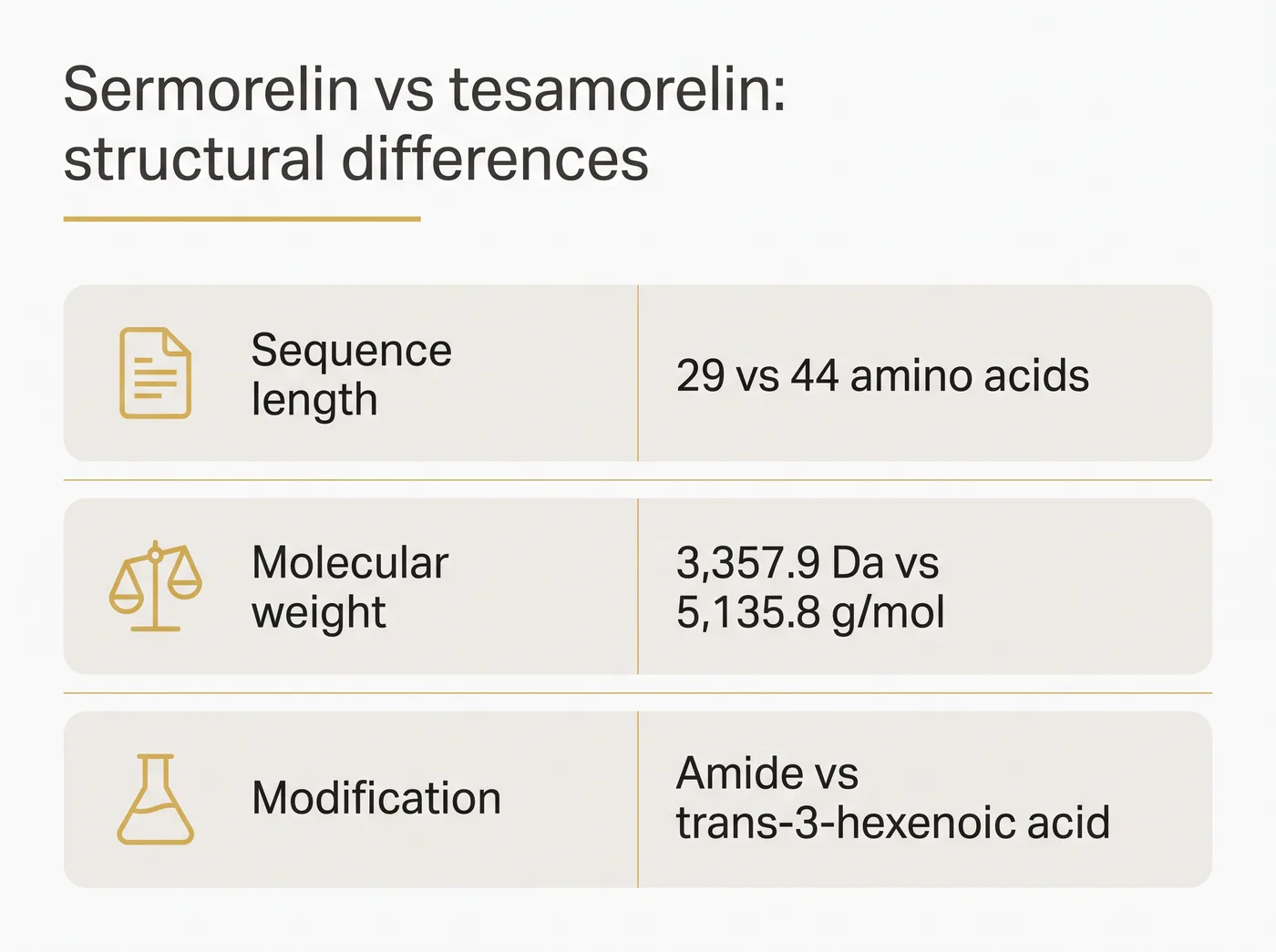
Sermorelin is essentially the abbreviated version of GHRH. Researchers discovered that the first 29 amino acids of the sequence are the only ones strictly necessary to bind to the GHRH receptor and trigger a response. Sermorelin is simply that 29-amino-acid sequence, finished with an amide group at the end to provide basic stability. In chemical terms, it is a GHRH 1-29 amide with a molecular weight of 3,357.9 Da 4.
Because it lacks the rest of the sequence and any major protective modifications, sermorelin is highly vulnerable to enzymatic breakdown. It has a short biological half-life of roughly 10 to 20 minutes. It binds to the receptor and is rapidly cleared.
Historically, this rapid clearance was perfectly fine for its original purpose. Sermorelin was studied and approved in the 1990s as a diagnostic agent to test pituitary function and for idiopathic growth hormone deficiency in prepubertal children 5. It was meant to trigger a quick pulse, not stick around for days.
Tesamorelin: the armoured sequence
Tesamorelin, developed later, followed the opposite structural approach. It retains the entire 44-amino-acid sequence of human GHRH, but with an addition: a trans-3-hexenoic acid group attached to the N-terminus 6. This makes it a much heavier molecule, weighing in at 5,135.8 g/mol.
That hexenoyl group is not there for show. It acts as a chemical shield, rendering the peptide highly resistant to cleavage by dipeptidyl aminopeptidase, the enzyme that normally shreds GHRH. As a result, tesamorelin survives much longer in the bloodstream, exerting sustained activity at the receptor.
The research path for tesamorelin also looked very different. It was evaluated in large phase 3 human trials, including a pooled analysis of 806 patients, specifically for visceral adipose tissue (deep belly fat) in HIV-infected patients suffering from lipodystrophy 7. It was also studied in a 12-month trial for non-alcoholic fatty liver disease (NAFLD) in adult HIV patients.
Comparing the research evidence
The internet loves to frame these two compounds as interchangeable, but the published clinical data tells a very rigid story about what each was actually studied for. If you want to untangle another pair of frequently confused peptides, read about how MOTS-c and SS-31 compare in research.
Tesamorelin has a modern evidence base in an adult immunodeficiency model. Sermorelin was rigorously studied for linear catch-up growth in children. There are no large-scale, high-quality human trials validating sermorelin for objective body composition changes in generalized adult populations.
| Feature | Sermorelin | Tesamorelin |
|---|---|---|
| Sequence length | 29 amino acids | 44 amino acids |
| Modification | C-terminal amide | N-terminal trans-3-hexenoic acid |
| Molecular weight | 3,357.9 Da | 5,135.8 g/mol |
| Primary phase 3 trials | Pediatric growth deficiency | HIV-associated lipodystrophy |
While sermorelin has been the subject of smaller phase 2 trials assessing memory and somatotrophic function in aging adults, the human evidence for its use in generalized adult populations simply is not there. The same is true for tesamorelin outside of its specific HIV-related applications: there is no human evidence assessing it as a generalized GLP-1 alternative or appetite suppressant.
Legal status and the 2026 HHS policy
If you follow peptide news, you have likely heard about the HHS enforcement discretion policy scheduled for late 2026, which will heavily restrict pharmacy compounding of certain bulk peptides 3. Here is a fact that surprises many people: neither sermorelin nor tesamorelin are on that list.
The October 2026 HHS policy exclusively covers bulk substances like BPC-157, TB-500, and Semax, compounds that were never approved as drugs in the US. Sermorelin and tesamorelin sit in a different legal category entirely.
Tesamorelin is an active, commercially marketed FDA-approved medication. Because it is the active ingredient in an approved drug, it legally qualifies for pharmacy compounding under Section 503A of the FD&C Act. Sermorelin was also an FDA-approved drug. Although its manufacturer voluntarily withdrew it in 2008 for commercial reasons (not for safety concerns), its historical approval means it also remains eligible for legal compounding 1.
Sourcing and lab reports
When sourcing research peptides for laboratory study, the history of the molecule means nothing if the vial on your bench contains something else. The research materials market is full of vaguely labelled vials and doctored documentation.
The only way to verify what you are buying is to check a third-party Certificate of Analysis (CoA) from a reputable analytical laboratory. You are looking for high Performance Liquid Chromatography (HPLC) testing, which separates the compounds to prove purity, and Mass Spectrometry (MS) to confirm the molecular weight (3,357.9 Da for sermorelin, 5,135.8 for tesamorelin).
A clean chromatogram is essentially a race where every impurity is forced to cross the finish line in public. If a seller will not show you the chromatogram or the mass spec results, they are asking you to trust them blindly. For reference, you can view the current test results and chromatograms for NuuVive's Tesamorelin, which show the measured purity.
Questions
Why is sermorelin compounded if it is not commercially manufactured?
The original commercially manufactured version of sermorelin was withdrawn from the market in 2008 for business reasons. Today, it is produced by compounding pharmacies, which are legally permitted to make it because it was previously an FDA-approved drug and was not withdrawn for safety reasons.
Can you buy these without a prescription?
Tesamorelin and sermorelin are prescription-only medications when intended for human or animal use. They are legally sold without a prescription strictly as laboratory reagents for in vitro research use only, and are not intended for human consumption.
What is the difference in half-life between the two?
Sermorelin has a very short biological half-life of roughly 10 to 20 minutes because it lacks protective modifications. Tesamorelin's trans-3-hexenoic acid addition shields it from rapid enzymatic cleavage, allowing it to survive significantly longer in the bloodstream.
Do these compounds bind to different receptors?
No. Both sermorelin and tesamorelin were designed to bind to the exact same growth hormone-releasing hormone (GHRH) receptor. They differ in how long they survive in the bloodstream to interact with it, rather than where they bind.
Sources
- cuny.edu. cuny.edu
- cuny.edu. cuny.edu
- pubchem.ncbi.nlm.nih.gov. National Library of Medicine
- pubmed.ncbi.nlm.nih.gov. National Library of Medicine
- pubchem.ncbi.nlm.nih.gov. National Library of Medicine
- pubmed.ncbi.nlm.nih.gov. National Library of Medicine