
Compounds explained
What is tesamorelin? What it has been studied for
NuuVive Journal · · 6 min read

Short answer
Tesamorelin is a synthetic analogue of growth hormone-releasing hormone (GHRH) consisting of a 44-amino-acid sequence modified with a trans-3-hexenoic acid group. It has been studied for its potential to resist enzymatic degradation and stimulate endogenous growth hormone release. It has been evaluated in phase 3 human trials for HIV-associated lipodystrophy and phase 2 trials for non-alcoholic fatty liver disease and mild cognitive impairment. It is an FDA-approved prescription medication for specific lipodystrophy indications, though there is no established human clinical evidence investigating it outside of these specific areas.
Key takeaways
- Tesamorelin is a synthetic 44-amino-acid peptide that mirrors human growth hormone-releasing hormone.
- Its structure includes an N-terminal trans-3-hexenoic acid modification to resist enzymatic breakdown.
- It has been evaluated in phase 3 trials for HIV-associated lipodystrophy and phase 2 trials for liver fat accumulation.
- There is no established human clinical evidence investigating it for systemic cosmetic fat changes.
- Because it is an active ingredient in an approved drug, it holds a unique regulatory position for compounding pharmacies.
The molecular machinery of tesamorelin
Search the internet for tesamorelin and you will find an ocean of fitness blogs. The actual science is far more specific and vastly more interesting. Tesamorelin is a synthetic growth hormone-releasing factor analogue, first discovered and developed by a Canadian biopharmaceutical company before receiving its initial approval from the U.S. FDA in 2010.
At a structural level, the compound consists of the complete 44-amino-acid sequence of human growth hormone-releasing hormone. However, native peptides are notoriously fragile in circulation. Blood plasma is full of enzymes, specifically dipeptidyl aminopeptidase, which actively look for unprotected peptide sequences to cleave apart. To bypass this rapid degradation, chemists modified the tesamorelin sequence by adding a trans-3-hexenoic acid group to the N-terminus, bringing its molecular weight to approximately 5135.9 g/mol.
Think of this hexenoyl group as a chemical helmet. The modification was designed to physically block the enzymes from attaching to and cutting the peptide chain. This deliberate engineering choice was investigated for its potential to allow the molecule to circulate longer and sustain its interaction with receptors, which is why researchers classify it distinctly from unmodified secretagogues as detailed in the National Library of Medicine records. Knowing the exact chemical shape of the molecule is the only way to understand what researchers are actually looking for when they study it in clinical trials.
Comparing tesamorelin and sermorelin
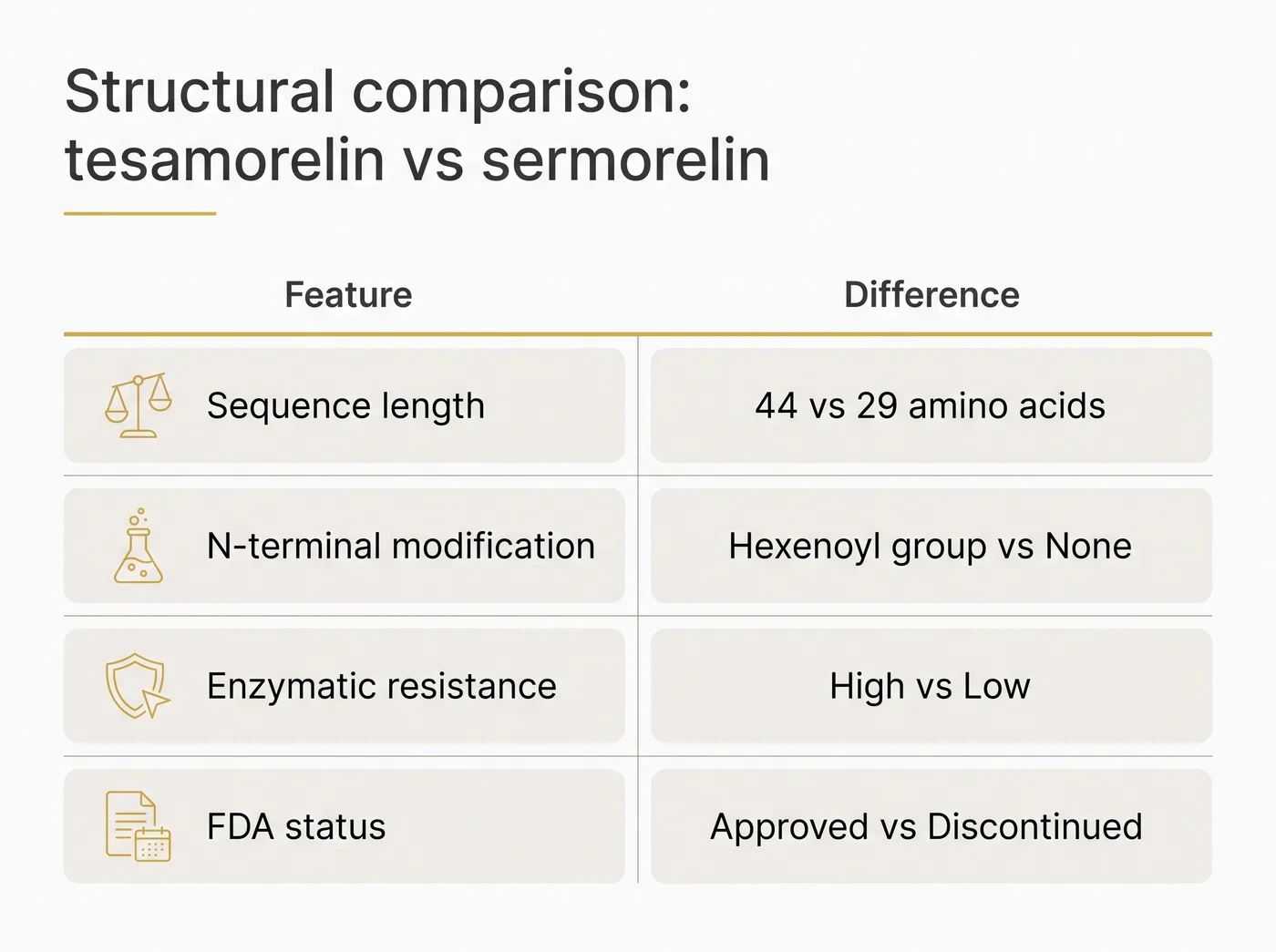
Researchers frequently compare tesamorelin to Sermorelin, another widely studied analogue of growth hormone-releasing hormone. While both belong to the same broad class of secretagogues, they represent completely different approaches to peptide engineering. Sermorelin is a truncated molecule containing only the first 29 amino acids of the native sequence. It lacks any protective modifications.
Because it is unmodified, sermorelin degrades rapidly in the bloodstream, displaying a short half-life of roughly 10 to 20 minutes as noted in the National Library of Medicine literature. Because of its unaltered structure, it has been evaluated as a fast-acting but fleeting compound in laboratory models. Tesamorelin is the marathon runner of the two, relying on its 44-amino-acid length and structural shield to evade immediate enzymatic destruction. If you want to trace exactly how their structures and half-lives diverge, read the detailed comparison of sermorelin and tesamorelin.
| Feature | Tesamorelin | Sermorelin |
|---|---|---|
| Sequence length | 44 amino acids | 29 amino acids |
| N-terminal modification | Trans-3-hexenoic acid group | None (unmodified) |
| Degradation rate | Resistant to enzymatic cleavage | Rapidly cleaved |
| Current FDA approval | Yes (for specific indications) | No (prior approval discontinued) |
The regulatory paths of these two compounds have also diverged sharply. The approved formulation of sermorelin was discontinued in 2008. In contrast, tesamorelin remains an actively marketed prescription medication, a distinction that fundamentally changes how compounding pharmacies handle the two substances under federal guidelines.
The clinical trial record
The research record for tesamorelin is highly specific and heavily concentrated on lipid metabolism. Its primary clinical evaluation occurred in phase 3 human trials assessing visceral adipose tissue accumulation in HIV-infected patients receiving antiretroviral medications. These lipodystrophy studies formed the basis for its eventual regulatory approval, as documented by the U.S. FDA.
Beyond lipodystrophy, the compound has been studied for non-alcoholic fatty liver disease. It was evaluated in a phase 2 placebo-controlled trial registered at clinicaltrials.gov investigating hepatic fat fraction changes via MRI-PDFF and liver histology in HIV-infected individuals. A separate trial registered at clinicaltrials.gov broadened this scope, assessing the peptide for changes in liver fat in a general adult population with fatty liver disease.
Researchers have also investigated its potential role in cognitive function. A 20-week randomized, placebo-controlled human trial detailed in the National Library of Medicine evaluated older adults aged 55 to 87, with and without mild cognitive impairment. The investigators tested for changes in executive function, verbal memory and visual memory over the trial period. This remains a distinct and highly specialised area of neurological study, far removed from the mainstream metabolic narratives.
What the research does not support
There is a massive gap between what researchers have formally evaluated and what internet forums claim. Despite intense off-label popularity, there is no established human clinical evidence investigating tesamorelin for systemic cosmetic fat changes in individuals without lipodystrophy.
In fact, the regulatory documents actively contradict the metabolic hype. The official information published by the U.S. FDA explicitly notes that the compound is not indicated for weight management, as it was evaluated for its weight-neutral profile in clinical assessments. Anyone claiming that the clinical literature supports routine athletic or cosmetic use is ignoring the actual data. To see a molecule actually navigating phase 3 obesity trials, read the clinical trial record of cagrilintide.
Regulatory status and the compounding loophole
Tesamorelin holds a unique and somewhat complex legal position. As a heavily regulated prescription medication, it is classified by the World Anti-Doping Agency as a prohibited substance at all times under the growth hormone-releasing factors category. Under WADA testing protocols, the presence of the compound or its metabolites constitutes an immediate violation.
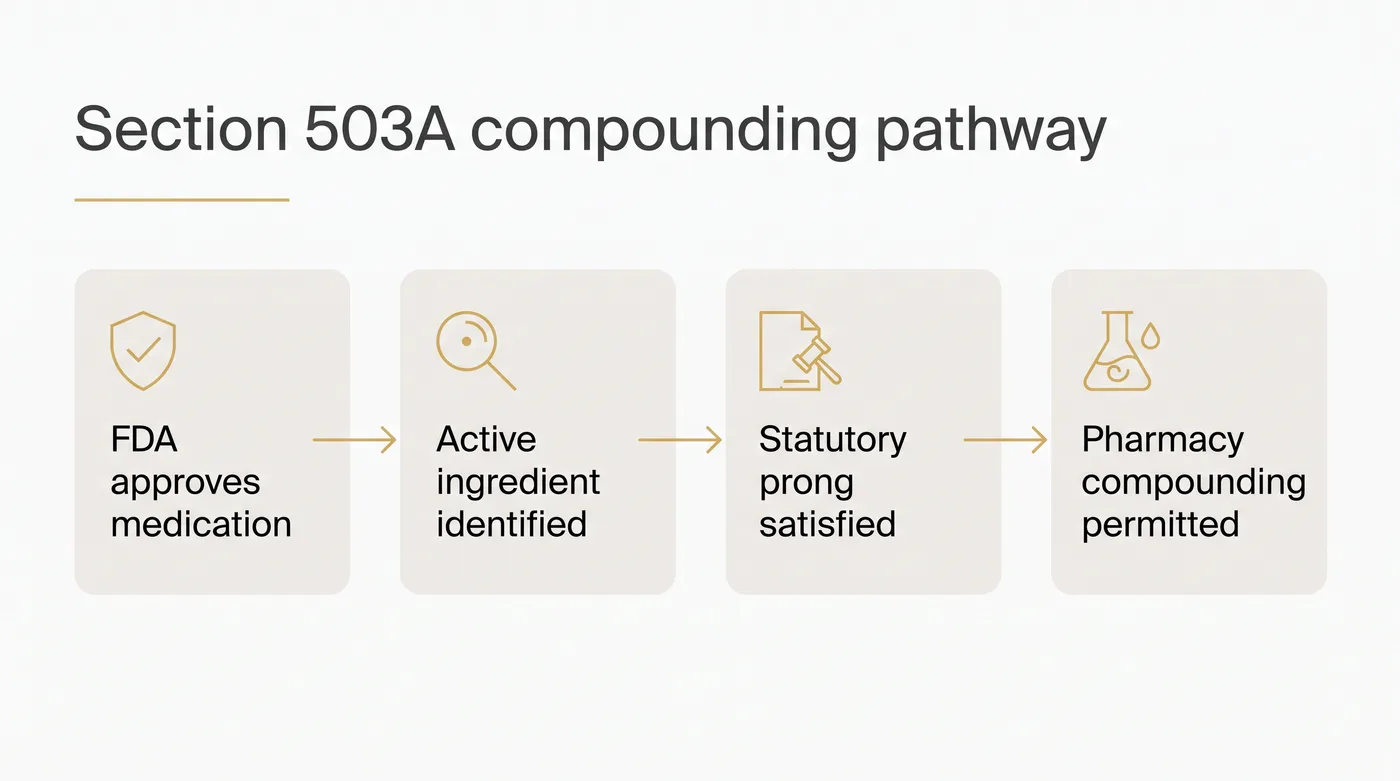
For compounding pharmacies in the United States, tesamorelin operates under a specific structural loophole. Under the U.S. FDA Section 503A enforcement discretion policy, a pharmacy may compound a medication if its active ingredient is already part of an FDA-approved drug. Because tesamorelin holds that approval, it automatically qualifies under the statutory prong.
This means the compound bypasses the normal bulk drug substances list process entirely. It does not require review by the Pharmacy Compounding Advisory Committee and is not subject to placement on the Category 1 or Category 2 lists that govern other peptides. It is a quiet administrative shortcut that has allowed compounding access to remain open while other unapproved molecules face strict regulatory barriers. To see exactly how those strict barriers impact unapproved compounds, read the breakdown of MOTS-c legal status.
Reading the laboratory data
When sourcing materials for laboratory research, reading the documentation is a critical skill. A vial of raw peptide is visually identical to a vial of flour, and marketing claims cannot replace hard analytical chemistry. The primary document you must verify is the Certificate of Analysis (COA) from an independent third-party laboratory.
A rigorous lab report will present a High-Performance Liquid Chromatography (HPLC) reading. This chromatogram acts as a race where every molecular impurity is forced to cross the finish line in public view, appearing as a separate peak on the graph. A reliable tesamorelin sample should show a singular, dominant peak indicating a high measured purity, with minimal area devoted to synthesis byproducts.
You also need to check the mass spectrometry results, which confirm that the molecule in the vial actually weighs the expected 5135.9 g/mol. Without this weight confirmation, a highly pure sample might be a completely different compound altogether. To see exactly how these metrics look on a verified document, you can check the current stock, pricing and independent laboratory results for NuuVive's Tesamorelin.
Questions
Is tesamorelin the same as human growth hormone?
No. Tesamorelin is a synthetic analogue of growth hormone-releasing hormone, which is studied as the upstream signal intended to prompt the pituitary gland to secrete its own natural growth hormone. It is a secretagogue, not actual recombinant growth hormone.
Why was the trans-3-hexenoic acid group added to the molecule?
The native sequence of growth hormone-releasing hormone is highly susceptible to rapid cleavage by enzymes in blood plasma. The N-terminal hexenoyl modification was added to physically shield the peptide from these enzymes, and has been studied for its ability to extend its circulating half-life in research models.
Is tesamorelin legal to buy for laboratory use?
Yes, as a synthetic peptide, it can be legally purchased as a research chemical for in vitro and laboratory experimentation. It is strictly sold for research purposes and not for human consumption, remaining distinct from the FDA-approved prescription medication process.
Is tesamorelin permitted in sports competition?
No. Tesamorelin is explicitly banned by the World Anti-Doping Agency (WADA) at all times, both in and out of competition, as it falls under the prohibited category of growth hormone-releasing factors.
Sources
- ClinicalTrials.gov. clinicaltrials.gov
- pubchem.ncbi.nlm.nih.gov. National Library of Medicine
- pubmed.ncbi.nlm.nih.gov. National Library of Medicine
- pubmed.ncbi.nlm.nih.gov. National Library of Medicine
- www.accessdata.fda.gov. U.S. FDA
- ClinicalTrials.gov. clinicaltrials.gov
- www.fda.gov. U.S. FDA