
Peptide chemistry
Thymosin alpha-1 identity: structure, molecular weight and form
NuuVive Journal · · 6 min read

Short answer
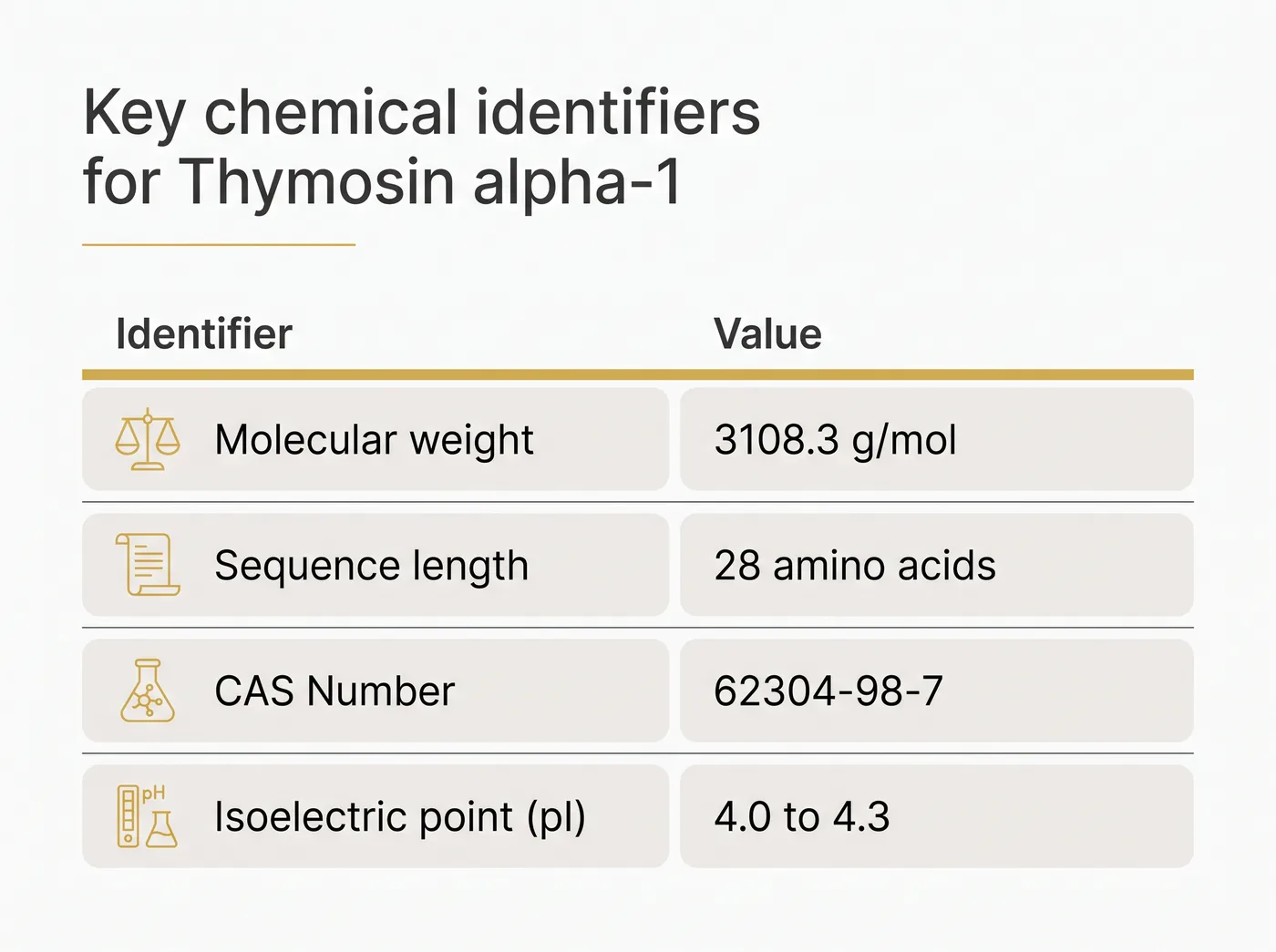
Thymosin alpha-1 is a 28-amino-acid synthetic peptide with an average molecular weight of 3108.3 g/mol and the chemical formula C129H215N33O55. Registered under the INN thymalfasin, it features an acetylated N-terminus and lacks cysteine residues, preventing disulfide bridge formation. It is supplied as a lyophilised white powder, typically as an acetate salt.
Key takeaways
- Thymosin alpha-1 is a highly acidic 28-amino-acid sequence defined by a molecular weight of 3108.3 g/mol.
- The structure lacks cysteine residues, leaving the peptide backbone largely extended rather than tightly folded.
- An N-terminal acetyl group is a mandatory structural feature that adds approximately 42 Da to the intact mass.
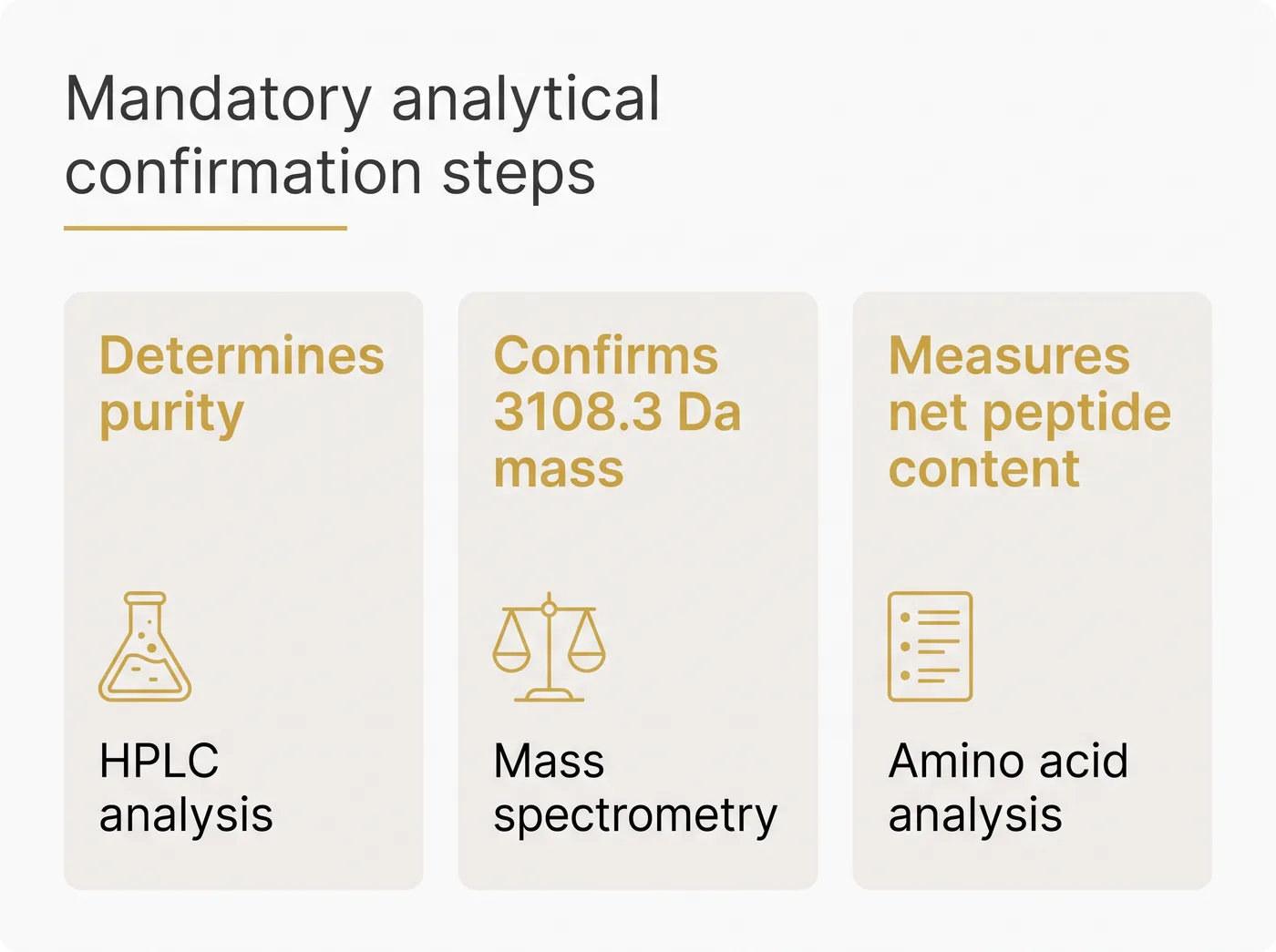
- Laboratories must use both liquid chromatography to determine purity and mass spectrometry to confirm the molecular mass.
- The solid form is a lyophilised powder that replaces harsh synthesis acids with acetate counterions.
The chemical identity of a 28-amino-acid sequence
You look at a tiny glass vial holding a faint white puck of solid material, and it demands an enormous amount of trust. A label is just paper. The only thing standing between ambiguity and certainty is the chemical data. Thymosin alpha-1 is a synthetic peptide known in the laboratory registry by the International Nonproprietary Name thymalfasin. Its official identification tag is CAS number 62304-98-7. For a broader look at why laboratories keep ordering this sequence, you can explore the research background of Thymosin alpha-1.
When a laboratory sets out to characterise this material, they are looking for a specific arrangement of carbon, hydrogen, nitrogen and oxygen atoms that matches the formula C129H215N33O55. Much like ARA-290, it requires thorough mass spectrometry to prove the molecular sequence is correct. If the shared family name causes confusion at the bench, clear things up by reading how this sequence differs from TB-500.
Mapping the primary structure and modifications
Peptides are built from amino acids, and reading their sequences can sometimes feel like staring at alphabet soup. For this molecule, the primary sequence is 28 amino acids long: Ac-SDAAVDTSSEITTKDLKEKKEVVEEAEN. Every single letter represents a structural requirement. The sequence is notably acidic because it contains a high concentration of aspartate and glutamate residues. These specific amino acids give the molecule a low isoelectric point, generally determined to be between 4.0 and 4.3.
It is also missing cysteine residues. Most peptides use cysteine to form intramolecular disulfide bridges, folding up tightly like chemical origami. Because it lacks these anchors, the backbone of this molecule remains largely extended and unstructured in an aqueous environment. You can read more about evaluating peptide documentation in reading a lab test.
The "Ac" at the beginning is not an amino acid. It represents an acetyl group attached to the N-terminal serine residue. This N-terminal acetylation is a mandatory structural modification. Without it, you are simply looking at an incomplete synthesis failure.
| Feature | Description |
|---|---|
| Sequence length | 28 amino acids |
| Terminal modification | N-terminal acetylation (Ac-Ser) |
| Disulfide bridges | None (zero cysteine residues) |
| Isoelectric point | Low (4.0 to 4.3) |
Solid-phase synthesis and removing the cleavage acids
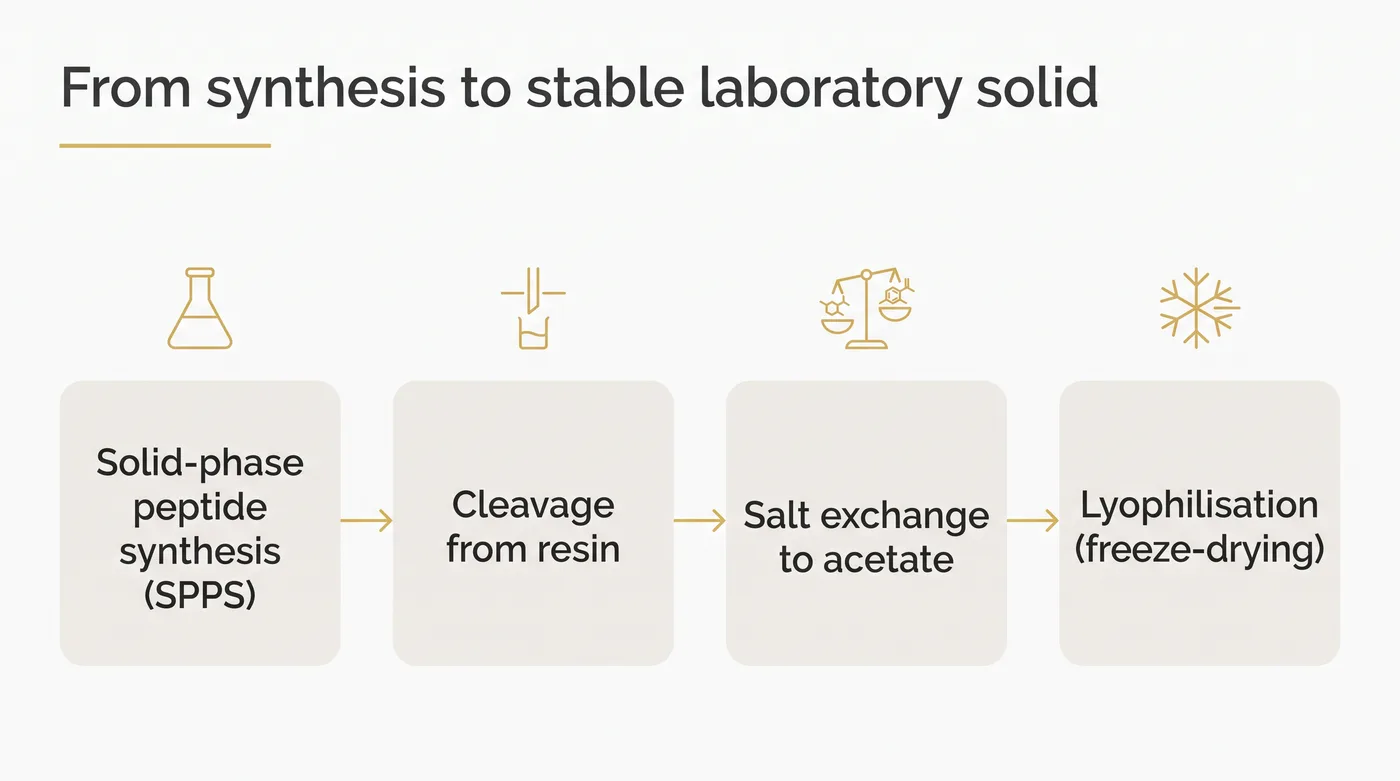
Synthetic reference materials do not materialise out of thin air. They are manufactured using solid-phase peptide synthesis, a method that builds the chain one amino acid at a time on a solid resin support. The foundational chemistry, including the repeated coupling and deprotection steps, is covered in Advances in Fmoc solid-phase peptide synthesis.
Once the 28-amino-acid chain is complete, it must be cleaved from the resin. This cleavage step typically requires harsh chemicals like trifluoroacetic acid. If left in place, residual acid ruins the viability of the material for sensitive cellular assays in the laboratory. Therefore, during the final purification stages, the acidic counterions are usually swapped for acetate. The resulting acetate salt is the standard format for high-quality laboratory supply.
The freeze-drying step and the solid powder
The purified peptide starts as a solution, but shipping and storing a liquid is an excellent way to accelerate degradation. To preserve the molecular structure, the manufacturer converts it into a solid through lyophilisation.
This is not as simple as leaving water to evaporate. According to the parameters outlined in Design of freeze-drying processes for pharmaceuticals: practical advice, the liquid is first frozen solid, and then the surrounding pressure is dropped. Under a vacuum, the frozen solvent turns directly into a gas without passing through a liquid phase. The primary and secondary drying stages remove the residual moisture, leaving behind the characteristic white to off-white powder. It is a stable, elegant format that stops the clock on chemical degradation.
Chromatography and verifying the purity
You cannot identify a white powder just by looking at it. That is where reversed-phase high-performance liquid chromatography enters the picture. Chromatography is essentially an obstacle course for molecules. A sample is dissolved in a mobile phase and pushed through a column packed with a stationary phase.
The method parameters, such as the acetonitrile gradients and column chemistry discussed in HPLC analysis and purification of peptides, determine how well the target molecule separates from its impurities. Truncated sequences, deletion sequences or deamidated byproducts will travel through the column at slightly different speeds. The detector records each substance as a peak on a graph.
The method must be capable of resolving challenging synthesis errors. For example, the final amino acid in the sequence is an asparagine residue. Asparagine is prone to deamidation, a chemical reaction that converts it into aspartate or isoaspartate, particularly if stored improperly in solution. A poorly designed chromatography method will hide these deamidated species inside the main peak, artificially inflating the purity score. A top-tier chromatogram shows one sharp, dominant peak. When you check the documents for NuuVive's material, you will find it boasts a ≥99% purity specification, measuring at 99.311% on Janoshik report #165290.
Mass spectrometry and confirming the exact weight
A chromatography report tells you that a sample is mostly one thing, but it does not tell you what that thing actually is. A single sharp peak could be 99.3% pure floor wax for all the detector knows. To prove the identity of the molecule, analysts use electrospray ionisation mass spectrometry.
Mass spectrometry weighs the molecule. For this sequence, the analysis must yield a deconvoluted intact mass that matches the theoretical average molecular weight of 3108.3 g/mol. In positive ion mode, the instrument detects multiply charged species that calculate back to 3108.3 Da. You can see how this exact weighing process verifies a smaller nine-amino-acid chain in the structural breakdown of DSIP.
This step is also the only way to prove the acetyl group is attached at the N-terminus. That tiny acetyl modification adds approximately 42 Da to the total mass. If the mass spectrometer returns a weight 42 Da too light, the laboratory instantly knows the modification step failed.
Net peptide content and the final measured amount
One of the most persistent analytical misunderstandings involves the difference between total mass and net peptide content. A vial labelled with 10 milligrams contains 10 milligrams of total solid material. However, because of the lyophilisation process, that solid powder is not simply the 28-amino-acid chain.
The white puck holds bound water molecules and the acetate counterions that replaced the cleavage acids. The actual fraction of the target peptide sequence is usually somewhere between 70 and 85 percent of the gross powder weight. When laboratories run assays that demand accurate molar concentrations, they use amino acid analysis to determine the net mass fraction.
Careful suppliers ensure the vial actually delivers the target amount. Janoshik report #165290 confirms a measured amount of 10.08 mg of pure Thymosin alpha-1 peptide inside NuuVive's product. Good analytical chemistry leaves no room for ambiguity. If you require certainty for a laboratory application, you can review the current stock, pricing and complete testing documentation at NuuVive's Thymosin alpha-1.
Questions
What is the difference between Thymosin alpha-1 and thymalfasin?
There is no chemical difference. Thymosin alpha-1 is the common structural identifier for the 28-amino-acid sequence, while thymalfasin is its designated International Nonproprietary Name (INN). Both names refer to the same molecule with the CAS registry number 62304-98-7.
Why does the mass spectrometer look for a weight of 3108.3 g/mol?
That number is the calculated average molecular weight of the C129H215N33O55 formula. The 28 specific amino acids, combined with the N-terminal acetyl group, add up to 3108.3 Da. If the mass spectrometry results show a different weight, the molecule in the vial is missing a component or contains an unintended synthesis error.
What does it mean if a lab report lacks a mass spectrometry result?
It means the chemical identity of the powder is unverified. Chromatography alone only proves that a sample is free from mixed impurities; it cannot identify the actual substance. Without a mass spectrometry result confirming the 3108.3 Da weight, the identity of the material remains a guess.
Can Thymosin alpha-1 form disulfide bonds?
No, it cannot. Disulfide bonds require the presence of cysteine residues to link different parts of a peptide chain together. Because this specific sequence is devoid of cysteine, the molecule remains loose and extended rather than folding into a rigid structure.