
Compounds explained
Thymosin alpha-1 vs TB-500: same family, different peptides
NuuVive Journal · · 4 min read

Short answer
Thymosin alpha-1 and TB-500 are entirely different peptides, despite sharing a naming convention based on their historical discovery in the thymus gland. Thymosin alpha-1 is a 28-amino-acid immunomodulatory peptide derived from prothymosin alpha, with an extensive human trial record and pharmaceutical approval in over 35 countries. TB-500 is a 7-amino-acid synthetic fragment of Thymosin beta-4, studied exclusively in cell and animal models of tissue injury and cellular migration, with zero published human trials.
Key takeaways
- Thymosin alpha-1 is a 28-amino-acid peptide that has been studied for its modulation of immune responses via Toll-like receptors.
- TB-500 is a 7-amino-acid synthetic fragment studied in localized tissue injury models by interacting with cellular actin.
- Thymosin alpha-1 has an extensive human trial record and is an approved drug in over 35 countries outside the US.
- The TB-500 fragment has zero published human clinical trials, relying entirely on preclinical data.
- As of late 2026, TB-500 is covered by the HHS 503A compounding enforcement discretion policy, while Thymosin alpha-1 is not.
Two very different molecules
The confusion between Thymosin alpha-1 and TB-500 starts with the name. Both carry the "thymosin" label because their parent proteins were first isolated from calf thymus glands 4,6. But that historical naming convention is where the similarity ends.
Thymosin alpha-1 is a 28-amino-acid peptide cleaved from a much larger precursor protein called prothymosin alpha. Its structure and activity were first described in 1977 5. It has been studied in systemic immunomodulator models for its interaction with Toll-like receptor pathways and its role in T-cell development and immune signaling.
TB-500, conversely, is a 7-amino-acid synthetic fragment, a truncated laboratory copy of a small segment of Thymosin beta-4 7. While Thymosin alpha-1 is studied in immune pathways, the TB-500 fragment and its parent protein have been investigated in tissue injury models for their interaction with cellular actin, a fundamental structural protein, and their role in cellular migration.
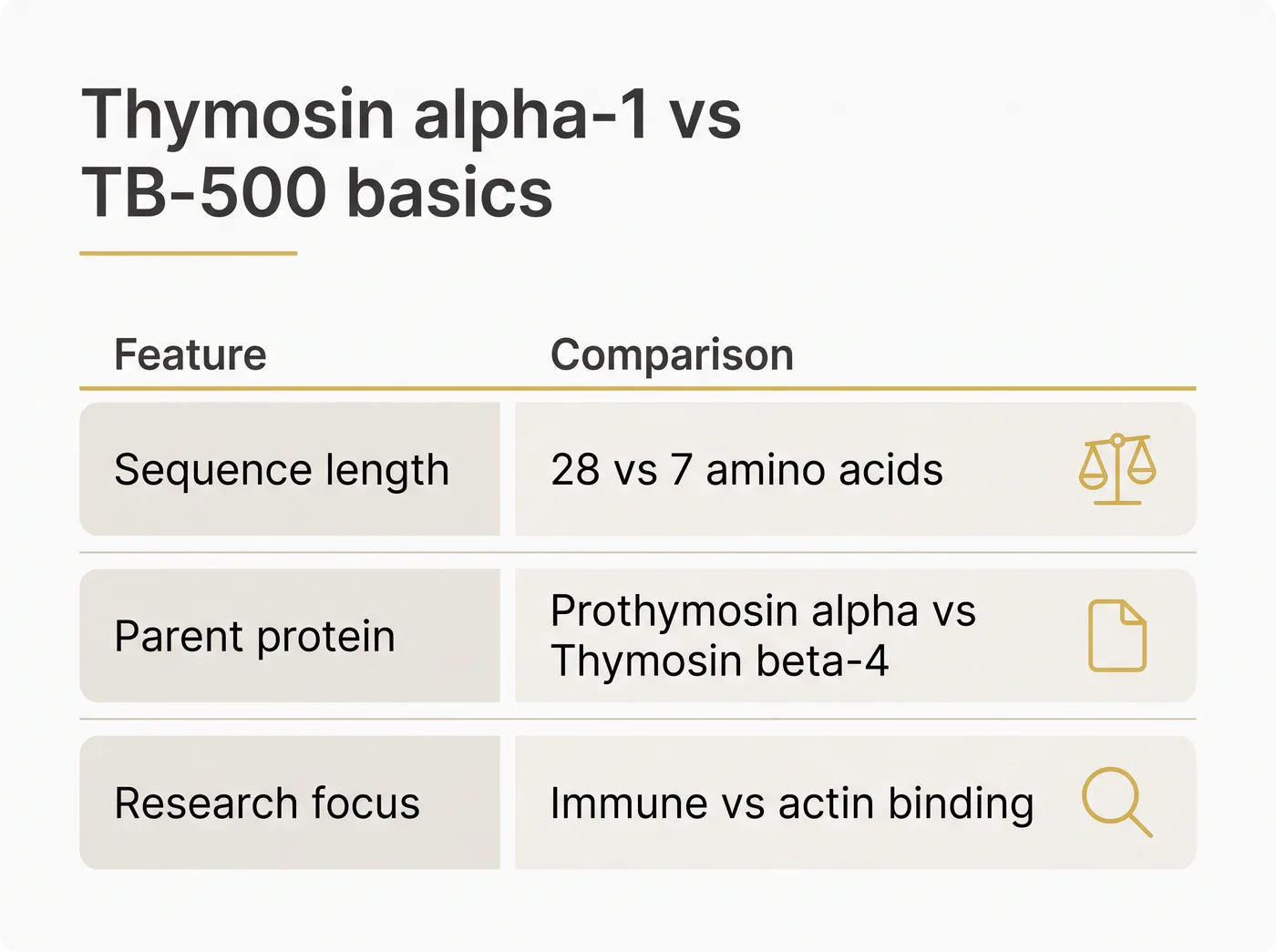
What Thymosin alpha-1 has been studied for
The research record for Thymosin alpha-1 is deep and established. In cellular models, researchers have investigated its role in dendritic cell maturation, natural killer cell activation, and the modulation of pro-inflammatory cytokines like TNF-α and IL-6 5. Animal studies have evaluated the peptide in murine models of viral infections, sepsis, and cancer metastasis.
Unlike many research peptides, Thymosin alpha-1 has an extensive human trial history. It has progressed through large Phase 3 clinical trials, including a 1,106-patient study for sepsis 5. Under the generic name thymalfasin, it holds pharmaceutical approval in more than 35 countries outside the United States for indications including chronic hepatitis B and as an immune adjunct in oncology.
What TB-500 has been studied for
The research record for TB-500 is entirely preclinical. The full-length parent protein, Thymosin beta-4, was identified in the 1980s as a key molecule for sequestering cellular actin 7. The specific 7-amino-acid synthetic fragment marketed as TB-500 only appeared in laboratory synthesis around 2003.
Animal models have investigated the full protein for dermal wound repair, corneal burns, and myocardial infarction. A 2026 scoping review of 80 studies found preclinical evidence heavily concentrated in wound, vascular, and ocular models. Direct musculoskeletal studies on tissues like tendon, ligament, or muscle were comparatively rare 7.
This is where the marketing fog rolls in. The reputation of TB-500 in tissue injury models relies entirely on preclinical biology and trials conducted on the full-length parent protein. According to a May 2026 FDA review, there are zero published human clinical trials and zero direct human exposure data for the 7-amino-acid TB-500 fragment itself.
Regulatory divergence: the 2026 HHS policy
Neither Thymosin alpha-1 nor TB-500 is an FDA-approved drug in the United States. However, their status in the US compounding pharmacy sector diverged sharply in late 2026.
In October 2026, HHS issued an interim enforcement discretion policy for specific peptides. Under this policy, HHS announced it does not intend to pursue regulatory action against state-licensed 503A pharmacies compounding single-ingredient TB-500 acetate, provided strict conditions are met while formal rulemaking is pending.
Thymosin alpha-1 is not covered by this policy. In December 2024, the FDA's Pharmacy Compounding Advisory Committee (PCAC) voted 4-17 against recommending its addition to the 503A Bulks List, citing concerns regarding immunogenicity and incomplete clinical data.
Reading a Thymosin alpha-1 lab report
When sourcing Thymosin alpha-1 for research, the lab report, the Certificate of Analysis (COA), is the only document that matters. A rigorous COA is the vial's passport, confirming identity and measuring exact purity.
A trustworthy report must come from an independent, third-party analytical laboratory. It should include testing to measure purity, confirm the molecular weight (3108.3 g/mol), and verify the exact amount of peptide in the vial 4.
For example, the Thymosin alpha-1 lab results (Janoshik report #165290) show a measured purity of 99.311% and verify 10.08 mg of actual peptide in a nominal 10 mg vial. If a seller cannot provide a recent, verifiable third-party report with exact figures, look elsewhere.
Questions
Are Thymosin alpha-1 and TB-500 the same peptide?
No. Thymosin alpha-1 is a 28-amino-acid immunomodulator derived from prothymosin alpha. TB-500 is a 7-amino-acid synthetic fragment of a different protein, Thymosin beta-4, studied in tissue injury models.
Is Thymosin alpha-1 FDA approved?
Thymosin alpha-1 is not FDA-approved for any indication in the United States. However, it holds pharmaceutical approval as a prescription drug in more than 35 other countries.
Does TB-500 have human clinical trials?
No. There are zero published human clinical trials for the 7-amino-acid TB-500 fragment. Early human data exists only for its full-length parent protein, Thymosin beta-4.
Are these peptides legal to compound in the US?
As of late 2026, TB-500 is covered by an HHS interim enforcement discretion policy allowing 503A pharmacy compounding under strict conditions. Thymosin alpha-1 is excluded from this policy and remains restricted.
Sources
- pubchem.ncbi.nlm.nih.gov. National Library of Medicine
- pubmed.ncbi.nlm.nih.gov. National Library of Medicine
- pubmed.ncbi.nlm.nih.gov. National Library of Medicine