
Compounds explained
What is Thymosin alpha-1 and what it has been studied for
NuuVive Journal · · 6 min read

Short answer
Thymosin alpha-1 is an endogenous 28-amino-acid peptide originally isolated from the thymus gland. It acts as an immunomodulatory agent and has been extensively investigated in human clinical trials for infectious diseases like chronic hepatitis and sepsis. It is not FDA-approved in the United States, sits outside current pharmacy compounding lists, and remains strictly a subject of ongoing laboratory and clinical research.
Key takeaways
- Thymosin alpha-1 is a 28-amino-acid peptide fragment derived from a larger precursor protein endogenously produced in the thymus gland.
- It has been investigated in phase 3 human clinical trials for sepsis and chronic viral hepatitis, focusing on its interaction with T-cells.
- It is entirely distinct from Thymosin beta-4 in structure, molecular weight, and the cellular mechanisms being researched.
- The peptide is not FDA-approved, and a recent advisory committee vote excluded it from the US compounding pharmacy bulk lists.
What exactly is Thymosin alpha-1?
Before looking at immune research, you have to know what molecule you are actually looking at. Isolating specific peptides from animal glands in the 1970s was a bit like panning for gold in a river of complex proteins. Researchers working with bovine thymus tissue isolated a preparation they called thymosin fraction 5. From that fraction, Dr. Allan Goldstein and colleagues chemically sequenced and characterized the first specific peptide in 1977.
That isolated molecule is Thymosin alpha-1. It is a highly conserved, 28-amino-acid peptide derived from the cleavage of a much longer, 113-amino-acid precursor protein called prothymosin alpha 1. In its synthetic form, it is frequently registered under the International Nonproprietary Name (INN) thymalfasin.
Chemically, it is an N-acetylated peptide, meaning a specific chemical cap is added to the end of the sequence (Ac-SDAAVDTSSEITTKDLKEKKEVVEEAEN) to provide structural stability in vitro. It has a molecular formula of C129H215N33O55 and a defined molecular weight of 3,108.3 g/mol. Isolating this exact sequence meant researchers no longer needed to extract crude fractions from animal tissue; they could synthesize the precise fragment cleanly in a laboratory setting. For a look at how scientists engineer specific synthetic fragments from other complex proteins, check out the research background of ARA-290.
The research areas: Toll-like receptors and clinical trials
Thymosin alpha-1 is classified as an immunomodulatory polypeptide. In cellular and animal models, it functions primarily as an agonist for Toll-like receptors, specifically TLR2 and TLR9, located on dendritic and myeloid cells. By binding to these receptors, the peptide has been studied to evaluate its impact on T-cell proliferation, the downregulation of pro-inflammatory cytokines like TNF-alpha, and the upregulation of interferon-gamma 2.
Unlike many purely experimental peptides, Thymosin alpha-1 has a vast footprint in human clinical trials, specifically regarding severe infectious diseases. Multiple randomized controlled trials and Cochrane systematic reviews have investigated it as a monotherapy and an adjuvant for chronic Hepatitis B and Hepatitis C. Researchers measured specific clinical endpoints, including changes in serum viral DNA and liver histology.
It has also been heavily investigated in the context of sepsis. The phase 3 TESTS trial studied Thymosin alpha-1 in a massive cohort of over 1,000 critically ill adults to evaluate its impact on 28-day mortality rates. More recently, human clinical trials investigated its application in hospitalized COVID-19 patients experiencing hypoxemia and severe lymphocytopenia, measuring its influence on T-cell exhaustion.
In oncology, observational studies and early-phase human trials have evaluated the peptide as an adjunct alongside traditional chemotherapy. Researchers studied hepatobiliary and gastrointestinal cancer models to measure fluctuations in absolute lymphocyte counts and chemotherapy-induced neurotoxicity.
Where human evidence is entirely missing
If you read certain online forums, you might walk away with the impression that this compound is a daily vitamin for the immune system. The reality of the published literature is far narrower.
No completed human clinical trials investigate whether it optimizes baseline immunity in the general public. Anyone presenting it as a cellular optimization tool is operating entirely outside the scientific literature.
Thymosin alpha-1 vs. Thymosin beta-4
Thymosin alpha-1 is frequently confused with Thymosin beta-4. Confusing the two is like confusing a steering wheel with a spark plug just because they both came from the same car factory. Both peptides were historically isolated from the exact same bovine thymus preparation, which is why they share a naming convention, but they are chemically and genetically unrelated.
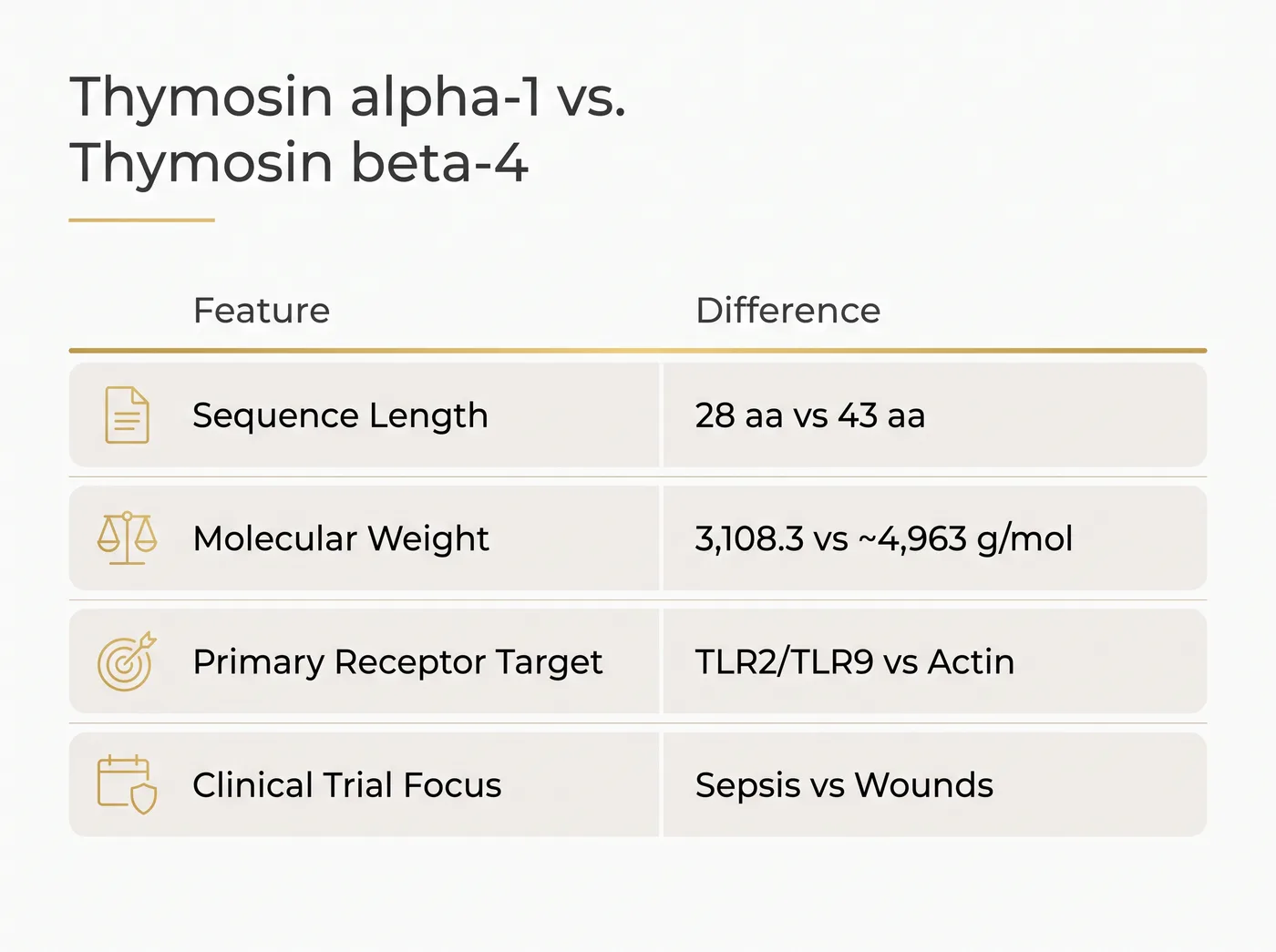
Thymosin alpha-1 is a 28-amino-acid peptide that modulates T-cells. Thymosin beta-4 is a significantly larger 43-amino-acid protein with a molecular weight of approximately 4,963 g/mol 3. It acts primarily as an actin-sequestering protein. By binding to monomeric G-actin via an LKKTET motif, it regulates cell motility and cytoskeleton structure.
Because their mechanisms are fundamentally different, they are researched in completely different clinical models. While Thymosin alpha-1 is studied in systemic viral infections and sepsis, Thymosin beta-4 and its truncated fragment, TB-500, are researched in models of wounds, acute myocardial infarction, and corneal defects 5. If you want to see exactly how those research paths diverged, check out the detailed breakdown of both distinct peptides.
| Feature | Thymosin alpha-1 | Thymosin beta-4 |
|---|---|---|
| Length | 28 amino acids | 43 amino acids |
| Molecular Weight | 3,108.3 g/mol | ~4,963 g/mol |
| Mechanism | Toll-like receptor agonist (TLR2/TLR9) | Actin-sequestering protein |
| Primary research models | Hepatitis, sepsis, virology | Wounds, cardiac ischemia |
Legal status and the 503A compounding shift
Thymosin alpha-1 is not FDA-approved for any indication in the United States. Historically, it was granted an FDA Orphan Drug designation for hepatocellular carcinoma. It is important to understand that an orphan designation is merely an investigational incentive granted to encourage research into rare diseases; it is not a market approval.
The peptide's status in the United States compounding market has also fundamentally changed. Under the current FDA and HHS regulations, it is not permitted to be compounded. In 2023, the FDA categorized it under the Category 2 bulk drug substances list.
In December 2024, the FDA's Pharmacy Compounding Advisory Committee voted against adding the peptide to the 503A Bulks List, and its nomination was subsequently withdrawn. Consequently, it sits entirely off the approved lists under the late 2026 HHS policy framework, restricting it strictly to analytical and preclinical laboratory environments. To see how these same 2026 compounding rules impact other molecules, you can read the breakdown of KPV's legal status.
Verifying the lab report
When handling research materials, the label on the vial is essentially just a polite suggestion until it is verified by a third-party analytical laboratory. A valid certificate of analysis strips away the marketing noise and leaves you with the exact physical reality of the compound in question.
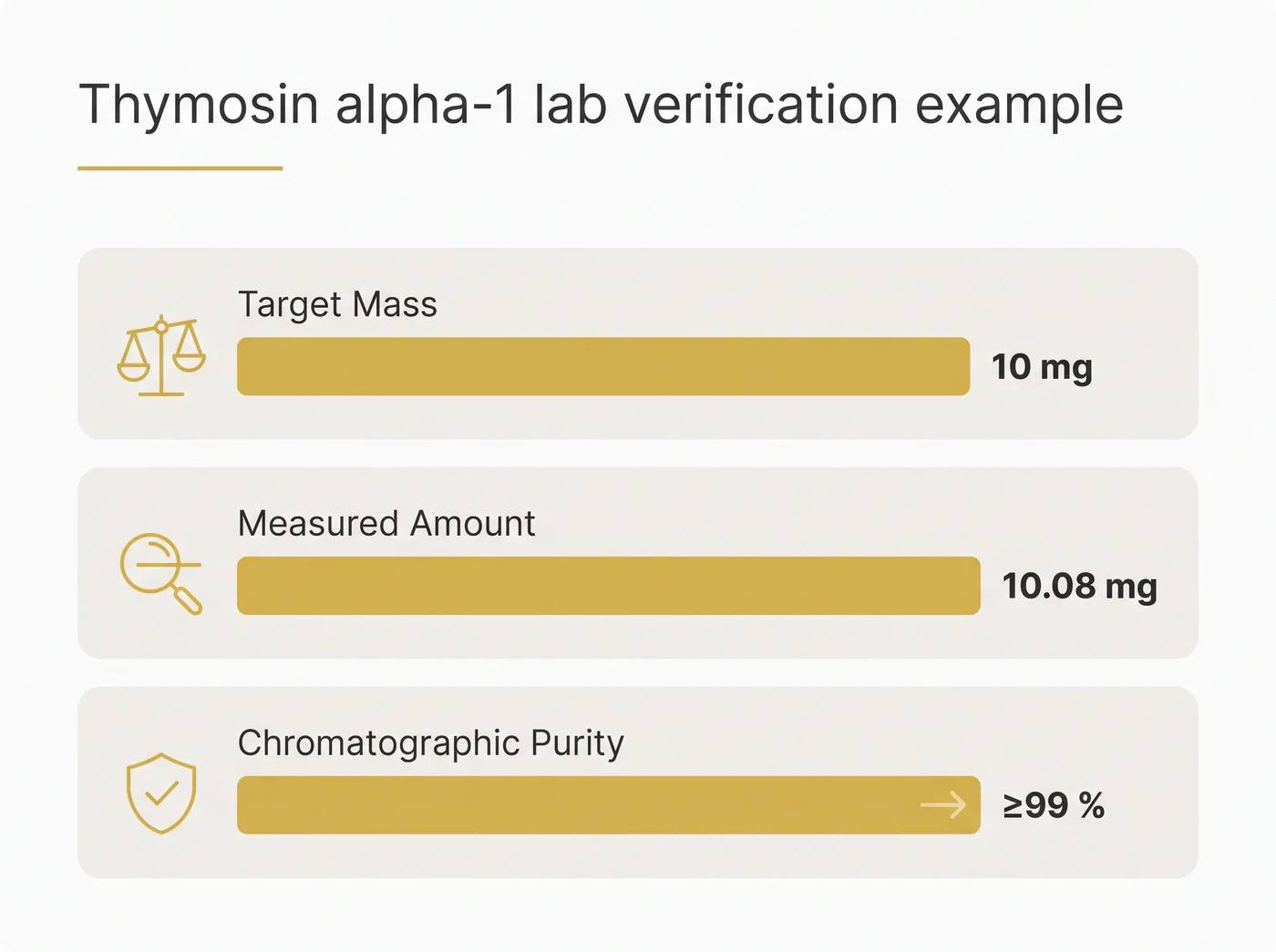
The first metric to check is the mass spectrometry result, which must definitively match the 3,108.3 g/mol molecular weight of the 28-amino-acid sequence. Next is the high-performance liquid chromatography (HPLC) result. A chromatogram is a race where every impurity has to cross the finish line in public; you are looking for a single, sharp peak indicating a high level of purity, typically ≥99%.
Finally, check the quantitative assay for the measured amount. A label stating 10 mg is a manufacturing target, whereas a lab report stating exactly 10.08 mg (as seen in Janoshik report #165290) is an empirical measurement of reality. You can check the current price, stock and exact measured purity on NuuVive's Thymosin alpha-1.
Questions
Is Thymosin alpha-1 banned in sports?
Thymosin alpha-1 is classified as an immunomodulator and is not listed on the World Anti-Doping Agency (WADA) prohibited list. Conversely, Thymosin beta-4 is prohibited by WADA under its classification as a growth factor.
What is thymalfasin?
Thymalfasin is simply the International Nonproprietary Name (INN) for the synthetic version of Thymosin alpha-1. It refers to the exact same 28-amino-acid sequence and chemical structure.
Why is it no longer compounded in the US?
In 2023, the FDA placed it on the Category 2 bulk drug substances list. Following a December 2024 advisory committee vote against its inclusion on the 503A Bulks List, it does not qualify for compounding under current regulatory frameworks.
How should the lyophilized powder be stored?
Like most peptides, it requires strict cold chain management to prevent degradation. It is supplied as a lyophilized powder and must be kept in a climate-controlled environment, as detailed in standard storage and cold chain management.
Sources
- pubchem.ncbi.nlm.nih.gov. National Library of Medicine
- pmc.ncbi.nlm.nih.gov. National Library of Medicine
- pubchem.ncbi.nlm.nih.gov. National Library of Medicine
- pubmed.ncbi.nlm.nih.gov. National Library of Medicine