
Reading lab reports
How to read a Thymosin alpha-1 lab report
NuuVive Journal · · 5 min read

Short answer
To read a Thymosin alpha-1 lab report, verify that the lot number matches the vial. Check the mass spectrometry (MS) section for an intact mass of approximately 3108.3 g/mol, which confirms the N-acetylated 28-amino-acid sequence is present. Then, review the high-performance liquid chromatography (HPLC) chromatogram to ensure the main peak represents the stated purity percentage, while remembering that relative UV signal area does not measure the absolute mass in the vial.
Key takeaways
- A trustworthy certificate of analysis must tie directly to the vial through a specific lot number.
- Mass spectrometry confirms identity by checking for a molecular weight of 3108.3 g/mol, ensuring the N-terminal acetylation is present.
- High-performance liquid chromatography measures relative purity by separating impurities, not the absolute mass of material in the vial.
- The actual mass of the peptide free-base will always be lower than the gross powder weight due to retained moisture and counter-ions.
The paperwork: why lot numbers anchor the document
A laboratory certificate of analysis is the only barrier separating a carefully synthesised peptide from a mystery vial of white powder. It carries the authority of complex graphs and decimal points, which makes it easy to misread. Sellers know that most people scan straight to the big purity percentage at the bottom and ignore the rest. But a lab report is a forensic document; understanding what it measures, and what it quietly omits, changes how you read these reports. Before you start dissecting the analytical data, explore what Thymosin alpha-1 actually is so you know exactly which molecule you are checking.
If a lab report lacks a lot number, it is essentially a photocopy of someone else's passport. The United States Code of Federal Regulations defines a lot number as a distinctive combination of letters, numbers or symbols from which the complete history of manufacture can be determined 21 CFR Part 210. Without it, the laboratory is merely confirming that some material existed in their facility on a Tuesday, untethered to the physical material being evaluated.
Mass spectrometry: confirming the 3108.3 g/mol signature
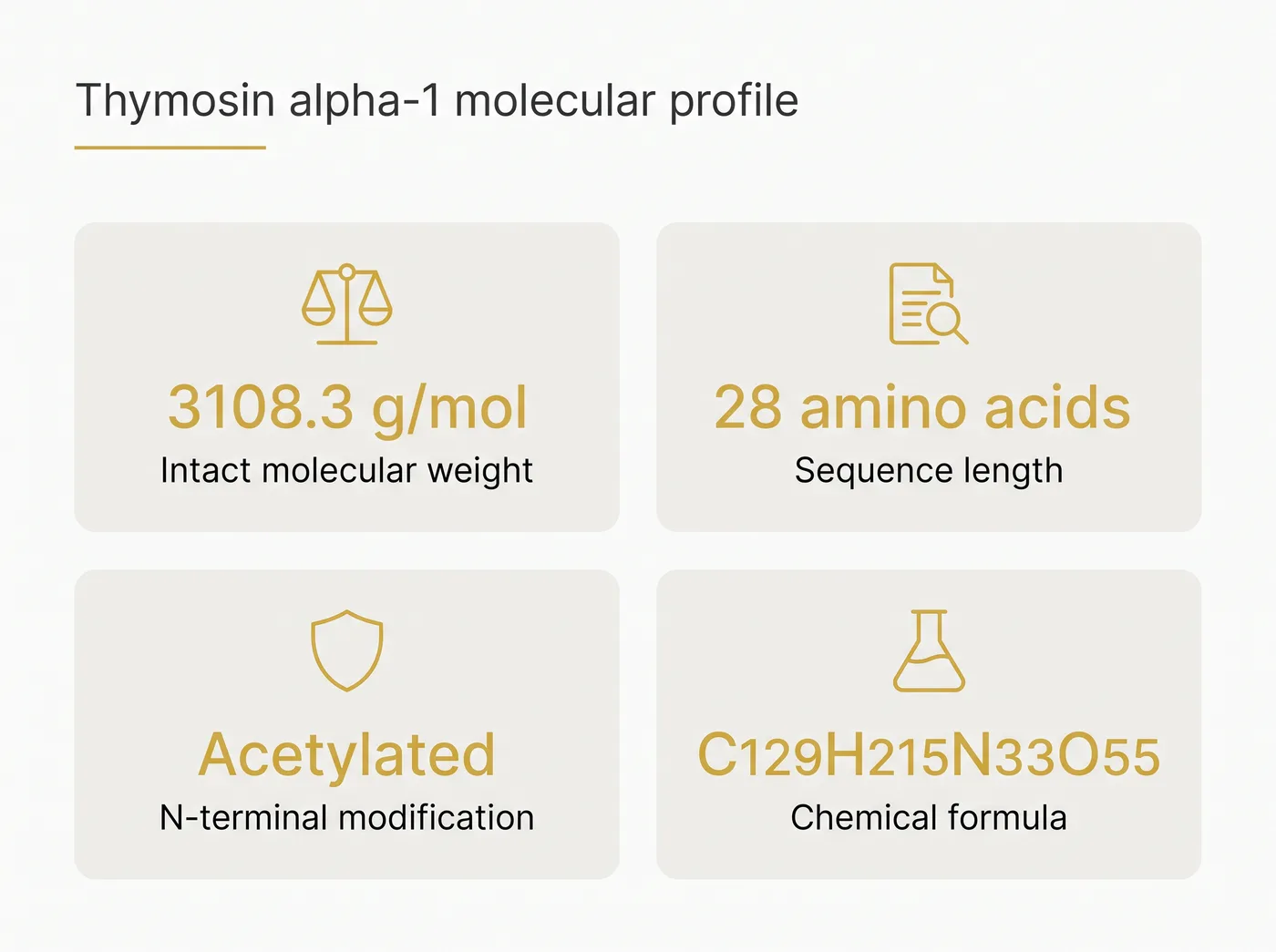
Thymosin alpha-1, known by its International Nonproprietary Name thymalfasin, is a synthetic 28-amino-acid peptide with the molecular formula C129H215N33O55 Thymosin alpha 1 review. Its exact sequence features an acetyl group at the N-terminus. This modification is not an accident; it adds specific mass to the molecule that a laboratory must verify. If you are curious about how the molecule is built, read about its complete chemical structure and physical properties.
When an analytical laboratory introduces a sample into a mass spectrometer, the instrument measures the mass-to-charge ratio of the ionised peptide. Because the Thymosin alpha-1 sequence contains four basic lysine residues, the molecule typically ionises into multiply charged species. Analysts then deconvolute these peaks to find the intact mass, which should measure approximately 3108.3 g/mol. If the reported mass is 42 daltons lighter than expected, the required N-terminal acetylation step failed. You will use this exact same mass spectrometry process to verify an Adamax lab report for its expected molecular weight.
HPLC: sorting the peptide from the debris
Once mass spectrometry confirms the molecule is likely correct, high-performance liquid chromatography (HPLC) answers the next question: how much of the sample is actually that molecule, and how much is manufacturing debris? Reversed-phase HPLC separates peptide variants based on slight differences in hydrophobicity.
A chromatogram is less like a photograph and more like a toll booth. As the material flows through the column in a liquid mobile phase, different molecules emerge at different times. An ultraviolet detector plots these arrivals as peaks on a graph. If a seller claims 99% purity, they mean the area under the main Thymosin alpha-1 peak accounts for 99% of the total area of all peaks detected at that specific wavelength.
Validating the analytical procedure
To trust the purity figure on the page, the laboratory method must be fit for purpose. International guidelines define rigorous validation characteristics for analytical procedures, including specificity, linearity, accuracy, and precision ICH Q2(R2): Validation of analytical procedures.
Specificity is the method's ability to assess the target molecule unequivocally in the presence of impurities. If an HPLC method uses the wrong mobile phase gradient or a poorly matched column temperature, it might force two distinct molecules to exit the column at the same moment. When an impurity hides inside the main peak, a disappointing 92% purity can masquerade on the report as a pristine 99%. A rigorous laboratory validates its procedures to ensure that manufacturing by-products are cleanly separated from the main signal.
The missing mass: counter-ions and moisture
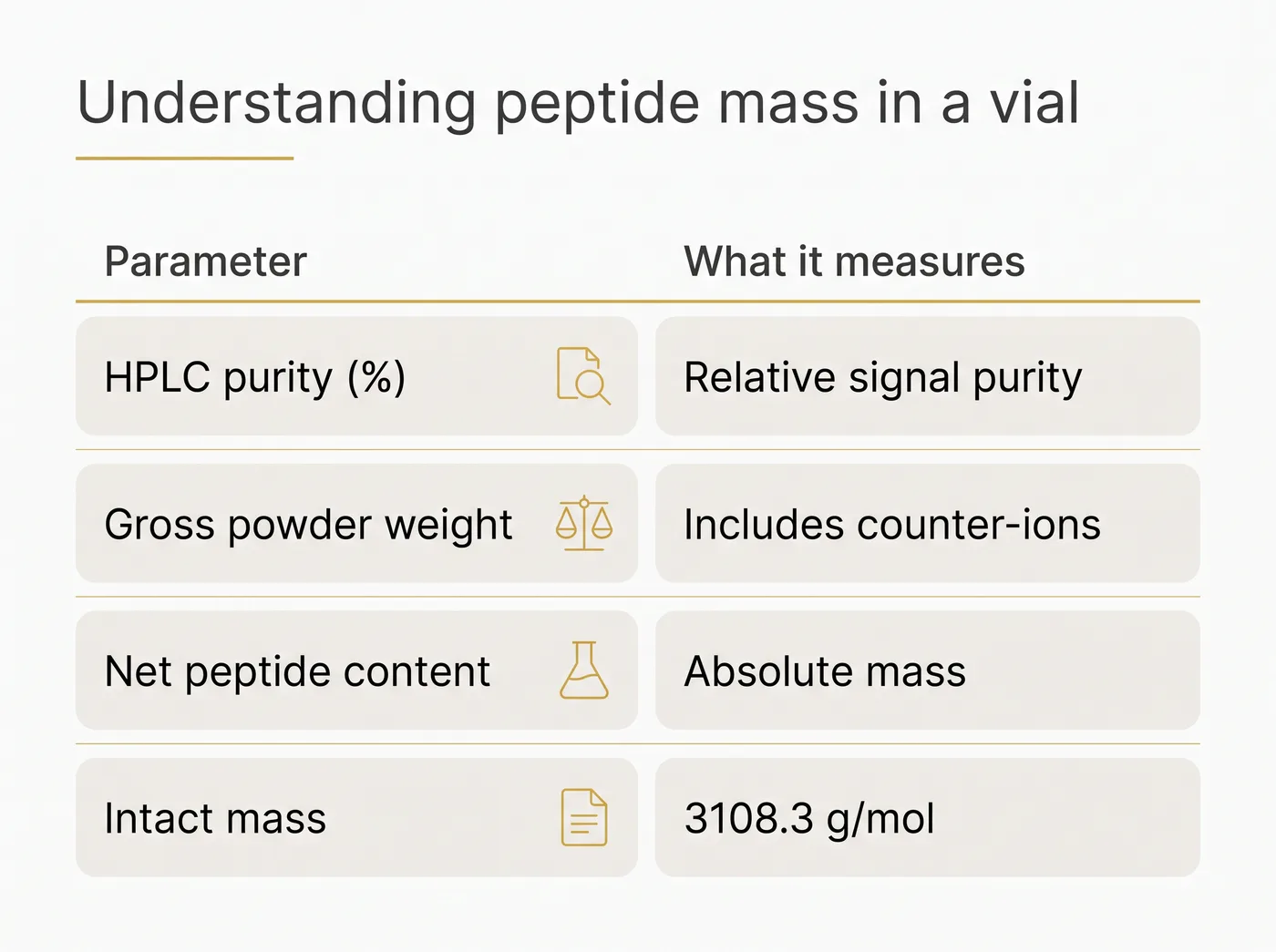
Here is the most common trap when reading a laboratory report: equating the HPLC purity percentage with the net mass of the peptide. A 99% purity score does not mean a 10 mg vial contains 9.9 mg of pure Thymosin alpha-1 free-base.
Synthetic peptides are lyophilised as salts, carrying counter-ions like acetate or trifluoroacetate. Because the Thymosin alpha-1 sequence contains four basic lysine residues, it binds multiple counter-ions. Freeze-dried powders stubbornly retain ambient moisture. Water and salt counter-ions are generally invisible to the UV detectors used in peptide chromatography.
Therefore, the gross powder weight in the vial will always be higher than the net peptide content, often by 10% to 30%. Without a calibrated quantitative assay against a reference standard to determine absolute mass, the HPLC purity simply measures the relative signal purity among the UV-active components.
Checking the final figures and accreditation
A certificate of analysis is only as reliable as the laboratory generating it. Look for an ISO 17025 accreditation, which dictates strict requirements for laboratory competence, method validation, and the transparent reporting of measurement uncertainty ISO/IEC 17025:2017. Vague marketing claims of independent testing mean very little without a verifiable laboratory name and a documented method. Once you know how to spot the red flags, you can use these exact same principles to evaluate a DSIP certificate of analysis.
Finally, check the actual measured parameters against the catalogue specifications. You can see how these figures look on a verified document by reviewing the current pricing and purity records for NuuVive's Thymosin alpha-1, which tested at ≥99% purity (99.311%, Janoshik #165290).
Questions
Does a 99% purity result mean the vial contains 99% Thymosin alpha-1 by weight?
No. The high-performance liquid chromatography (HPLC) percentage represents the relative UV signal area of the main peak compared to all detected impurities. It does not account for the mass of non-UV-active substances like retained moisture or salt counter-ions, meaning the net peptide weight is always lower than the gross powder weight.
Why does the mass spectrometry report show a mass 42 daltons lower than expected?
A missing 42 daltons typically indicates that the required N-terminal acetylation step during synthesis was unsuccessful. For Thymosin alpha-1, the intact molecular weight must measure approximately 3108.3 g/mol to confirm the complete, modified sequence.
Can mass spectrometry prove the exact amino acid sequence?
Intact mass spectrometry confirms the overall molecular weight, which is strong evidence of identity, but it cannot differentiate between sequence isomers where the amino acids are simply arranged in a different order. Confirming the precise sequence requires tandem mass spectrometry to fragment the peptide and map its structure.
Why do counter-ions matter in a peptide lab report?
Synthetic peptides are produced as salts, such as acetates or trifluoroacetates, rather than free bases. Because Thymosin alpha-1 has four lysine residues, it binds multiple counter-ions, which contribute significantly to the total powder mass and must be accounted for during analytical assay preparations.
Sources
- Thymosin alpha 1: A comprehensive review of the literature. National Library of Medicine
- ICH Q2(R2): Validation of analytical procedures. ICH
- ISO/IEC 17025:2017 General requirements for the competence of testing and calibration laboratories. ISO
- 21 CFR Part 210: Current good manufacturing practice, general. eCFR