
Compounds explained
What is cagrilintide? What it has been studied for
NuuVive Journal · · 6 min read

Short answer
Cagrilintide is a 37-amino-acid synthetic peptide engineered to mimic human amylin, a pancreatic hormone. Discovered by Novo Nordisk, it has been modified with a fatty-acid side chain to extend its half-life. It has been studied in phase 2 and phase 3 human trials for weight management and type 2 diabetes, most notably alongside semaglutide. As of late 2026, it remains an unapproved investigational compound.
Key takeaways
- Cagrilintide is an investigational amylin analogue, not a GLP-1 receptor agonist.
- It was engineered with a specific C20 fatty-acid side chain to extend its half-life to over 150 hours.
- Research primarily focuses on its use in obesity and weight management, both alone and in combination with semaglutide.
- While it has entered phase 3 trials, there is currently no completed long-term human trial data for it as a standalone compound.
- As of late 2026, it lacks FDA approval and is explicitly excluded from the HHS pharmacy compounding pathways.
The amylin connection
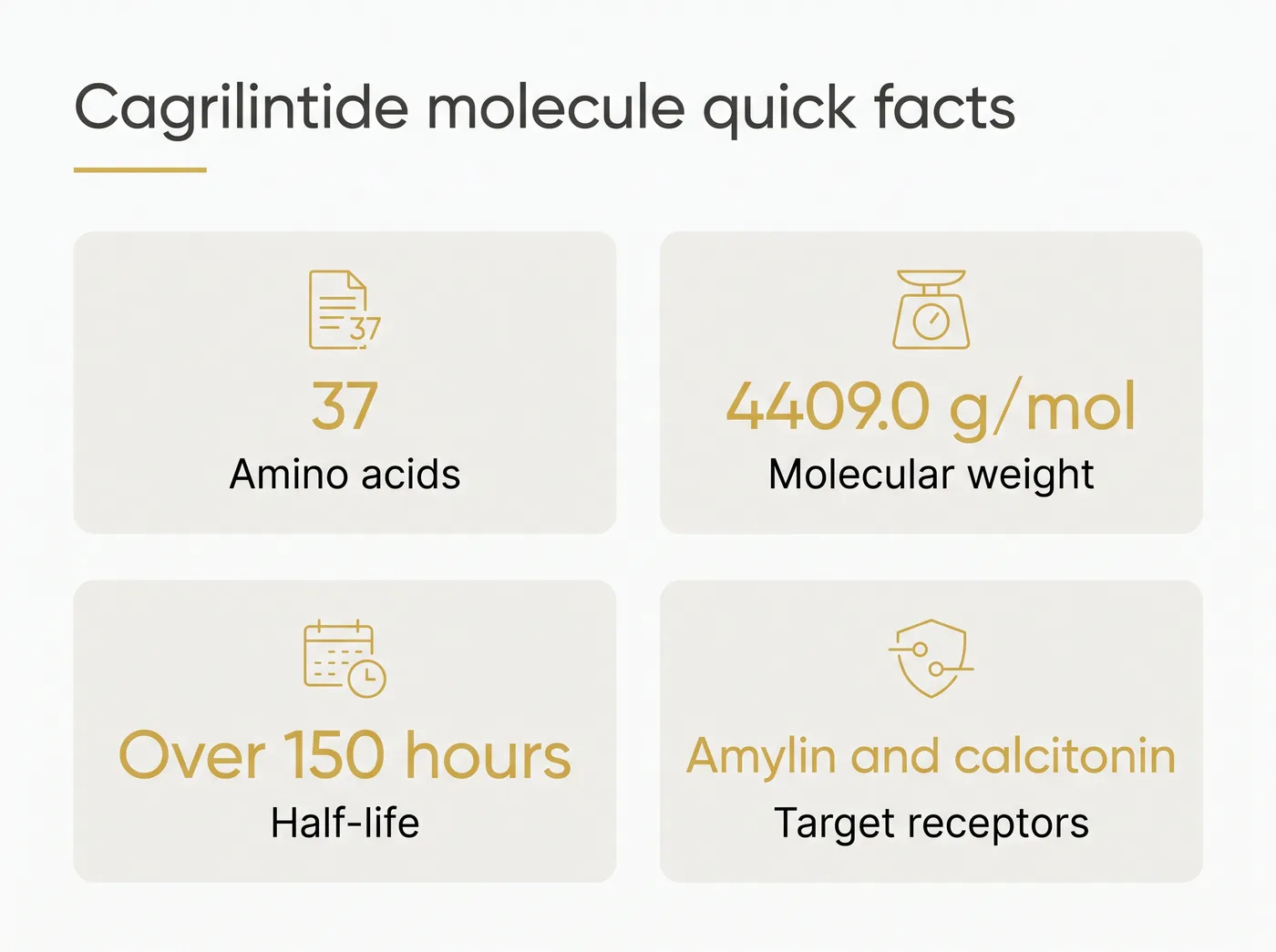
If you spend enough time looking at the research pipeline for metabolic compounds, you eventually hit a wall of proprietary development codes like AM833 or NNC0174-0833. Usually, those belong to molecules that vanished quietly in early testing. This one, however, became cagrilintide. Discovered by researchers at Novo Nordisk, cagrilintide is a synthetic, 37-amino-acid peptide engineered to mimic human amylin National Library of Medicine.
Native amylin is a peptide hormone co-secreted with insulin by the pancreatic beta cells. In human physiology, it acts as a signal to regulate gastric emptying and satiety. The problem with native amylin in a laboratory setting is that it is incredibly unstable, forming amyloid clumps almost immediately. Cagrilintide bypasses this structural flaw using targeted proline substitutions in its peptide backbone, which keep the molecule stable and prevent aggregation.
The real engineering trick, however, is on the side. To extend its half-life, chemists acylated the peptide, attaching a specific C20 fatty-diacid side chain. This lipid addition allows the molecule to bind reversibly to albumin in the bloodstream, slowing its clearance and giving it a half-life of over 150 hours. The resulting compound has a molecular formula of C194H312N54O59S2 and a molecular weight of approximately 4409.0 g/mol.
What has cagrilintide been studied for?
Cagrilintide is classed as a non-selective agonist at amylin and calcitonin receptor complexes. It has been investigated almost entirely in the context of chronic weight management and obesity, as well as an adjunctive focus in type 2 diabetes research Cardiology in Review. Because it targets a completely different biological pathway than the incretin hormones, it has drawn immense attention from researchers looking for additive metabolic responses. If you are curious about other molecules investigated in this area, you can read the plain-English breakdown of AOD-9604.
The evidence base for the compound spans several distinct stages of testing:
- In vitro models: Cell studies have used cagrilintide to evaluate competitive binding and receptor affinity at the AMY1, AMY2, and AMY3 complexes.
- Animal models: Preclinical pharmacology studies in rodents and non-human primates investigated its mechanisms on brainstem appetite centers, particularly the area postrema, and its role in delaying gastric emptying.
- Early human studies: Phase 1 clinical trials evaluated its basic pharmacokinetics and exploratory applications, such as bone metabolism markers.
- Phase 2 trials: A notable randomized, double-blind trial evaluated the profiles of the peptide against a placebo over a 26-week period in adults with overweight or obesity.
- Phase 3 trials: The compound is currently the subject of extensive late-stage clinical evaluation. Standalone phase 3 trials investigating cagrilintide alone for weight management are active and recruiting ClinicalTrials.gov.
The bulk of the phase 3 attention, however, focuses on a fixed combination. In the REDEFINE and REIMAGINE trial programs, cagrilintide is studied alongside semaglutide as a combination investigational product known as CagriSema. The two peptides are paired in research strictly because their anatomically separate targets do not compete with one another.
The missing evidence
It is easy to look at the sheer scale of the phase 3 trials and assume the science is settled. But if you are mapping out the actual evidence that exists today, there is a gaping hole in the published data. There is currently no completed, published phase 3 standalone clinical data for cagrilintide outside of its combination with semaglutide.
Because the compound has not completed the full regulatory lifecycle, no human evidence exists for long-term real-world use outside of tightly controlled clinical trial protocols. The long-term cardiovascular data and durability profiles for cagrilintide as a standalone compound simply do not exist yet.
Cagrilintide vs. semaglutide
To understand where cagrilintide fits into the broader field of metabolic research, analytical chemists typically compare it to an established compound: semaglutide. The differences lie primarily in their origins and target receptors. If you need to catch up on that baseline compound, you can read the complete explainer on semaglutide.
| Feature | Cagrilintide | Semaglutide |
|---|---|---|
| Class | Amylin analogue | GLP-1 receptor agonist |
| Origin target | Mimics pancreatic hormone | Mimics gut incretin hormone |
| Target receptors | Amylin and calcitonin complexes | GLP-1 receptors |
Early synthetic analogues National Library of Medicine lacked a fatty-acid chain to anchor them to plasma proteins, clearing from the system in roughly 20 to 45 minutes. Cagrilintide was engineered specifically to solve that problem, achieving a half-life measured in days rather than minutes.
Legal status: FDA and compounding
If you are trying to understand the regulatory status of cagrilintide, the answer is remarkably simple: it has none. As of late 2026, cagrilintide is entirely investigational. It is not approved by the U.S. Food and Drug Administration (FDA) or any other global governmental health authority for any medical condition. While a New Drug Application was submitted to the FDA in December 2025 for the CagriSema combination, no approved commercial label exists for cagrilintide itself.
This lack of approval has a cascading effect on compounding pharmacies. Under the October 2026 HHS enforcement discretion policy regarding 503A compounding, cagrilintide is explicitly excluded. The FDA has publicly noted that the compound does not possess a USP monograph, is not on the bulk substances shortage list, and lacks any established 503A or 503B pathway. Any material sold online as "compounded" cagrilintide operates entirely outside the regulated framework.
Reading a cagrilintide lab report
Because the molecule sits outside the traditional pharmaceutical supply chain, independent laboratory testing is the only barrier between a buyer and a vial of mystery powder. A proper Certificate of Analysis (COA) is not a marketing flyer; it is a technical audit. The first thing you want to look at is the High-Performance Liquid Chromatography (HPLC) results.
A chromatogram is essentially a molecular footrace where every impurity has to cross the finish line in public. For a complex, lipidated 37-amino-acid peptide like cagrilintide, synthesis is difficult and prone to truncated sequences or missing side chains. You want to see a single, sharp, massive spike on that graph, representing a measured purity of ≥99%. If the baseline is jagged or full of smaller hills, the synthesis was sloppy, and the purification was worse.
Always verify that the lot number on the COA matches the lot number printed on the vial in your hand. A lot number is the vial's passport; if it does not match the paperwork, the paperwork belongs to someone else's test. If you want to see what a verified, third-party audited testing standard looks like for this specific molecule, you can review the Cagrilintide lab results directly.
Questions
Is cagrilintide a GLP-1 receptor agonist?
No. Cagrilintide operates via an entirely separate mechanistic pathway. It is an amylin analogue that acts on calcitonin and amylin receptor complexes, mimicking a pancreatic hormone rather than a gut hormone.
What is CagriSema?
CagriSema is the investigational name for a fixed combination of two separate peptides: cagrilintide and semaglutide. It is currently being studied in phase 3 clinical trials for weight management and type 2 diabetes.
What is the legal status of cagrilintide?
Cagrilintide is an unapproved, investigational compound. It may be legally purchased and sold exclusively as a research chemical for laboratory research use only. It cannot be legally sold or marketed as a drug, medication, or dietary supplement for human consumption.
Sources
- pubchem.ncbi.nlm.nih.gov. National Library of Medicine
- pubmed.ncbi.nlm.nih.gov. National Library of Medicine
- ClinicalTrials.gov. clinicaltrials.gov
- pubchem.ncbi.nlm.nih.gov. National Library of Medicine