
Compounds explained
Semaglutide vs tirzepatide vs retatrutide: the differences explained
NuuVive Journal · · 7 min read

Short answer
Semaglutide is a single GLP-1 receptor agonist based on the human GLP-1 sequence. Tirzepatide is a dual GLP-1 and GIP receptor agonist engineered on a GIP sequence. Retatrutide is an investigational triple agonist targeting GLP-1, GIP, and glucagon receptors, built on a highly modified GIP backbone. While semaglutide and tirzepatide are fully FDA-approved for specific indications, retatrutide remains strictly an investigational new drug in clinical trials.
Key takeaways
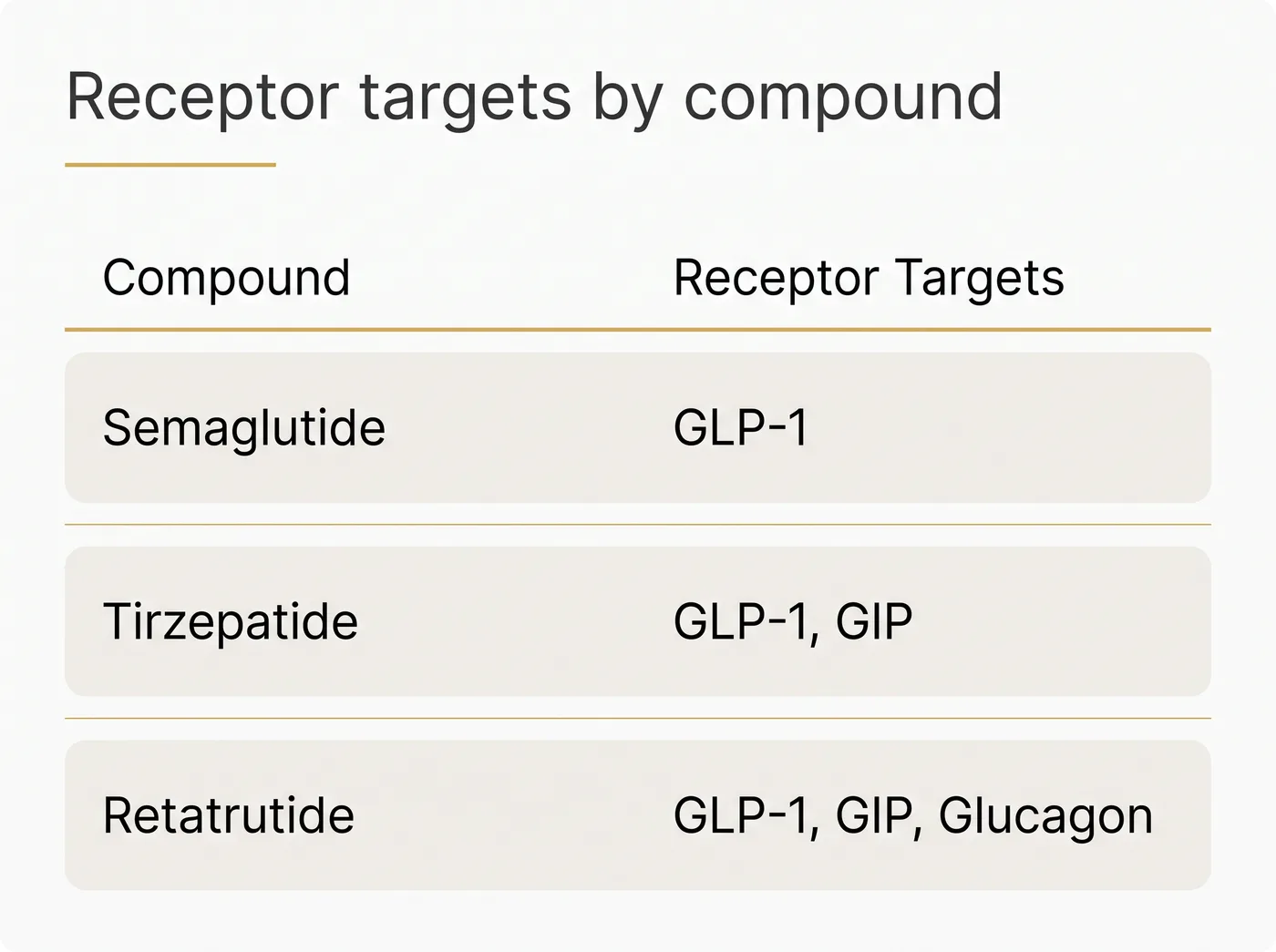
- Semaglutide targets one receptor (GLP-1), tirzepatide targets two (GLP-1 and GIP), and retatrutide targets three (GLP-1, GIP, and glucagon).
- Semaglutide is built on a modified human GLP-1 backbone, whereas both tirzepatide and retatrutide are engineered upon a GIP peptide backbone.
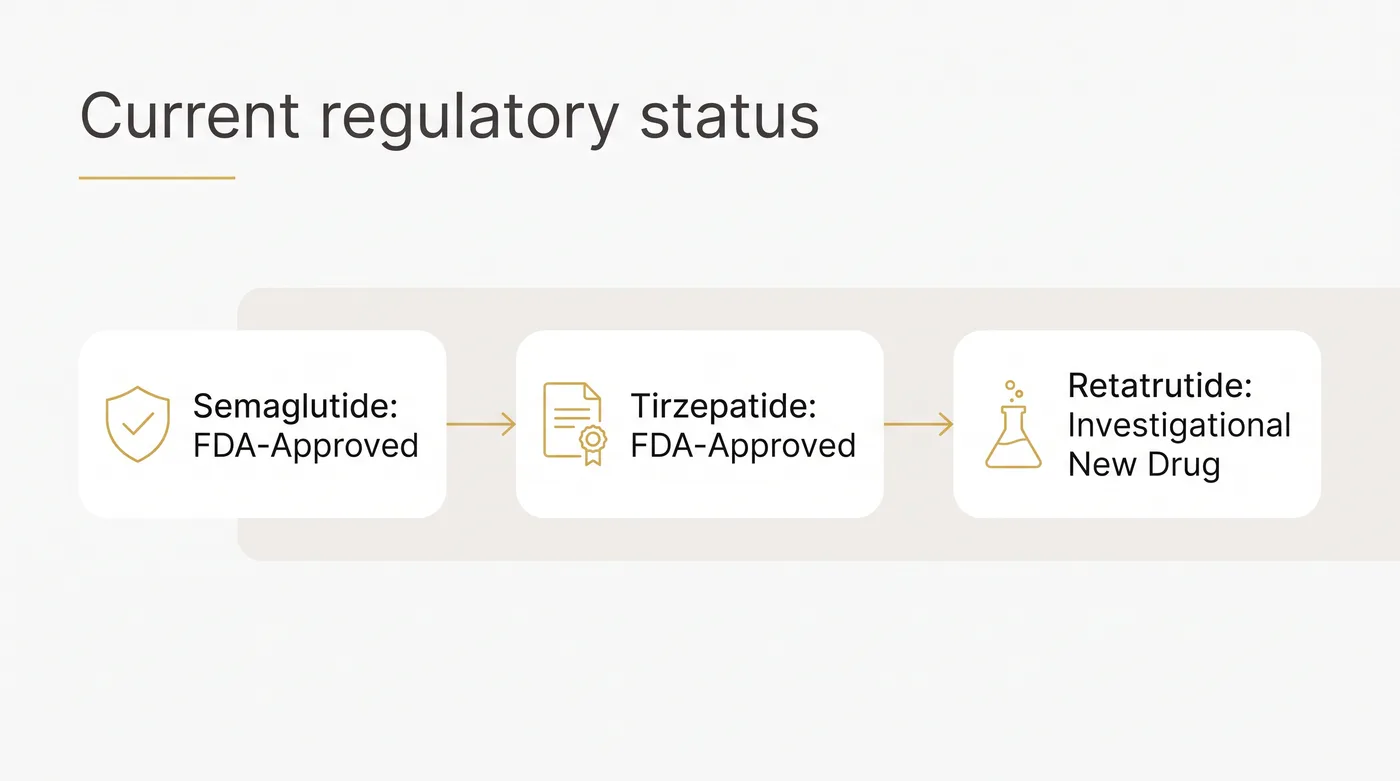
- Semaglutide and tirzepatide are FDA-approved, while retatrutide is an Investigational New Drug (IND) currently undergoing Phase 3 human clinical trials.
- The 2026 HHS 503A enforcement policy dictates that compounding pharmacies may no longer use bulk active ingredients to manufacture copies of semaglutide or tirzepatide.
- Retatrutide is completely excluded from 503A bulk compounding lists, making bulk compounding of the compound prohibited under federal law.
The core difference: counting the targets
Look up these three compounds online, and the noise is deafening. Between the forum chatter and the marketing haze, it is easy to miss the actual science. The real story lives in a handful of dense research papers written by chemists who spend their lives manipulating molecular backbones. If you want to understand the true difference between these molecules, you have to ignore the noise and focus on the receptor targets.
Imagine a cell's surface covered in distinct locks, waiting for precisely milled chemical keys to turn them. The entire distinction between semaglutide, tirzepatide, and retatrutide comes down to how many of those specific locks they are engineered to engage. Semaglutide is designed to turn a single lock. Tirzepatide was built to turn two simultaneously. Retatrutide was heavily modified to turn three. They are not merely different concentrations of the same compound; they are structurally distinct molecules with different amino acid sequences, different molecular weights, and entirely different lipid side chains.
Understanding how these molecules differ requires looking at their origin stories and their chemical blueprints. The shift from a single receptor agonist to a triple receptor agonist represents a fundamental shift in peptide chemistry, not just a simple upgrade. This is why GLP-1 drugs are patented and research peptides are not: engineering a peptide to survive degradation while targeting multiple receptors requires highly specific, proprietary modifications.
Semaglutide: the single-target pioneer
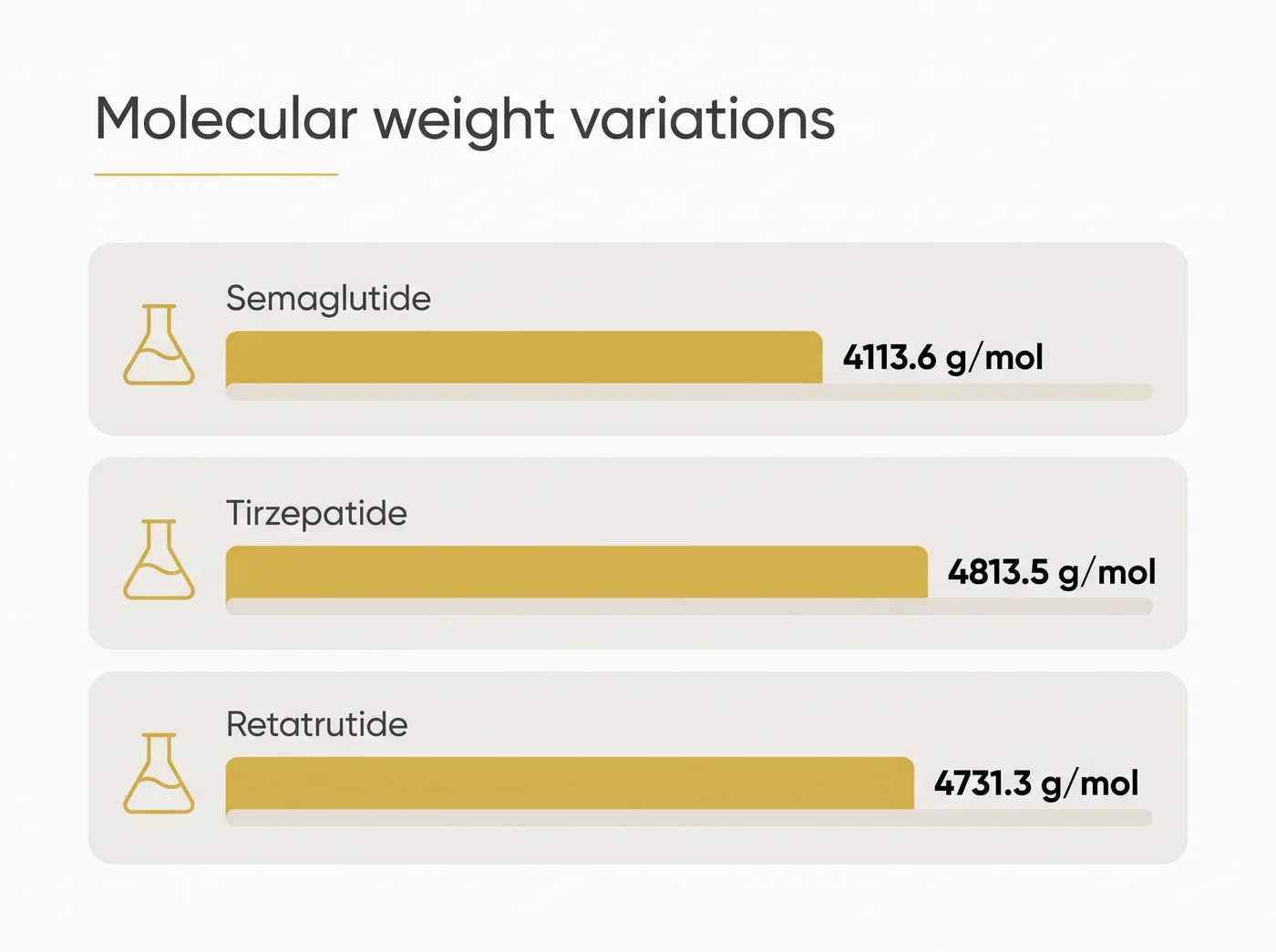
First detailed in the scientific literature in 2012, semaglutide is a synthetic modified 31-amino acid polypeptide. It belongs to the class of GLP-1 receptor agonists and acts selectively on that single target. Its molecular weight is exactly 4113.6 g/mol PubChem. For a look at a compound that belongs in an entirely different research category, explore why cagrilintide sits outside the GLP-1 class.
Structurally, semaglutide is an analogue of human glucagon-like peptide-1. To keep the molecule from being immediately destroyed by enzymes in the lab, researchers substituted alanine with alpha-aminoisobutyric acid (Aib) at position 8. This acts like molecular armor against DPP-4 cleavage. Additionally, a C18 fatty di-acid spacer was attached to a lysine at position 26 to facilitate albumin binding Review Article.
It has been evaluated in cell models using pancreatic beta-cell lines and in animal models such as diabetic mice. In human research, multiple Phase 3 trials have investigated it for type 2 diabetes, obesity, cardiovascular risk, and metabolic dysfunction-associated steatohepatitis (MASH). Semaglutide is fully FDA-approved for specific indications in these areas Review Article. If you want the full story on its origins and the trials it went through, read the complete explainer on semaglutide.
Tirzepatide: the dual-target engineer
Tirzepatide arrived in the scientific literature in 2016 as a synthetic 39-amino acid linear polypeptide. Unlike semaglutide, it is a dual GIP and GLP-1 receptor agonist, and its molecular weight is larger, sitting at 4813.5 g/mol PubChem.
Instead of being based on GLP-1, tirzepatide's structural backbone is based on the gastric inhibitory polypeptide (GIP) sequence. It features a modification with Aib at position 2, and uses a longer C20 fatty di-acid moiety linked via a hydrophilic spacer to a lysine at position 20 Review Article.
In research settings, it was assessed in cell assays measuring cAMP accumulation in receptor-expressing cells, as well as in diet-induced obesity animal models. In human clinical trials, it has been investigated in extensive Phase 3 programs for type 2 diabetes, obesity, and obstructive sleep apnea. Tirzepatide holds full FDA approval for several of these indications Review Article.
Retatrutide: the triple-receptor investigational compound
The newest of the three, retatrutide, had its early preclinical pharmacology described in 2022. It is a synthetic 39-amino acid polypeptide designed as a triple receptor agonist (triagonist), targeting GLP-1, GIP, and glucagon (GCG) receptors. Its molecular weight measures at 4731.3 g/mol PubChem.
Like tirzepatide, retatrutide is built on a GIP-based backbone and uses a C20 fatty di-acid side chain. However, it integrates three unique non-coded amino acids (Aib2, aMeL13, Aib20) into its sequence. The inclusion of alpha-methyl-L-leucine is a highly specific substitution designed to fine-tune its engagement with the glucagon receptor Review Article.
Retatrutide has been evaluated in cell assays for receptor binding affinities and in mouse models investigating energy expenditure. In humans, it has been studied in Phase 2 and Phase 3 trials for obesity and metabolic syndrome, alongside small Phase 2 cohorts assessing NAFLD/MASH Review Article.
Comparing the structures side-by-side
When you put the three compounds side by side, the architectural choices made by the researchers become clear. The fatty acid chains and the peptide backbones dictate how each molecule behaves in an experimental model.
| Feature | Semaglutide | Tirzepatide | Retatrutide |
|---|---|---|---|
| Receptor Targets | GLP-1 | GLP-1, GIP | GLP-1, GIP, Glucagon |
| Peptide Backbone | Human GLP-1 | GIP Sequence | GIP Sequence |
| Amino Acid Length | 31 | 39 | 39 |
| Fatty Acid Chain | C18 at position 26 | C20 at position 20 | C20 side chain |
| Molecular Weight | 4113.6 g/mol | 4813.5 g/mol | 4731.3 g/mol |
These precise structural differences are what researchers rely on when selecting a compound for a specific laboratory model. A C18 chain interacts with albumin differently than a C20 chain, changing the fundamental parameters of any cellular assay it is introduced to. If you want to explore how other molecular designs target entirely different pathways, review the structural differences between CJC-1295 and ipamorelin.
The 2026 HHS compounding policy and FDA status
The regulatory machinery moves at its own glacial pace, but when a policy shifts, the rules change overnight. For years, the FDA drug shortage list provided a narrow lane for certain compounding pharmacies to operate. That lane is closing. Under the 2026 HHS 503A enforcement discretion policy, the rules for these three compounds are strictly defined.
Semaglutide and tirzepatide are both fully FDA-approved drugs. Following their removal from the FDA drug shortage list, the 2026 policy dictates that 503A compounding pharmacies may no longer use bulk active pharmaceutical ingredients (API) to compound copies of them without facing regulatory action. Access to these specific compounds in a clinical setting is now strictly restricted to the FDA-approved manufactured products.
Retatrutide sits in an entirely different legal category. It is an Investigational New Drug (IND) and is not FDA-approved for any indication. It does not possess a USP monograph and is absent from the 503A bulks list. Consequently, it is entirely excluded from the 2026 HHS 503A enforcement discretion policy. Any bulk compounding of retatrutide by a pharmacy is strictly prohibited under federal law. If you need to untangle the rest of the rules, look at the complete breakdown of retatrutide's legal status in the US.
The lab report: what separates research from regret
If you are sourcing any of these compounds for a laboratory setting, the only document that matters is the Certificate of Analysis (CoA). A lot number is the vial's passport, and a chromatogram is a race where every impurity has to cross the finish line in public. Without high-performance liquid chromatography (HPLC) and mass spectrometry testing, a vial of white powder could be anything.
Because these three molecules have drastically different synthesis costs and legal standings, the incentive for a careless supplier to substitute a different compound is high. When reviewing a CoA, you must match the exact mass spectrometry measurement to the known molecular weight (for example, 4731.3 g/mol for retatrutide) to verify identity. Then, you check the HPLC purity percentage. Knowing how to spot a doctored certificate is a basic requirement for modern research procurement.
You can view the verifiable HPLC and mass spectrometry documents for NuuVive's Retatrutide to see the current stock, pricing, and measured purity of ≥99%.
Questions
Can compounding pharmacies still make semaglutide or tirzepatide from bulk powders?
No. Under the 2026 HHS 503A enforcement discretion policy, their removal from the FDA shortage list means compounding pharmacies can no longer use bulk active pharmaceutical ingredients to make copies without facing regulatory action.
Why does retatrutide target the glucagon receptor when the others do not?
Retatrutide incorporates three specific non-coded amino acids, including alpha-methyl-L-leucine, into its 39-amino acid sequence. This structural modification was engineered by researchers specifically to fine-tune engagement with the glucagon receptor, separating it from dual agonists like tirzepatide.
Is retatrutide FDA approved?
No. Retatrutide is currently an Investigational New Drug (IND) and is not FDA-approved for any indication. It remains in Phase 3 human clinical trials.
How can a lab tell the difference between these three compounds in a blind test?
A laboratory would use mass spectrometry. Because each compound has a distinct molecular weight, 4113.6 g/mol for semaglutide, 4813.5 g/mol for tirzepatide, and 4731.3 g/mol for retatrutide, mass spectrometry can instantly identify which molecule is present in the sample.
Sources
- pubchem.ncbi.nlm.nih.gov. National Library of Medicine
- pubmed.ncbi.nlm.nih.gov. National Library of Medicine
- pubchem.ncbi.nlm.nih.gov. National Library of Medicine
- pubmed.ncbi.nlm.nih.gov. National Library of Medicine
- pubchem.ncbi.nlm.nih.gov. National Library of Medicine
- pubmed.ncbi.nlm.nih.gov. National Library of Medicine