
Compounds explained
What is ipamorelin? Chemistry, origins and research areas
NuuVive Journal · · 6 min read

Short answer
At its chemical core, ipamorelin is a laboratory-engineered pentapeptide built to act as a selective growth hormone secretagogue. Developed in 1998, the molecule was investigated in animal models assessing bone and fat metabolism, alongside a discontinued phase 2 human trial for postoperative bowel motility. Today, it remains an unapproved research chemical with no established clinical data supporting its popular internet reputation.
Key takeaways
- Ipamorelin is a synthetic pentapeptide investigated for its binding to the ghrelin receptor and its selectivity regarding secondary hormone release.
- It was first described in the scientific literature in 1998 by researchers investigating compounds with high endocrine selectivity.
- The molecule has been investigated in rodent and swine models, as well as an early human trial for postoperative bowel function.
- There are no published human clinical trials establishing it for sleep, body composition, or athletic performance.
- It is not an approved drug and is not covered by the 2026 federal compounding enforcement discretion policy.
The five-amino-acid lockpick
If you browse enough online forums, you might assume this pentapeptide is a universally established asset. The reality sits inside a few niche chemistry journals: a highly specific, synthetic sequence that a pharmaceutical company designed, tested, and ultimately shelved over a decade ago. The gap between internet lore and the actual laboratory record is vast, but the genuine chemistry is fascinating on its own merits.
Ipamorelin is a synthetic pentapeptide, meaning it consists of a chain of exactly five amino acids. Its specific sequence is Aib-His-D-2-Nal-D-Phe-Lys-NH2. To a peptide chemist, that sequence is interesting because it features non-standard residues, including alpha-aminoisobutyric acid and two D-configured aromatic residues, capped with a C-terminal amide. These modifications are typically engineered into a sequence to be investigated for their influence on enzymatic degradation in biological systems. The resulting molecule has a mass of 711.9 g/mol and is classified as a selective growth hormone secretagogue National Library of Medicine.
The compound was first described in the peer-reviewed literature in 1998 by researchers at Novo Nordisk. They identified it during a synthetic chemistry program focused on creating compounds that lacked a central dipeptide found in earlier generations of secretagogues. Their goal was to design a highly selective molecule that could bind to the ghrelin receptor to prompt a specific pituitary response National Library of Medicine. That mechanical selectivity became the defining characteristic of the compound in subsequent laboratory research.
The selectivity question: Ipamorelin vs related compounds
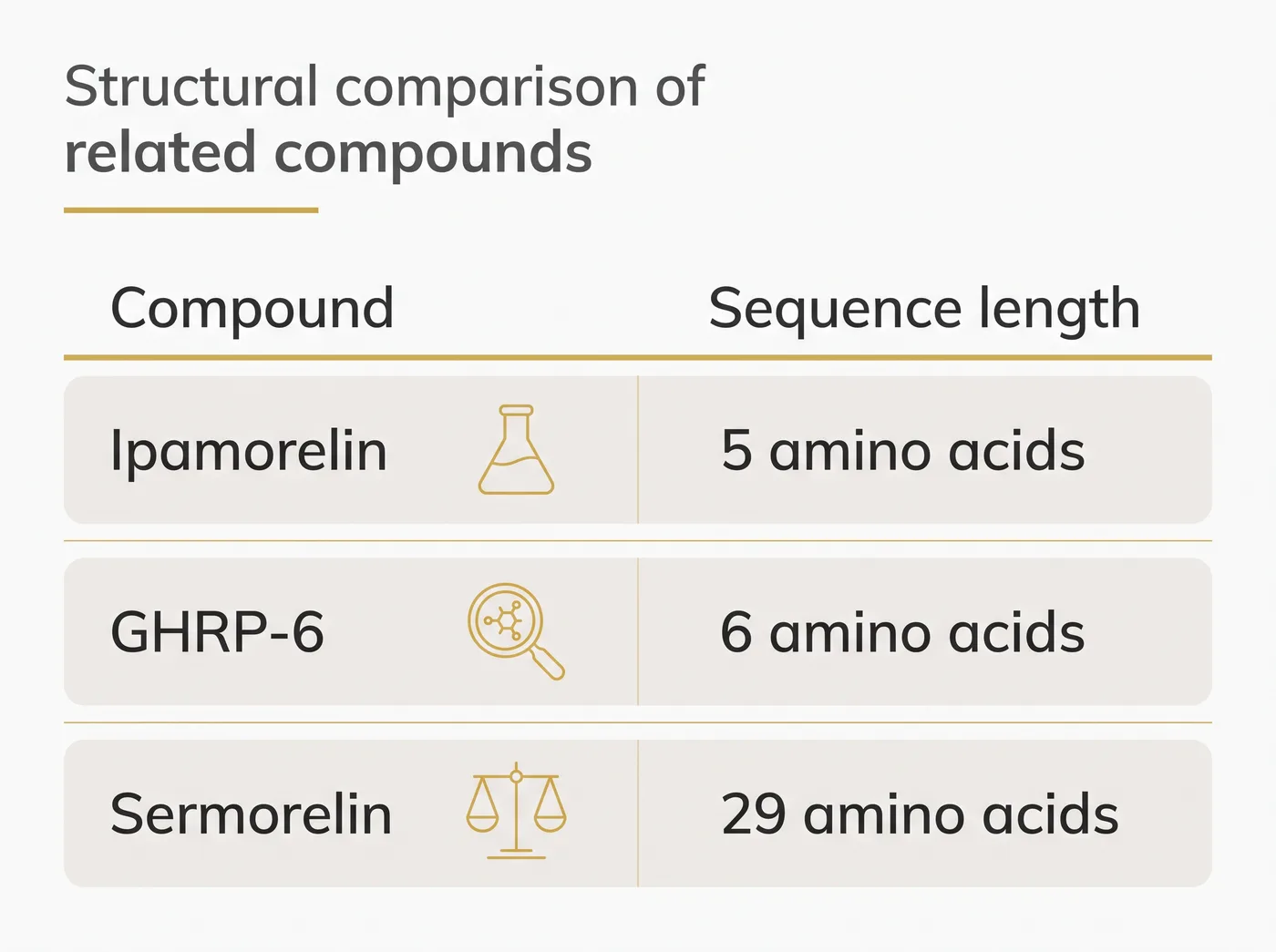
In the timeline of peptide research, molecules are rarely studied in isolation. Researchers frequently compare a novel compound against older models to understand its binding profile. For ipamorelin, the standard points of comparison in the literature are GHRP-6 and sermorelin. While all three belong to a broad family of compounds investigated for endocrine signaling, their structures and receptor targets differ. To see another classic example of a direct derivative parting ways with its parent, explore the differences between PT-141 and Melanotan II.
| Compound | Structure | Primary Receptor Target | Selectivity Profile |
|---|---|---|---|
| Ipamorelin | 5 amino acids | Ghrelin receptor (GHS-R1a) | Investigated for selective signaling without ACTH or cortisol involvement |
| GHRP-6 | 6 amino acids | Ghrelin receptor (GHS-R1a) | Investigated for non-selective signaling involving ACTH and cortisol |
| Sermorelin | 29 amino acids | GHRH receptor | Investigated for its interaction with a different receptor pathway |
GHRP-6 is a hexapeptide that also binds to the ghrelin receptor, but early animal studies investigated its noisy biological response. In models such as conscious swine, GHRP-6 was investigated for its influence on the release of adrenocorticotropic hormone (ACTH), cortisol, and prolactin alongside its primary signaling National Library of Medicine. Ipamorelin was designed specifically to avoid that noise, and subsequent animal studies investigated its interaction with those secondary stress hormones National Library of Medicine.
Sermorelin presents a different contrast entirely. It is a much larger 29-amino-acid peptide that represents the functional fragment of an endogenous hormone. Rather than being studied for ghrelin receptor interaction like the synthetic secretagogues, it has been investigated for its binding to the GHRH receptor National Library of Medicine. While the two are frequently discussed together in public forums, they are biochemically distinct tools used in different laboratory applications. If you are curious about another large molecule in that receptor family, read about the clinical trials and structure of tesamorelin.
What the compound has been studied for
The research history of this pentapeptide spans several decades, moving from isolated cells to animal models and eventually a specific clinical trial. In the earliest stages, the peptide's receptor selectivity and binding dynamics were evaluated extensively in primary rat pituitary cells. Researchers wanted to map exactly how the synthetic molecule interacted with cellular machinery.
From there, investigations moved into animal models. Studies in normal and genetically modified mice, as well as rats and swine, were conducted to measure its impact on longitudinal bone growth and adiposity. Some specific murine models also investigated the compound when paired with other molecules, which is where the concept of a CJC-1295 + Ipamorelin combination originated in the literature. Small human pharmacological studies in the late 1990s looked at circulating blood levels and biological half-life in a handful of subjects National Library of Medicine.
The most significant human data comes from a phase 2, randomized, double-blind clinical trial. Pharmaceutical developers advanced the compound into this trial to investigate its potential to restore gastrointestinal function after surgery, a condition known as postoperative ileus. The study followed 114 patients in a modified evaluation population, evaluating the time required to consume a standardized solid meal. Following this trial, clinical development for the indication was discontinued National Library of Medicine.
Legal status and the compounding framework
Ipamorelin has never been approved by the FDA as a pharmaceutical drug for any human or veterinary indication. It exists purely as an unapproved substance, a fact that often gets buried under the marketing language of online clinics. Regulatory agencies categorize it strictly, and recent policy shifts have dramatically narrowed how it can be handled by pharmacies in the United States.
The compound is not eligible for routine pharmacy compounding under Section 503A of the Federal Food, Drug, and Cosmetic Act. In late 2024, the FDA's Pharmacy Compounding Advisory Committee evaluated the molecule and voted against adding it to the authorized bulk substances list, citing insufficient evidence. Consequently, the compound is entirely excluded from the new HHS enforcement discretion policy beginning in October 2026. Only a specific handful of peptides received favorable committee votes to remain accessible through that temporary compounding pathway. To see how another synthetic molecule fared in this exact regulatory maze, check out the research and regulatory facts for PT-141.
The compound also sits on the Category 2 bulk drug substances list under the interim 503B policy. That category flags substances that present significant compounding risks, with authorities citing concerns over peptide aggregation or impurities. This stringent regulatory posture underlines the gap between laboratory research and clinical viability.
Reading the laboratory documentation
When sourcing a research compound, the vial itself tells you very little. A white lyophilized powder is visually indistinguishable from any other. The only way to verify what sits on the laboratory bench is through independent, third-party analytical testing. A certificate of analysis is the vial's passport, detailing exactly what the chemical synthesis left behind.
High-Performance Liquid Chromatography (HPLC) and Mass Spectrometry (MS) are the standard tools. A chromatogram is a race where every impurity has to cross the finish line in public; the main compound forms a massive peak, and any synthetic byproducts form smaller peaks alongside it. The purity percentage is derived from the area under that main peak relative to the total area. You also want to see a quantitative test that confirms the exact mass inside the vial, as manufacturing variations can easily shortchange the total yield.
A rigorous vendor will provide documentation that matches the specific batch number on the vial. For example, laboratory testing of the current catalogue batch yields a purity of 99.897% alongside a measured compound weight of 5.49 mg per vial (verified via Janoshik report #215323). Relying on generic, undated certificates is a fast track to compromised research data. For the current price, stock and measured purity, see NuuVive's Ipamorelin.
Questions
Is ipamorelin a hormone?
No. It is a synthetic peptide that belongs to a class known as secretagogues. It has been studied for its ability to bind to cellular receptors and prompt the release of endogenous hormones, but it is not a hormone itself.
Why is it formulated with D-amino acids?
The inclusion of D-configured amino acids in its sequence is a deliberate chemical modification. These non-standard residues are investigated in synthetic chemistry for their relationship to enzymatic degradation and biological half-life during experiments.
What is the difference between a pentapeptide and a hexapeptide?
The prefix denotes the exact number of amino acids in the chemical chain. Ipamorelin is a pentapeptide, containing exactly five amino acid residues, whereas related compounds like GHRP-6 are hexapeptides containing six.
Is ipamorelin available as a prescription?
It is an unapproved drug and is not FDA-approved for any indication. Additionally, recent federal compounding regulations have excluded it from routine pharmacy compounding pathways, restricting it to non-clinical laboratory research.
Sources
- pubmed.ncbi.nlm.nih.gov. National Library of Medicine
- pubmed.ncbi.nlm.nih.gov. National Library of Medicine
- pubchem.ncbi.nlm.nih.gov. National Library of Medicine
- pubchem.ncbi.nlm.nih.gov. National Library of Medicine
- pmc.ncbi.nlm.nih.gov. National Library of Medicine