
Compounds explained
What is PT-141? The research and regulatory facts
NuuVive Journal · · 7 min read

Short answer
PT-141, formally known by its generic name bremelanotide, is a synthetic seven-amino-acid cyclic peptide derived from Melanotan II. It was originally developed in the 1980s during academic research into synthetic pigmentation agents. In clinical settings, it has been heavily studied for its binding affinity to central melanocortin receptors. The compound was evaluated in extensive human trials and holds FDA approval for acquired, generalized hypoactive sexual desire disorder in premenopausal women.
Key takeaways
- PT-141 is a synthetic, cyclic seven-amino-acid peptide that targets central melanocortin receptors.
- It originated as an active metabolite of the unapproved peptide Melanotan II during 1980s research into synthetic pigmentation agents.
- The compound was investigated in extensive Phase 3 human trials tracking sexual desire metrics in premenopausal women.
- It holds full FDA approval under the generic name bremelanotide, meaning it automatically qualifies for pharmacy compounding under a valid prescription.
- Authentic laboratory supply is verified through third-party liquid chromatography and mass spectrometry testing.
The accidental discovery
Look closely at the history of modern science and you will find a surprising number of multimillion-dollar breakthroughs that began with someone trying to do something else entirely. The lineage of PT-141 traces back to the 1980s at the University of Arizona. Scientists were attempting to develop synthetic analogs of alpha-melanocyte-stimulating hormone as pigmentation agents 4.
During the development of an early analog called Melanotan II, researchers pivoted their focus to investigate the compound's central nervous system interactions. Realizing the compound interacted with the central nervous system in ways entirely unrelated to pigmentation, they abandoned the pigmentation applications for this specific derivative. By the early 2000s, pharmaceutical development shifted to isolating the mechanisms of sexual desire while actively stripping away the skin-darkening properties.
This effort resulted in bremelanotide. It was initially investigated in early trials, but due to variable absorption profiles and blood pressure observations, the pharmaceutical development was forced to shift focus. It is a rare example of a compound that began as a cosmetic hypothesis and ended up going through the full regulatory process of modern drug development. If you want to trace the clinical paperwork for another peptide, you can read the trial history and regulatory status of tesamorelin.
What the compound actually is
At a molecular level, PT-141 is a synthetic cyclic heptapeptide lactam. It is registered under the International Nonproprietary Name bremelanotide and acts as a central melanocortin receptor agonist. Its primary target is the MC4R receptor in the central nervous system. The compound carries a molecular weight of 1025.2 g/mol and the chemical formula C50H68N14O10 2.
Peptide sequence notation can look like a cat walked across a keyboard, but every letter dictates the molecule's physical reality. The sequence is Ac-Nle-cyclo(Asp-His-D-Phe-Arg-Trp-Lys)-OH. This means it features an N-terminal acetyl group and a norleucine residue. The "cyclo" prefix indicates that the peptide is folded into a ring, stabilized by a lactam bridge specifically formed between the Asp and Lys amino acid residues.
That structural stability is why it is distinct from linear peptides. The cyclization is studied for its role in stabilizing the molecule in biological environments compared to a simple amino acid chain. When supplied for laboratory use, it arrives as a lyophilized powder, requiring strict cold-chain storage to maintain the integrity of that lactam bridge over time. Researchers looking at related structural classes often review ipamorelin alongside it, as both use targeted amino acid sequencing to engage specific receptor pathways.
The research trail and trial history
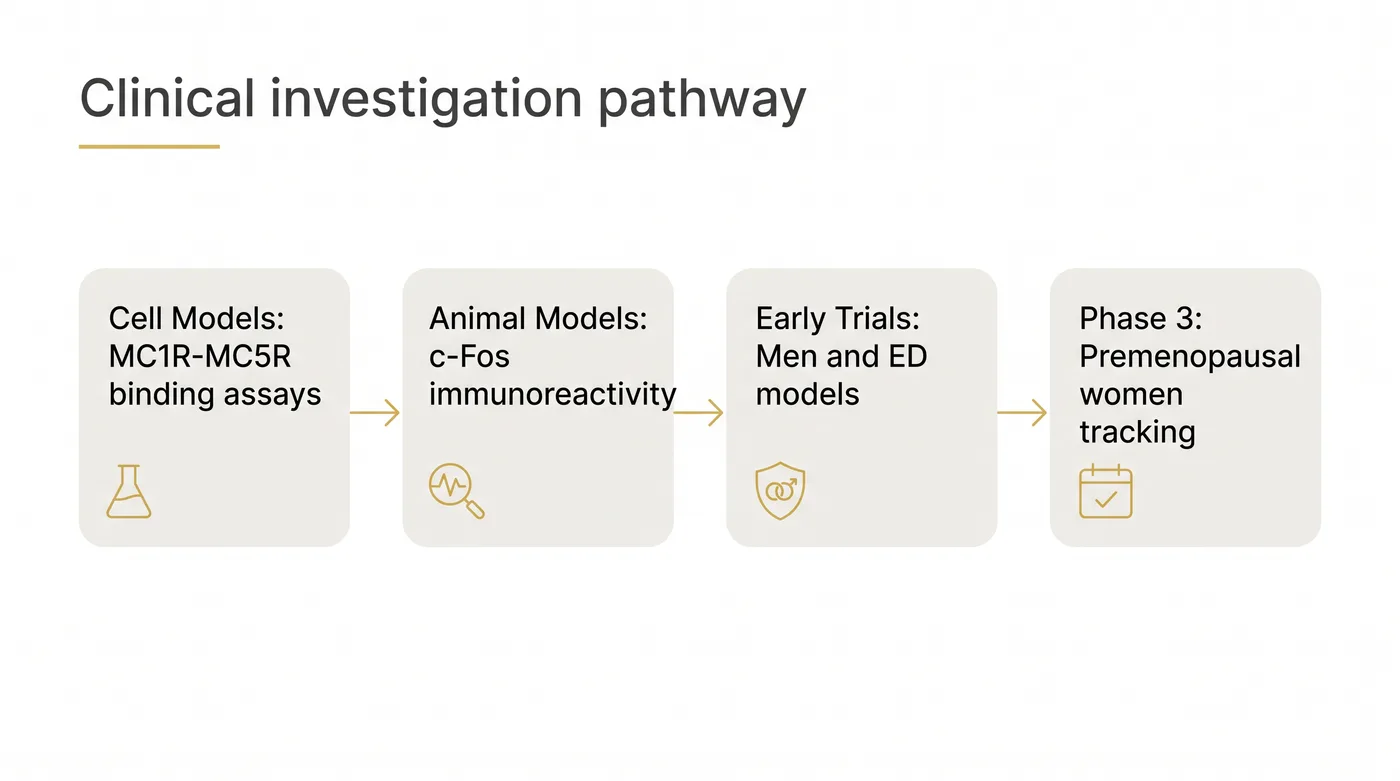
The formal investigation of PT-141 spans decades and encompasses multiple models of study. In laboratory cell models, researchers use receptor binding assays to determine its exact affinity across the entire human melanocortin receptor family, spanning from MC1R through MC5R. In animal testing, rodent studies have evaluated the peptide's effects on c-Fos immunoreactivity in hypothalamic neurons. This serves as a vital biological marker, allowing scientists to map the precise central nervous system receptor engagement in the brain.
Human research began with small-scale Phase 1 and Phase 2a clinical trials in men and men with mild-to-moderate erectile dysfunction, including patient populations that were previously unresponsive to sildenafil. These early investigations measured erectile responses in controlled environments while strictly monitoring cardiovascular changes, particularly blood pressure and heart rate fluctuations 3.
The focus eventually narrowed entirely to female patient populations. Phase 2b trials were conducted in premenopausal women with hypoactive sexual desire disorder (HSDD) and female sexual arousal disorder. These tracked sexual desire indices, arousal metrics, and satisfying sexual events. This laid the groundwork for the large Phase 3, double-blind, placebo-controlled RECONNECT studies. These large-scale trials tracked the change in specific clinical scoring indices following evaluation 1.
Where the human evidence stops
The internet is a machine for removing context, and sellers often extrapolate a single trial into a universal promise. The actual published evidence base has strict boundaries. Despite its initial testing in male populations, there is no large-scale, Phase 3 human evidence establishing a clinical profile in male erectile dysfunction or male sexual desire disorders.
Similarly, the extensive Phase 3 trials exclusively evaluated premenopausal populations. There is a distinct lack of Phase 3 clinical data establishing the compound's profile in postmenopausal women. The trials evaluated specific study parameters; there is no clinical data establishing a profile for daily or continuous evaluation.
Comparing the molecules: PT-141 vs Melanotan II
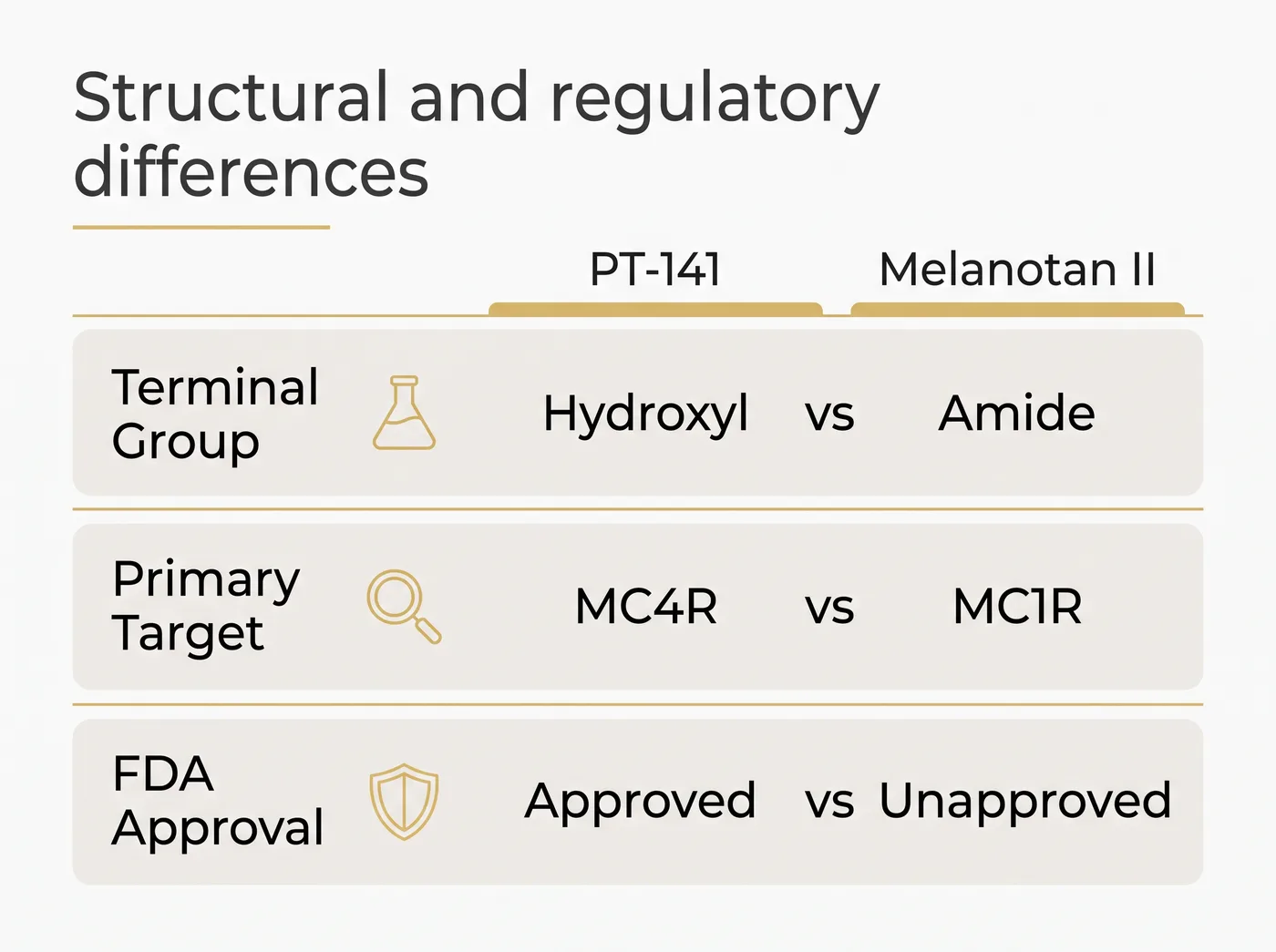
Because they share an academic lineage, PT-141 and Melanotan II are often confused in forum discussions. They are structurally related, but biologically and legally distinct. PT-141 is an active metabolite of Melanotan II. The concrete structural difference is that PT-141 lacks the C-terminal amide group present in its predecessor. It terminates with a hydroxyl group (-OH), whereas Melanotan II terminates with an amide group (-NH2) 5.
| Feature | PT-141 (Bremelanotide) | Melanotan II |
|---|---|---|
| Target Receptor | MC4R (Central Nervous System) | MC1R (Pigmentation) |
| Terminal Group | Hydroxyl (-OH) | Amide (-NH2) |
| FDA Status | Approved for specific populations | Unapproved |
Their targeted functions reflect this structural split. Melanotan II is a non-selective agonist that targets MC1R in melanogenesis research, and was subsequently investigated for secondary interactions involving systemic arousal. PT-141 was engineered specifically to bypass those pigmentation effects and selectively target the MC4R pathway. If you want to untangle their distinct receptor targets and trial records, read the full comparison of PT-141 and Melanotan II.
The regulatory realities could not be further apart. While bremelanotide successfully cleared full FDA clinical trials, Melanotan II has never cleared FDA review for any indication. It remains an unlicensed compound broadly associated with reports of rhabdomyolysis and renal infarction in medical literature 6. To look closer at the troubled clinical history and specific receptor pathways of the predecessor molecule, read the research profile of MT-2.
Regulatory status and the compounding rules
The legal status of research compounds is often a gray area of enforcement discretion, but bremelanotide represents a rare absolute clarity. The FDA granted formal approval in June 2019 for acquired, generalized hypoactive sexual desire disorder in premenopausal women under the generic name bremelanotide.
Because it holds this status, its position in the compounding pharmacy system is unique. Unlike many research peptides that must be formally nominated to the FDA's 503A Bulk Drug Substances List to be legally prepared, bremelanotide automatically qualifies. As the active pharmaceutical ingredient of an approved drug, it falls cleanly under Section 503A of the Food, Drug, and Cosmetic Act. For a clear look at how federal policy handles completely unapproved molecules, you can read about the 2026 regulatory status of DSIP.
This means it is fundamentally exempt from the FDA's recent Category 1 or Category 2 bulk peptide enforcement restrictions. Licensed compounding pharmacies can legally prepare it pursuant to a valid, patient-specific prescription. For researchers tracing the shifting policies surrounding synthetic compounds, understanding why specific molecules bypass these restrictions offers a window into how federal authorities prioritize established clinical data over gray-market availability.
Reading the laboratory data
A vial of white powder is an exercise in faith unless you know how to read the paperwork attached to it. A certificate of analysis is the only document that separates rigorous analytical chemistry from wishful marketing. When evaluating a research supplier, the purity must be verified by High-Performance Liquid Chromatography (HPLC), a process that acts like a highly sensitive race where every microscopic impurity is forced to cross the finish line in public.
Equally critical is mass spectrometry, which confirms the molecular weight matches the theoretical 1025.2 g/mol exactly. Without this step, a highly pure vial of the wrong substance will still look flawless on an HPLC chart. You must also check the measured mass. Because of the lyophilization process, a nominal 10 mg vial always requires slightly more raw material to account for the weight of bound water and counterions.
Precision is what you are paying for. For instance, testing for this specific catalogue item (Janoshik #99774) confirms a measured purity of 99.908%, with an actual measured mass of 11.67 mg per vial. You can verify these exact figures, check the current laboratory certificates, and review sourcing details directly at NuuVive's PT-141.
Questions
What kind of molecule is PT-141?
It is a synthetic, cyclic heptapeptide lactam. It belongs to the class of central melanocortin receptor agonists and is composed of a tightly folded seven-amino-acid chain.
Was it originally studied for skin pigmentation?
No, but its precursor was. Melanotan II was investigated as a pigmentation agent in the 1980s. PT-141 was subsequently developed as an active metabolite of that compound, engineered specifically to isolate its central nervous system interactions while discarding the pigmentation effects.
Is it completely FDA approved?
Yes, but only for a highly specific population. It holds full FDA approval under the generic name bremelanotide for premenopausal women with acquired, generalized hypoactive sexual desire disorder. It is not approved for men, postmenopausal women, or general use.
Does the HHS 503A policy restrict its availability?
No. Because bremelanotide is the active pharmaceutical ingredient of an already approved drug, it automatically qualifies as an eligible bulk drug substance. It bypassed the recent enforcement restrictions that impacted unapproved research peptides.
Sources
- Bremelanotide for the Treatment of Hypoactive Sexual Desire Disorder: Two Randomized Phase 3 Trials. National Library of Medicine
- pubchem.ncbi.nlm.nih.gov. National Library of Medicine
- pubmed.ncbi.nlm.nih.gov. National Library of Medicine
- pubmed.ncbi.nlm.nih.gov. National Library of Medicine
- pubchem.ncbi.nlm.nih.gov. National Library of Medicine
- pubmed.ncbi.nlm.nih.gov. National Library of Medicine