
Compounds explained
PT-141 vs Melanotan II: what are the differences?
NuuVive Journal · · 7 min read
Short answer
PT-141 (bremelanotide) is a direct metabolite of Melanotan II. While both are synthetic analogues of alpha-MSH, they have distinct chemical structures. Melanotan II terminates with an amide group and binds non-selectively to multiple melanocortin receptors. PT-141 terminates with a hydroxyl group and primarily targets the MC4R and MC1R receptors. PT-141 was investigated in Phase 3 clinical trials and approved by the FDA, whereas Melanotan II development was abandoned without Phase 3 trials or FDA approval.
Key takeaways
- PT-141 is a direct chemical derivative of Melanotan II, differing only by a hydroxyl group replacing the amide group at the molecular terminus.
- Melanotan II acts non-selectively across four different melanocortin receptors, while PT-141 has a targeted profile focused on MC4R and MC1R.
- PT-141 has been investigated in large-scale Phase 3 clinical trials, whereas Melanotan II human research is limited to early-stage pilot studies.
- PT-141 is the active ingredient in an FDA-approved prescription medication, while Melanotan II remains entirely unapproved.
- The FDA removed Melanotan II from compounding Category 2 in April 2026 solely because its nomination was withdrawn, not due to any regulatory approval.
The origin story of two related peptides
Look up these two compounds online and the search results quickly blur into a fog of identical-sounding claims. Sorting out the relationship between Melanotan II and PT-141 requires stepping away from the sellers' blogs and looking at the actual chemistry. They are intimately related, but their paths diverged entirely decades ago.
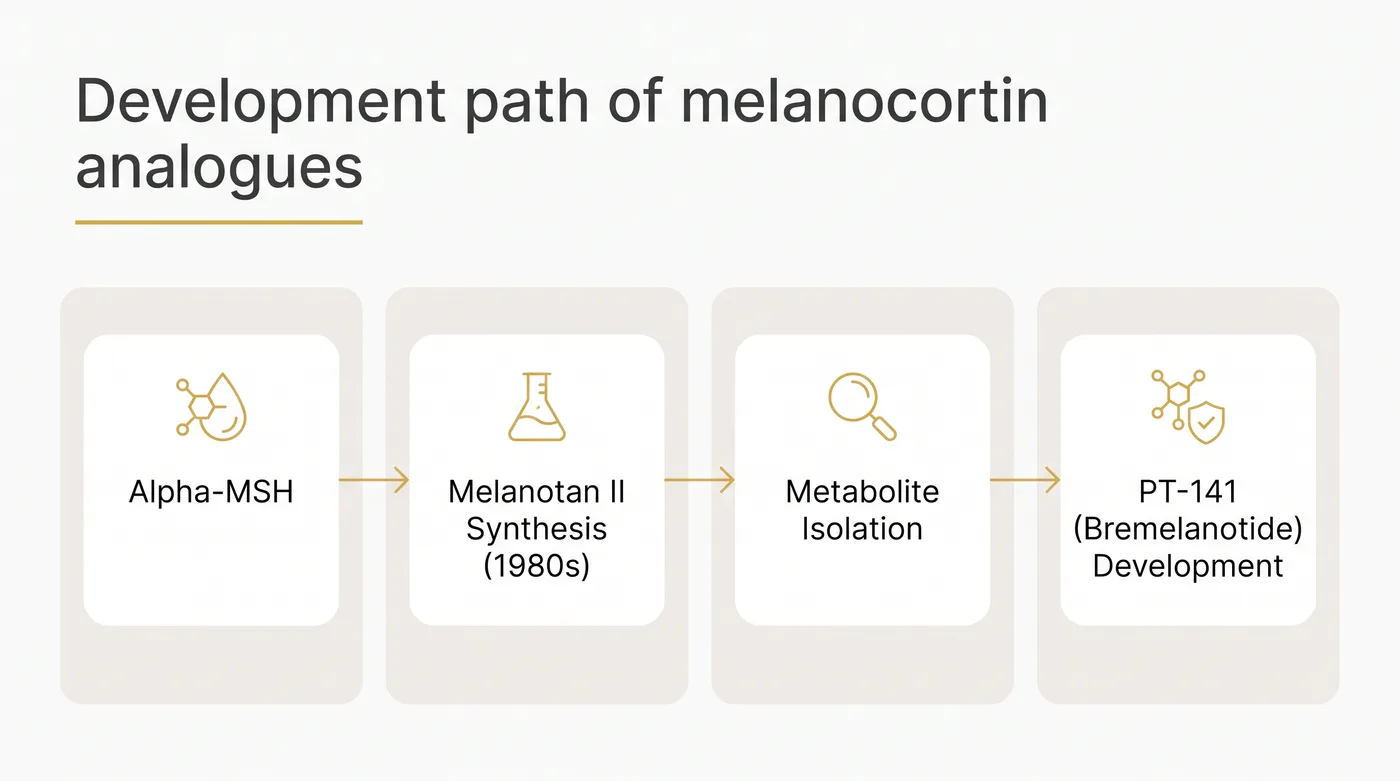
The story begins in the 1980s at the University of Arizona. Scientists there were working to develop synthetic analogues of a naturally occurring peptide called alpha-MSH. Their initial research objective was strictly cosmetic: they investigated the compound in models of pigmentation pathways. The resulting compound was Melanotan II.
During laboratory investigations of Melanotan II's melanogenesis properties, researchers observed that the compound interacted with systemic pathways far beyond pigmentation. However, the formal pharmaceutical development of Melanotan II was abandoned around the year 2000. It never progressed to late-stage clinical trials.
Instead of shelving the entire project, researchers isolated a specific direct metabolite of Melanotan II. This chemical derivative was named bremelanotide, known in laboratory settings as PT-141. In the early 2000s, PT-141 was developed to specifically target neurological pathways involved in sexual motivation, completely shifting away from the pigmentation focus of its predecessor. You can read more about the early days of these compounds in the guide to MT-2 (Melanotan II) identity: structure, molecular weight and form.
Structural differences at the molecular level
While PT-141 is born directly from Melanotan II, they are not the same molecule. The difference comes down to a single functional group at the end of the peptide chain, which fundamentally changes how the molecule interacts with receptor pathways.
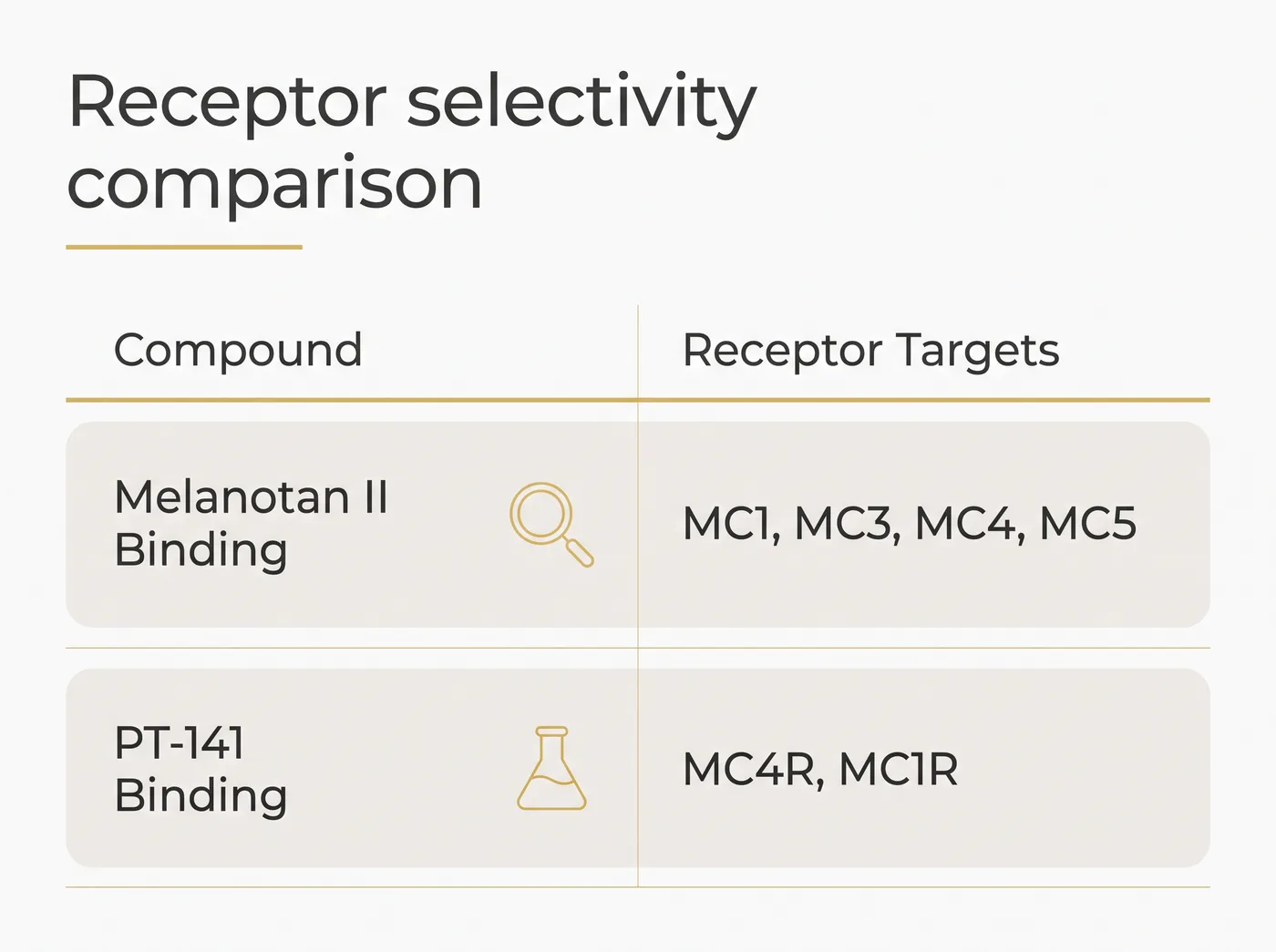
Melanotan II is a synthetic, cyclic peptide analogue of alpha-MSH. Its exact amino acid sequence is Ac-Nle-cyclo[Asp-His-D-Phe-Arg-Trp-Lys]-NH2. That "-NH2" at the end indicates it terminates with an amide group. It has a molecular weight of 1024.2 g/mol. Because of this specific structure, Melanotan II is a non-selective melanocortin receptor agonist. It binds broadly to the MC1, MC3, MC4, and MC5 receptors. In peptide chemistry, non-selective binding means the compound interacts with multiple different systems simultaneously.
PT-141 is a cyclic heptapeptide lactam analogue of alpha-MSH. Its sequence is identical to Melanotan II until the very end: Ac-Nle-cyclo[Asp-His-D-Phe-Arg-Trp-Lys]-OH. The molecular structure terminates with a hydroxyl group (-OH) instead of an amide. This tiny substitution shifts its molecular formula to C50H68N14O10 and its molecular weight to 1025.2 g/mol.
That single structural change narrows the compound's focus. PT-141 possesses a targeted receptor profile, primarily binding to the MC4R receptors located in the central nervous system, alongside MC1R receptors. It does not bind broadly across the entire melanocortin family like its predecessor. If you are curious how other related compounds compare in the lab, check out the structural differences between sermorelin and tesamorelin.
| Feature | Melanotan II | PT-141 |
|---|---|---|
| Molecular Terminus | Amide group (-NH2) | Hydroxyl group (-OH) |
| Molecular Weight | 1024.2 g/mol | 1025.2 g/mol |
| Receptor Profile | Non-selective (MC1, MC3, MC4, MC5) | Targeted (MC4R, MC1R) |
| Development Origin | University of Arizona (1980s) | Metabolite isolated from MT-II |
What Melanotan II has been studied for
Because Melanotan II was abandoned early in its pharmaceutical lifecycle, the published research surrounding it is exceptionally limited. It has been investigated in cell cultures and in vivo animal models of melanogenesis, the process of melanin production.
In human subjects, Melanotan II has only been evaluated in early-stage, small-scale pilot studies. These initial investigations typically involved groups as small as 3 to 10 participants. A sample size of ten is a dinner party, not a strict clinical baseline. Researchers evaluated its interactions with sexual dysfunction pathways in these tiny cohorts, but the data never progressed beyond these initial pilot investigations.
When you encounter claims about Melanotan II's definitive mechanisms or long-term human viability, you are reading marketing copy, not scientific literature. The formal research stops squarely at early exploratory data. If you want the straightforward timeline of those investigations, dive into the guide on what Melanotan II has been studied for.
What PT-141 has been studied for
PT-141 has a starkly different research pedigree. It was the subject of the RECONNECT clinical trial program, which included Study 301, Study 302, and a 52-week open-label extension phase. These were Phase 3 randomized, double-blind, placebo-controlled multicenter trials. For a look at how another compound progressed through clinical investigations, read the research profile of tesamorelin.
In these massive studies, PT-141 was investigated in premenopausal women with acquired, generalized hypoactive sexual desire disorder (HSDD). Researchers evaluated parameters including changes in patient-reported sexual desire, distress related to low sexual desire, and the number of satisfying sexual events. This represents the gold standard of clinical evidence gathering.
Earlier in its development lifecycle, PT-141 was also studied in animal models evaluating dopamine brain centres. It was further investigated in small human studies involving men with erectile dysfunction who did not respond to PDE5 inhibitors. You can explore the timeline of these trials in the overview of What is PT-141? The research and regulatory facts.
The FDA status and compounding rules
The regulatory realities of these two compounds are entirely distinct. Bremelanotide (PT-141) successfully cleared the rigorous hurdles of the FDA drug pathway. It received formal FDA approval in 2019. The approval is specifically indicated for acquired, generalized HSDD in premenopausal women. It is not approved for men.
Because bremelanotide is the active component of an FDA-approved drug, it holds a specific status in the compounding pharmacy world. It does not appear on the FDA's 503A bulk drug substances list. Compounding pharmacies are legally permitted to compound it only when stringent federal criteria applicable to components of approved drugs are met, alongside state-law and strict prescription requirements.
Melanotan II is not approved by the FDA for any medical or cosmetic condition. Under the HHS and FDA Section 503A bulk drug substances policy, it is not an authorized bulk drug substance for compounding. Previously, the FDA had placed Melanotan II in Category 2, a list designating substances identified as presenting significant risks.
On April 22, 2026, the FDA removed Melanotan II from Category 2. Sketchy sellers often spin this as a victory, but the reality is mundane: the original nominators voluntarily withdrew their nominations. The administrative removal occurred without any new data or agency approval. Melanotan II remains entirely ineligible for compounding and is currently scheduled for a formal review by the Pharmacy Compounding Advisory Committee (PCAC) before the end of February 2027.
Reading the lab reports
When researchers source a compound like PT-141, the supplier's word is meaningless without a third-party laboratory certificate of analysis (CoA). A valid CoA is the vial's passport. It tells you exactly what is inside the lyophilized powder and what is not.
The first figure to check on a lab report is the HPLC purity. High-Performance Liquid Chromatography is essentially a microscopic race where every impurity has to cross the finish line in public. For a laboratory-grade compound with the CAS identifier 189691-06-3, the purity must strictly exceed 99%. A standard specification for a high-quality synthesis is ≥99%.
The second figure is the measured net peptide content. This tells you the actual mass of the target molecule inside the vial, completely separate from the salts and moisture left over from the synthesis process. If a report lacks this quantitative measurement, you are looking at an incomplete document. A rigorous analytical test will list the exact milligram count alongside the purity figure.
At NuuVive, every batch is independently analysed before it reaches the catalogue. You can verify the current measured net content (11.67 mg in a nominal 10 mg vial) and the absolute purity (99.908%, Janoshik report #99774) by checking the documentation on NuuVive's PT-141.
Questions
What does PT-141 stand for?
PT-141 is the original laboratory designation given to the compound bremelanotide during its initial isolation and development. The alphanumeric code stuck in research literature and supplier catalogues, even after it received an International Nonproprietary Name (INN).
Is Melanotan II an approved drug?
No. Melanotan II has never received FDA approval for any purpose. Its formal pharmaceutical development was abandoned roughly two decades ago without completing late-stage human clinical trials.
Can compounding pharmacies make Melanotan II?
No. Melanotan II is not an authorized bulk drug substance under the FDA's Section 503A policy. It was recently removed from Category 2 due to a withdrawn nomination, but it remains ineligible for compounding and faces a Pharmacy Compounding Advisory Committee review by early 2027.
Why is the molecular weight of PT-141 different from Melanotan II?
The difference in molecular weight (1025.2 g/mol for PT-141 versus 1024.2 g/mol for Melanotan II) corresponds exactly to the structural change at the end of the peptide chain. PT-141 replaces the amide group of Melanotan II with a heavier hydroxyl group.
Sources
- Frontiers | Clinical trial evidence on emerging pharmacological therapies for hypoactive sexual desire disorder in women: a systematic review and analysis of completed studies registered on ClinicalTr. Frontiers
- pubchem.ncbi.nlm.nih.gov. National Library of Medicine
- "Melanotan II" AND review - Search Results. National Library of Medicine
- pubchem.ncbi.nlm.nih.gov. National Library of Medicine