
Compounds explained
What is NAD+? What it has been studied for
NuuVive Journal · · 6 min read
Short answer
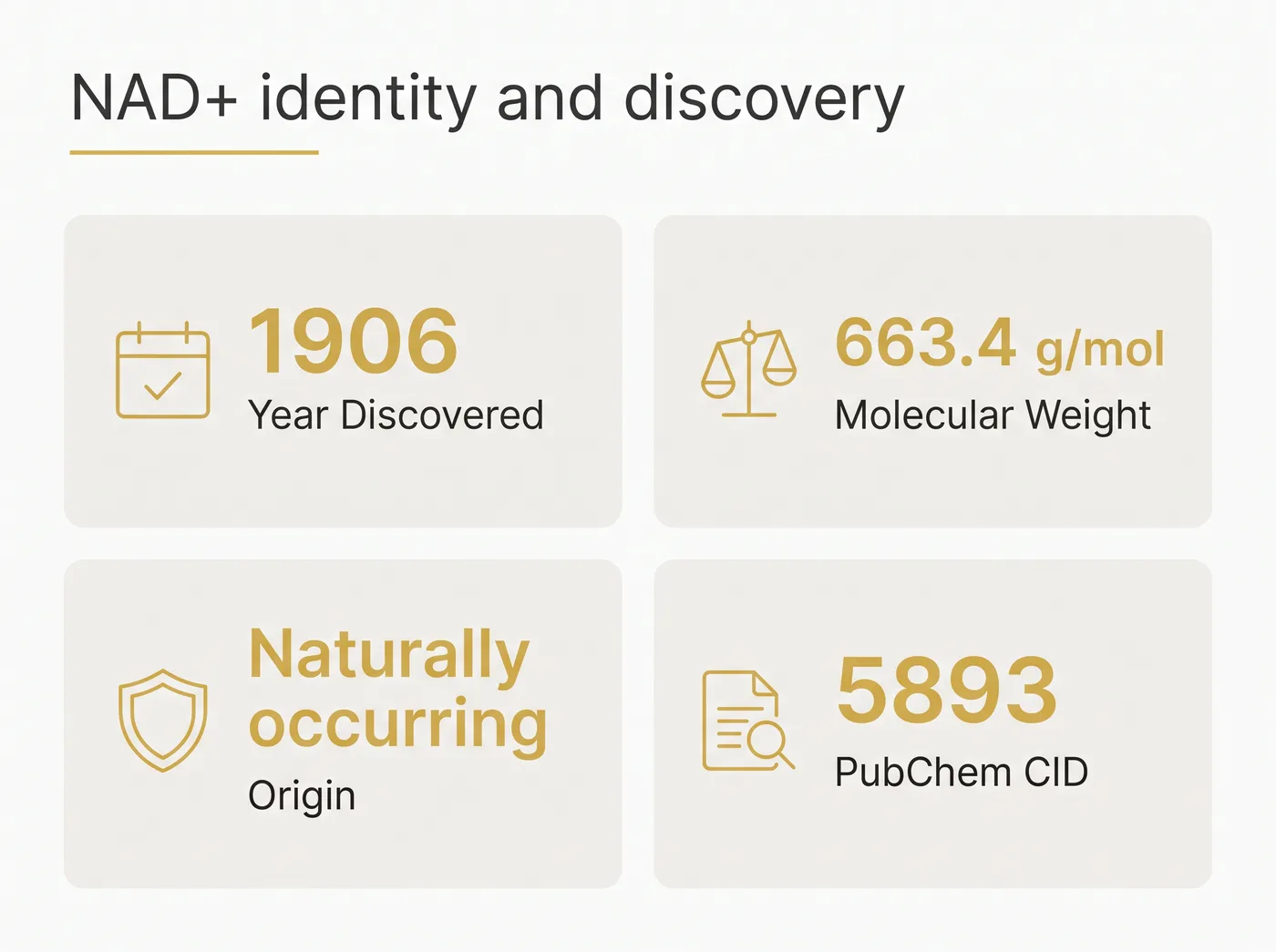
Nicotinamide adenine dinucleotide (NAD+) is a naturally occurring dinucleotide coenzyme found in all living cells. First discovered in yeast extracts in 1906, it functions biochemically as an electron acceptor in cellular metabolism. It has been extensively studied in cell and animal models investigating mitochondrial function, DNA repair, and cellular senescence. While oral precursors have seen human trials, there are currently no large-scale, published clinical trials validating direct NAD+ evaluation in humans, and it is not an FDA-approved drug.
Key takeaways
- NAD+ is a naturally occurring dinucleotide coenzyme that plays a mandatory role in cellular energy metabolism research.
- First discovered in 1906, it has been studied extensively in animal models of mitochondrial function and cellular senescence.
- There are currently no large-scale published human trials confirming the outcomes of direct NAD+ evaluation in trial participants.
- The compound sits in 503A Category 1 under the FDA's interim enforcement discretion compounding policy.
- A valid lab report for NAD+ must show high purity via chromatography and an exact mass spectrometry weight of 663.4 g/mol.
The 1906 discovery: from "coferment" to cellular engine
Search for NAD+ online and you are immediately buried in a digital avalanche of flashy marketing. Step away from the noise, however, and you find a much older, quieter story. Nicotinamide adenine dinucleotide (NAD+) is not a modern biotech invention. It is a fundamental dinucleotide coenzyme present in all living cells, synthesised from scratch using amino acids like tryptophan or salvaged from vitamin B3 precursors like niacin and nicotinamide National Library of Medicine.
British biochemists Arthur Harden and William John Young stumbled upon it in 1906 while poking around yeast extracts in a laboratory. They noticed a heat-stable fraction that vastly accelerated alcoholic fermentation. Not knowing exactly what they had isolated, they called it a "coferment." Years passed before subsequent researchers, notably Hans von Euler-Chelpin, to map its chemical structure and realise it was the central axis of cellular metabolism. At 663.4 g/mol, it is a heavy, complex molecule, a far cry from the simple synthetic fragments that dominate modern catalogues. It consists of two nucleotides joined through their phosphate groups, with one containing an adenine nucleobase and the other a nicotinamide base.
What has NAD+ been studied for?
Researchers have spent decades putting NAD+ through its paces in cell cultures and rodent models. The primary targets of this research are cellular energy metabolism, specifically glycolysis and the tricarboxylic acid pathway, alongside mitochondrial function and oxidative stress regulation National Library of Medicine. Readers curious about other compounds evaluated for mitochondrial function should also explore the SS-31 research and regulatory facts.
In these preclinical models, scientists investigate NAD+ as a mandatory substrate for a specific class of enzymes. Sirtuins, poly(ADP-ribose) polymerases (PARPs), and CD38 all require NAD+ to function. These enzymes are the subjects of intense study in the fields of DNA repair, epigenetic regulation, and cellular senescence. Animal models frequently observe the biochemical changes that occur when NAD+ levels are studied in rats bred to model neurodegeneration or metabolic dysfunction. If those cellular senescence models catch your eye, you might also enjoy the plain English guide to Epitalon.
You might also see it investigated alongside other mitochondria-targeted research compounds like SS-31, as laboratories attempt to map exactly how cellular respiration degrades over time. But notice the venue: these are rats, mice, and laboratory cell lines, not human subjects. The preclinical data is vast, but it remains confined to animal research. If mitochondrial targets are your primary focus, you may also want to review the MOTS-c research profile.
The human evidence gap
This is where the grand promises of commercial marketing collide with the quiet reality of clinical data. There are currently no large-scale, published, randomised controlled human trials confirming that direct evaluation of NAD+ changes anything regarding energy levels, cognition, or cellular senescence outcomes in trial participants. Long-term human clinical data evaluating the finished coenzyme simply do not exist yet.
When you look at the clinical trial registries, the studies you find are almost entirely focused on oral NAD+ precursors like nicotinamide riboside or nicotinamide mononucleotide, not the finished coenzyme itself. For example, a recent phase 1 trial was set up to evaluate the extracellular concentration of NAD+ in human plasma after participants were given an oral precursor clinicaltrials.gov. Other registered trials use magnetic resonance spectroscopy to measure tissue levels. The evidence base for the direct compound remains strictly preliminary, and it is honest to say the marketing has outrun the science by miles. If a vendor implies that human trials have settled the science on direct NAD+ evaluation, they are inventing data.
NAD+ vs NADH: Two sides of the same shuttle
If you spend enough time looking at metabolic pathways, you will see NADH mentioned in the same breath. While NAD+ and NADH are two forms of the exact same molecule, they operate on opposite sides of a continuous cellular redox pathway National Library of Medicine.
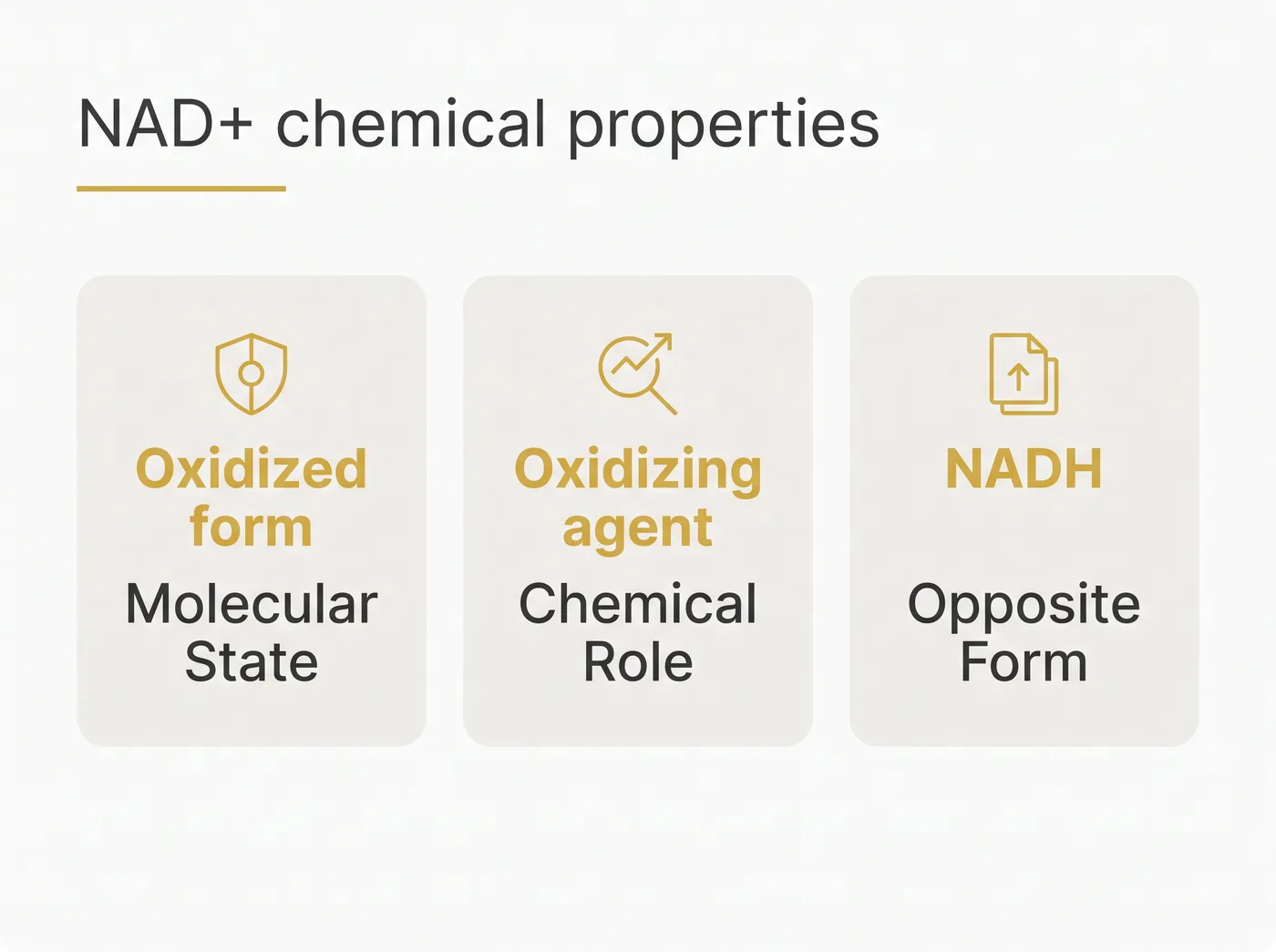
Think of the molecule as a microscopic transport shuttle. NAD+ is the oxidized form. Its specific chemical role is to act as an oxidizing agent, meaning it accepts electrons and a hydrogen ion during cellular metabolic reactions, such as the breakdown of glucose. It is the empty shuttle, waiting at the platform.
Once it accepts those electrons, it converts into NADH, the reduced form. NADH acts as a metabolic reducing agent, carrying and donating those captured electrons to the mitochondrial electron transport chain. That delivery is a mandatory step for the production of adenosine triphosphate (ATP). The shuttle arrives full, drops off its passengers, and reverts to NAD+. The two molecules are locked in a constant loop, driving the engines of cellular respiration.
| Feature | NAD+ | NADH |
|---|---|---|
| Molecular State | Oxidized form | Reduced form |
| Chemical Role | Oxidizing agent (accepts electrons) | Reducing agent (donates electrons) |
| Analogy | Empty shuttle ready for passengers | Full shuttle delivering to mitochondria |
| PubChem CID | 5893 | 439153 |
The FDA, compounding, and legal status
None of this biochemical pedigree makes NAD+ an approved drug. It holds no FDA approval for any medical indication. The agency has never evaluated a manufactured NAD+ drug product for manufacturing quality or clinical parameters.
Because there is no commercially approved drug, some pharmacies compound it. This introduces the framework of federal regulation. As of the FDA's updated 2026 bulk drug substances materials, nicotinamide adenine dinucleotide sits in 503A Category 1. This category covers bulk drug substances nominated for compounding that are currently under evaluation.
Under a January 2025 interim enforcement discretion policy, the FDA generally does not intend to initiate enforcement action against licensed 503A pharmacies compounding with Category 1 substances, provided they meet strict conditions like state-law compliance and sterile preparation standards. NAD+ is absent from the 503B list, meaning large-scale outsourcing facilities generally cannot compound it. It occupies a very specific, tightly bound legal grey area that separates small compounding pharmacies from commercial manufacturers.
How to read an NAD+ lab report
When a complex molecule is synthesised for laboratory use, things can easily go wrong. A supplier might ship a degraded batch, a mislabelled vial, or a powder padded with unknown fillers. The only defence a buyer has is a third-party Certificate of Analysis (CoA).
A proper lab report centres on high-performance liquid chromatography (HPLC). A chromatogram is essentially a public race where every impurity has to cross the finish line for everyone to see. You are looking for a single, sharp peak representing the target compound, with an area calculating the purity percentage. If the graph looks like a jagged mountain range, the synthesis was sloppy.
Mass spectrometry (MS) is the second half of the equation. It weighs the molecules in the vial. For NAD+, the mass spectrometry result must show a molecular weight matching 663.4 g/mol. If the weight is wrong, the vial does not contain NAD+. Always verify that the lot number on the vial exactly matches the lot number on the lab report, and check the documentation carefully to ensure the testing facility actually exists. For a baseline of what precise testing looks like, you can review the current purity figures, measured batch reports, and inventory for NuuVive's NAD+.
Questions
Is NAD+ an FDA-approved medication?
No. There are no FDA-approved NAD+ drug products for any medical indication. The agency has never evaluated it for clinical use or manufacturing quality.
Where does NAD+ come from in research settings?
While it is naturally synthesised in human cells from amino acids or vitamin B3 precursors, the compound used in laboratory research is synthesised or extracted specifically for experimental use.
Can outsourcing facilities compound NAD+?
Generally, no. It does not appear on the FDA's 503B bulk drug substances list, meaning 503B outsourcing facilities are restricted from compounding it, though it sits in Category 1 for 503A pharmacies.
What is the molecular weight of NAD+?
The molecular weight of NAD+ is 663.4 g/mol. A third-party mass spectrometry report should reflect this exact mass to confirm the compound's identity.
Sources
- NAD+ metabolism and its roles in cellular processes during ageing. National Library of Medicine
- ClinicalTrials.gov. clinicaltrials.gov
- pubchem.ncbi.nlm.nih.gov. National Library of Medicine
- pubchem.ncbi.nlm.nih.gov. National Library of Medicine