
Compounds explained
What Epitalon is and what it has been studied for
NuuVive Journal · · 6 min read

Short answer
Epitalon (or epithalon) is a synthetic tetrapeptide consisting of four amino acids (Ala-Glu-Asp-Gly). It was developed by Russian researchers as a laboratory-made analog to epithalamin, a crude natural extract from the bovine pineal gland. Over the last 25 years, it has been primarily studied in cell and animal models for its role in cellular aging, telomerase expression, and circadian rhythms, though it remains an unapproved experimental compound lacking large-scale human clinical trials.
Key takeaways
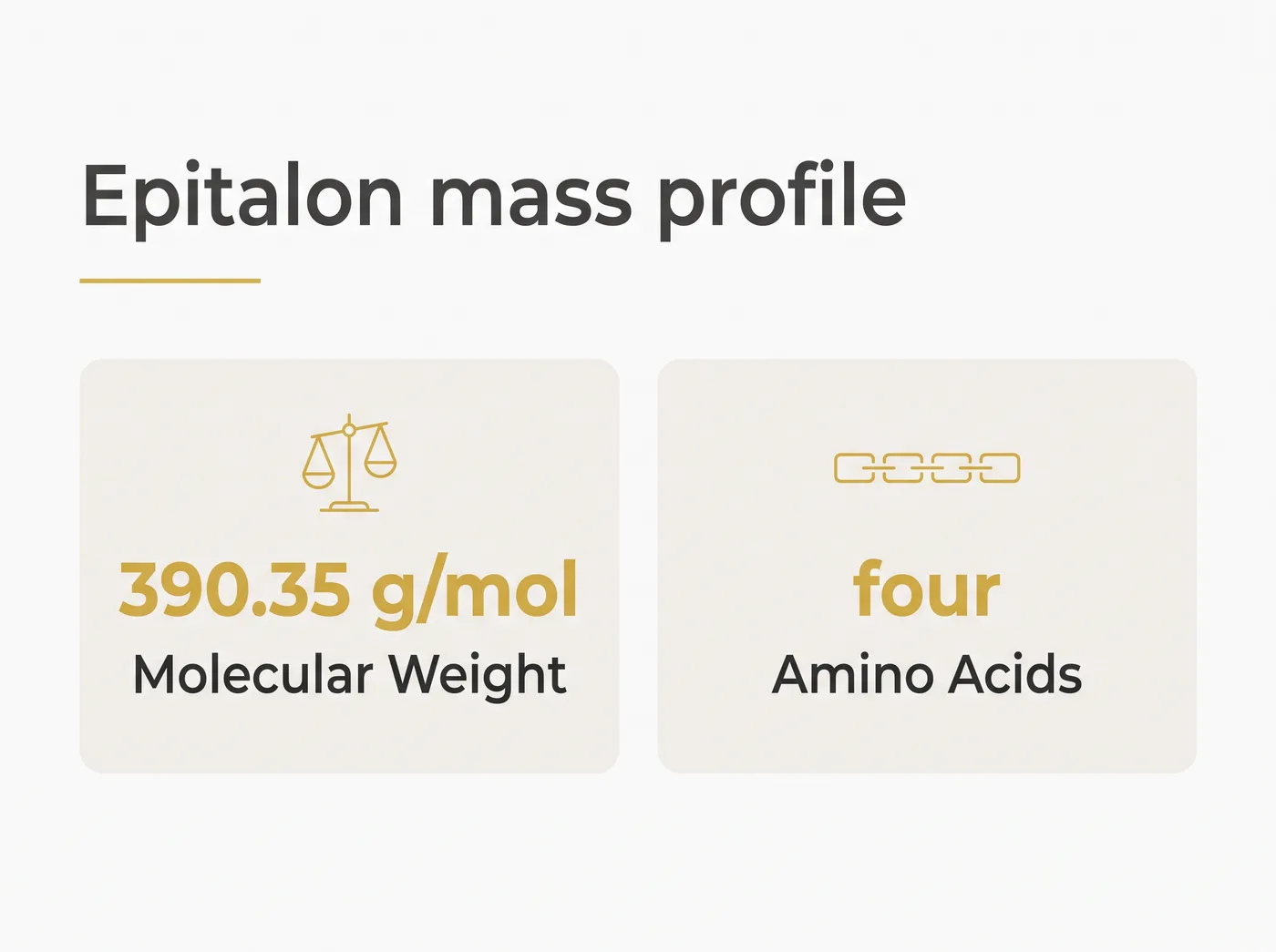
- Epitalon is a synthetic sequence of four amino acids (Ala-Glu-Asp-Gly) with a molecular weight of 390.35 g/mol.
- It was designed to mimic the biological profile of a crude bovine pineal extract called epithalamin.
- Research has focused on cellular models of telomere length and animal models of circadian rhythms.
- The compound lacks independent human trials and is not an FDA-approved drug.
- A late 2026 HHS policy allows specific pharmacy compounding of the acetate form under strict conditions.
The extract and the isolate
Look up this compound online and you will likely encounter a fog of exaggerated longevity claims and aggressive marketing. The reality is much more mundane, but arguably more interesting: a quarter-century scientific pursuit by one specific research team attempting to replicate the properties of a mammalian gland extract.
Epitalon is a synthetic tetrapeptide, which simply means it is a chain built of exactly four amino acids: alanine, glutamic acid, aspartic acid, and glycine, or Ala-Glu-Asp-Gly National Library of Medicine. It is categorized by researchers as a putative telomerase activator and a peptide bioregulator. To see how scientists classify a slightly longer synthetic chain, you can review the structure and evidence base of Semax.
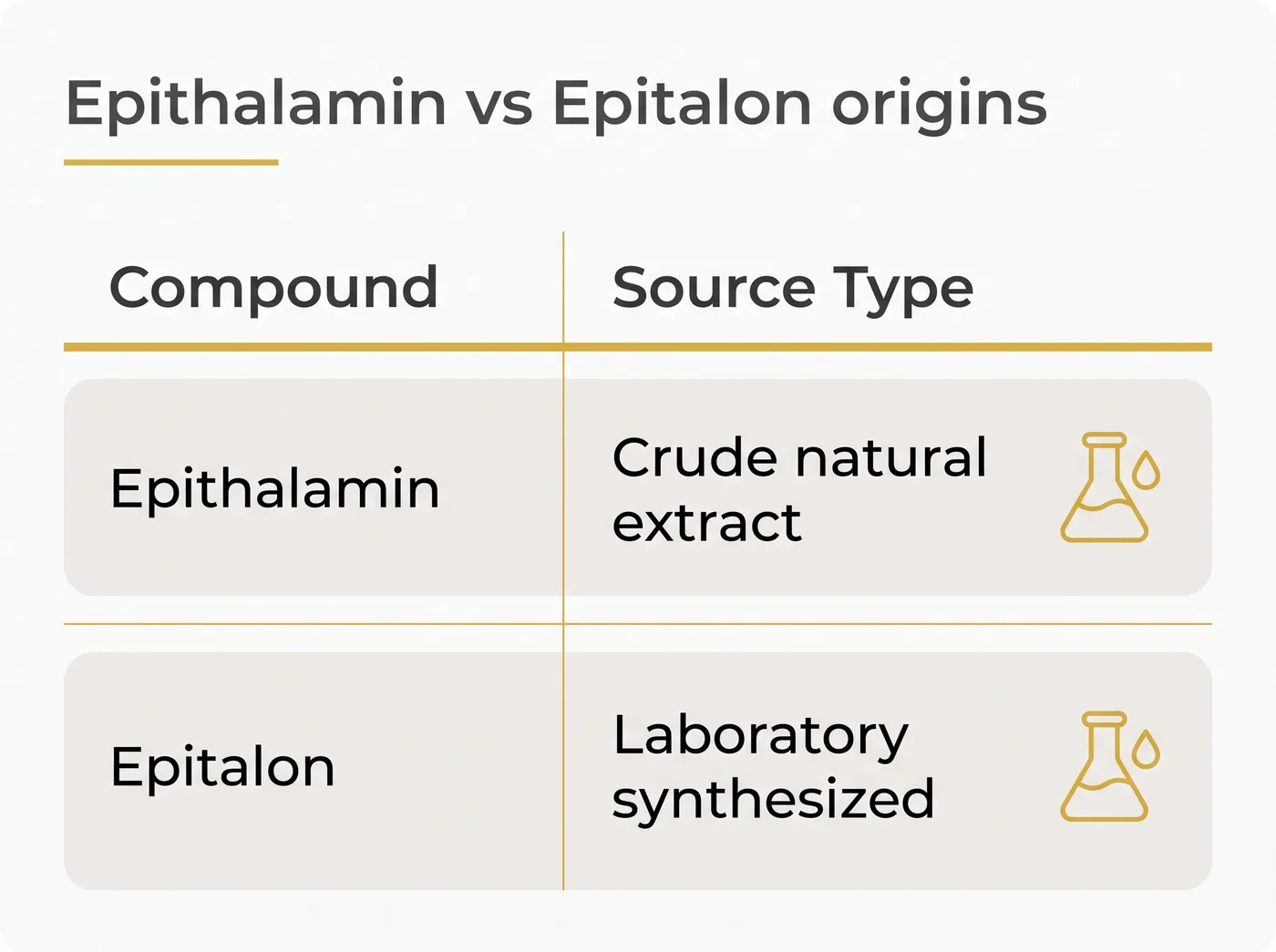
The story begins in 1973, when Russian researchers first described a crude polypeptide mixture extracted from the pineal glands of cattle, which they named epithalamin. Working with animal extracts is a notoriously messy business. Because an extract is a complex biological mixture, its exact composition varies wildly from batch to batch, making precision science difficult. To solve this, researchers eventually synthesized Epitalon in the laboratory National Library of Medicine.
| Feature | Epithalamin | Epitalon |
|---|---|---|
| Origin | Crude natural extract | Laboratory synthesized |
| Source | Bovine pineal glands | Chemical synthesis |
| Composition | Complex mixture of polypeptides | Single molecule (four amino acids) |
| Standardization | Highly variable between extractions | Exact structural consistency |
By engineering a single isolate, the researchers eliminated the impurities and sourcing variables of the crude cow extract. What remains is a clean, precisely measurable molecule that has fueled decades of continuous preclinical investigation.
What Epitalon has been studied in
The overwhelming majority of published literature on Epitalon originates from the St. Petersburg Institute of Bioregulation and Gerontology. This research has heavily focused on cellular biology, the neuroendocrine system, and circadian rhythms National Library of Medicine.
In isolated cellular models, researchers have evaluated the peptide in human fetal fibroblast cultures, looking specifically at its capacity to induce telomerase expression. Telomeres are the protective caps at the ends of DNA strands, and researchers observed these cell cultures to see if the compound allowed them to bypass the normal limits of cellular division. Further *in vitro* studies investigated bovine cumulus cells, human lymphocytes, and human embryonic thymic cells.
Animal models have provided the bulk of the *in vivo* data. Researchers have studied Epitalon in aging rhesus macaques, measuring variables like evening melatonin synthesis and circadian cortisol rhythms. Other extensive studies on aging rats, mice, and fruit flies examined the subjects under constant illumination and other controlled lighting conditions. Additionally, researchers investigated the compound in chickens to observe morphological changes in the thymus and thyroid glands National Library of Medicine.
Beyond the animal data, there is a very narrow slice of human data. Researchers have conducted physiological biomarker studies on blood drawn from small cohorts of patients aged 60 to 80, primarily to measure telomere lengths. One older, small-scale clinical trial also evaluated Epitalon in patients with the eye condition retinitis pigmentosa. You can read more about how scientists map these domains in the guide to how peptides are studied.
The gap in human evidence
If you are waiting for a massive, multi-center, randomized clinical trial investigating this compound in humans, you should get comfortable. The quiet truth about Epitalon is that it entirely lacks independent validation by Western researchers. To compare this with a molecule that actually reached human trials for sepsis, you can read the clinical research profile of Thymosin alpha-1.
Despite a massive online reputation in certain subcultures, there is no adequately powered, placebo-controlled clinical trial investigating Epitalon in the context of biological aging or musculoskeletal tissue. The human pharmacokinetic data simply do not exist in the published record. For a look at a peptide that has actually progressed into clinical trials, review the research and regulatory facts of SS-31.
This gap was highlighted starkly during recent regulatory reviews. For example, despite widespread anecdotal chatter about using the peptide for sleep, FDA staff reviewers noted an absolute lack of human trials evaluating Epitalon for insomnia. This means there is no published data using polysomnography, validated sleep questionnaires, or actigraphy U.S. HHS. It is a textbook example of laboratory curiosity running far ahead of clinical evidence.
The FDA and the 2026 HHS policy
Epitalon is not an FDA-approved drug. It holds no New Drug Application (NDA), and it lacks a United States Pharmacopeia (USP) monograph. For years, this meant it sat completely outside the established pathways for human prescription or pharmacy compounding. If you want to see how the rules apply to a very different synthetic molecule, you can review the research and regulatory facts of PT-141.
That regulatory framework experienced a tectonic shift in July 2026. The FDA's Pharmacy Compounding Advisory Committee (PCAC) reviewed Epitalon for potential inclusion on the Section 503A bulk drug substances list. Defying agency staff reviewers, who repeatedly raised concerns about the complete lack of clinical data and potential immunogenicity, the committee voted 7-5-1 to recommend adding it to the list U.S. HHS.
An advisory vote does not make a compound legal; it merely starts a long bureaucratic clock. However, in October 2026, the HHS published an interim enforcement discretion policy. Under this specific framework, federal regulators announced they do not intend to pursue enforcement action against state-licensed pharmacies compounding the acetate form of Epitalon, provided it is for a specific patient prescription and meets strict sourcing rules.
Reading the lab report
When a compound has no commercial pharmaceutical manufacturer, the burden of verifying its identity falls entirely on independent analytical laboratories. A vendor's word is meaningless; the only thing that matters is the data printed on a Certificate of Analysis (CoA).
The first step in verification is mass spectrometry. This instrument measures the molecular weight of the substance in the vial. For the free base form of Epitalon, the molecular weight must register exactly at 390.35 g/mol National Library of Medicine. If the mass is off, the sequence is wrong, and the vial contains a different molecule entirely.
The second step is High-Performance Liquid Chromatography (HPLC), which determines purity. Think of a chromatogram as a race where every impurity is forced to cross a finish line in public. You want to see one massive, singular peak indicating the target peptide, with virtually no noise or secondary spikes trailing behind it. Without a traceable, third-party lab test confirming both identity and purity, a vial is just mystery powder.
Every batch requires its own documentation. For an example of rigorous, verifiable testing, you can review the current Janoshik report for NuuVive's Epitalon, which confirms ≥99% purity (specifically 99.154%, Janoshik #99782) and a measured amount of 10.73 mg per vial.
Questions
Is Epitalon an FDA-approved drug?
No. It is an unapproved experimental compound. While a 2026 HHS policy allows for specific pharmacy compounding of the acetate form under strict conditions, this is an exercise of enforcement discretion and does not equal FDA approval.
What is the difference between Epitalon and epithalamin?
Epithalamin is a crude, natural polypeptide mixture extracted from bovine pineal glands. Epitalon is a laboratory-synthesized isolate consisting of a single molecule made of exactly four amino acids, designed to mimic the extract without the impurities.
Why is it sometimes referred to as the AEDG peptide?
AEDG is the shorthand for its amino acid sequence. The letters stand for the four amino acids that make up the chain: Alanine (A), Glutamic acid (E), Aspartic acid (D), and Glycine (G).
Where does the research on Epitalon come from?
The vast majority of the published preclinical literature over the last 25 years originates from the St. Petersburg Institute of Bioregulation and Gerontology in Russia. There has been very little independent replication of these studies by Western research institutions.
Sources
- pubchem.ncbi.nlm.nih.gov. National Library of Medicine
- pmc.ncbi.nlm.nih.gov. National Library of Medicine
- hhs.gov. U.S. HHS