
Compounds explained
BPC-157 vs TB-500: what is the difference?
NuuVive Journal · · 5 min read
Short answer
BPC-157 is a 15-amino-acid synthetic sequence derived from a human gastric juice protein, while TB-500 is a 7-amino-acid synthetic fragment of the naturally occurring protein thymosin beta-4. They are studied for entirely different mechanisms: BPC-157 is investigated for its role in growth factor and nitric oxide pathways, whereas TB-500 is studied as an actin-binding motif that modulates the cellular cytoskeleton. Both are unapproved substances.
Key takeaways
- BPC-157 is a 15-amino-acid sequence based on a protein isolated from human gastric juice in the early 1990s.
- TB-500 is a 7-amino-acid fragment designed to mimic the actin-binding section of a much larger 43-amino-acid protein called thymosin beta-4.
- Laboratory research on BPC-157 focuses on growth factor pathways and nitric oxide signalling, while TB-500 research models target cellular cytoskeleton modulation.
- Neither compound is approved by the FDA for human use, and both appear on the World Anti-Doping Agency prohibited list.
- As of late 2026, an interim policy by the US Department of HHS outlines when compounding pharmacies may supply these specific peptides.
Origins and structural blueprints
Spend five minutes reading about peptide research and you will invariably find these two names mentioned in the same breath. Sellers bundle them, forums debate them, and marketing blogs present them as two sides of the exact same coin. But look at their chemical blueprints and you will find two completely unrelated molecules with different origins, different sizes and entirely different targets under a microscope. For a look at another pair that sellers constantly group together, read about the structural differences between CJC-1295 and ipamorelin.
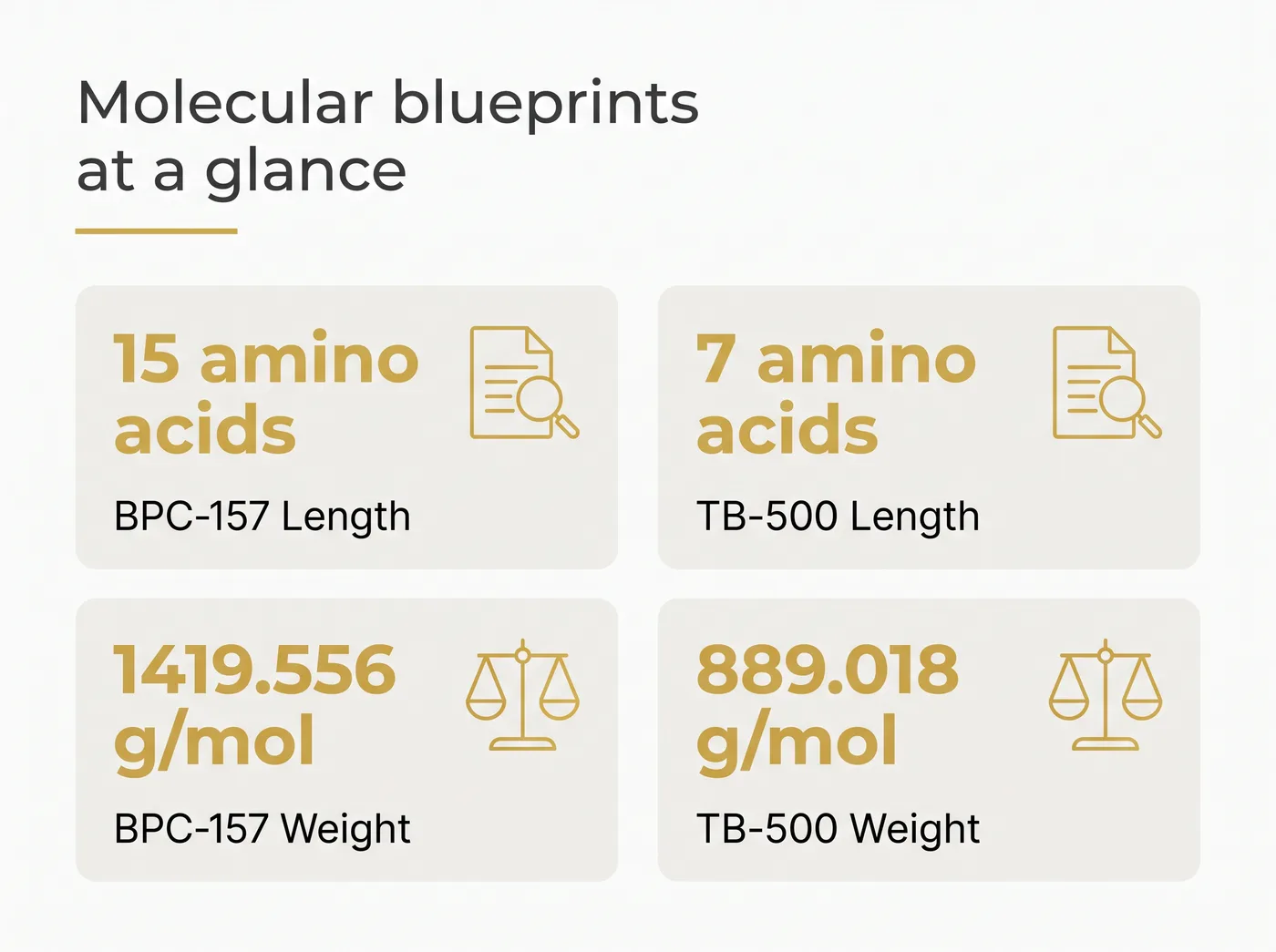
The first compound, BPC-157, is a synthetic 15-amino-acid sequence (a pentadecapeptide). It was first isolated and described in 1993 by researchers at the University of Zagreb School of Medicine. The sequence is derived from a naturally occurring protein found in human gastric juice, giving it a molecular weight of 1419.556 g/mol 5. It is a standalone sequence built from the ground up for laboratory study.
TB-500 has a very different backstory. It is a tiny synthetic fragment containing just seven amino acids, with a molecular weight of 889.018 g/mol 6. It was synthesised to isolate one highly specific active domain (amino acids 17 through 23) of a much larger, 43-amino-acid protein called thymosin beta-4. That parent protein is endogenous and ubiquitous, meaning it is naturally found in almost all human and animal tissues, particularly concentrated in platelets. For another look at a naturally occurring human sequence, check out the research history of GHK-Cu.
How their targets differ in the lab
When chemists and cellular biologists study these compounds in vitro, they are looking for completely different mechanisms of action. BPC-157 is primarily evaluated for its interaction with growth factor pathways. Researchers study how it targets the VEGFR2-Akt-eNOS pathway and measures its influence on nitric oxide synthase (NOS) gene expression. In cell cultures, it is investigated for FAK-paxillin pathway activation and fibroblast migration models.
TB-500 is studied for a mechanical function rather than a signalling one. The seven-amino-acid fragment (sequence Ac-LKKTETQ) is an N-acetylated synthetic analogue specifically designed to isolate the actin-binding motif of its parent protein. In a cell, actin is the structural scaffolding that allows movement and division. TB-500 is studied in G-actin sequestration and motility assays to see how it binds to that scaffolding, directly modulating the cellular cytoskeleton 7.
What the models show (and what they do not)
The research literature for BPC-157 is heavily concentrated in animal models. Over the last three decades, it has been studied in rats and mice to evaluate experimental models of muscle tears, Achilles tendon ruptures, medial collateral ligament injuries and bone fractures. It has also been investigated in models of gastric and duodenal ulcers induced by NSAIDs, alcohol and stress, as well as in neuroinflammation and traumatic brain injury models.
The evidence base for TB-500 features a massive discrepancy that sellers rarely mention. Almost all the literature surrounding this compound actually belongs to its 43-amino-acid parent molecule, thymosin beta-4. In animal models involving pigs, rats and mice, the full-length protein is evaluated in models of myocardial infarction, corneal epithelial debridement, skeletal muscle damage and dermal wounds. The synthetic 7-amino-acid fragment itself has a fraction of that literature 7. To see exactly where the fragment's own evidence ends and the parent protein begins, read what TB-500 has actually been studied for.
Comparing the molecules at a glance
To cut through the marketing fog, it helps to put the hard chemistry of the two compounds side by side. When you compare the basic facts of what is in the vial, the differences in structure and research history are stark. If you are trying to untangle another closely watched category of molecules, check out how semaglutide, tirzepatide and retatrutide differ.
| Characteristic | BPC-157 | TB-500 |
|---|---|---|
| Amino acid count | 15 (pentadecapeptide) | 7 (heptapeptide) |
| Molecular weight | 1419.556 g/mol | 889.018 g/mol |
| Origin | Gastric juice protein isolate | Thymosin beta-4 synthetic fragment |
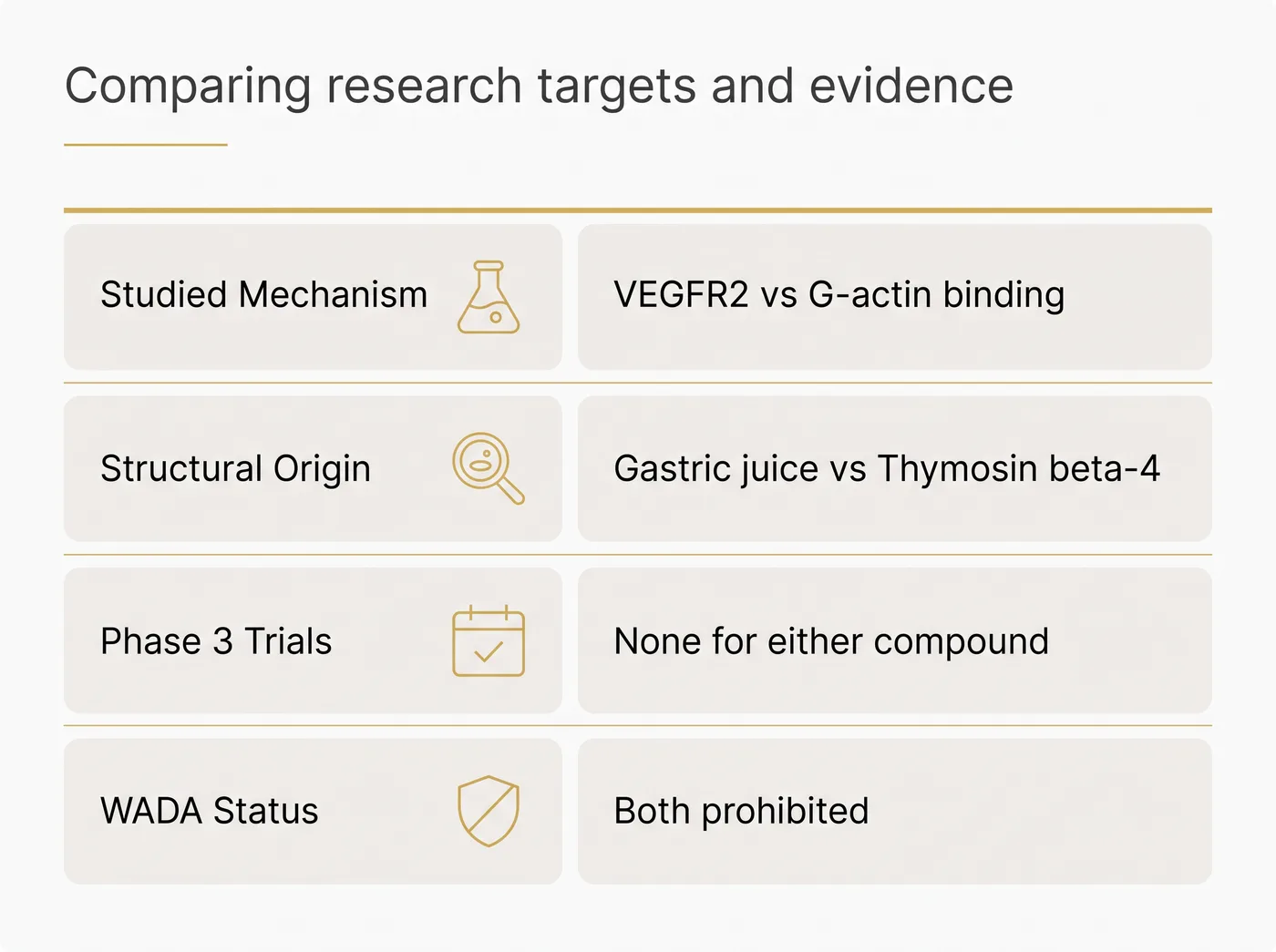
| Studied mechanism | VEGFR2 and nitric oxide pathways | G-actin cellular binding |
| Human clinical trials | Phase 1 (unsubmitted), small pilot studies | None for the fragment (parent protein only) |
Legal status and the 2026 HHS policy
Neither BPC-157 nor TB-500 is an FDA-approved drug for human use. They sit completely outside the standard approval pathway and lack any approved indications. In competitive sports, both are firmly banned by the World Anti-Doping Agency (WADA). BPC-157 is classified under the S0 category for Unapproved Substances, while TB-500 and its parent protein fall under the S2 category for Peptide Hormones and Growth Factors.
The regulatory situation shifted significantly in late 2026. On October 30, 2026, the US Department of HHS published an interim enforcement discretion policy alongside an Appendix A. Under this framework, both BPC-157 and TB-500 are permitted to be supplied by qualifying compounding pharmacies for human use pending final FDA rulemaking, despite remaining officially unapproved.
What to check on a lab report
When you buy a research chemical, a PDF from a stranger is often all that stands between you and a vial of unknown white powder. The paperwork matters. The first thing to check on any Certificate of Analysis is the HPLC chromatogram. Think of a chromatogram as a race where every impurity has to cross the finish line in public. You are looking for a single, sharp peak that corresponds to a purity percentage above 99%.
The second check is the net peptide content. A vial might be highly pure, but if it only contains half the stated milligrams, the research calculations will be completely wrong. A credible supplier provides batch-specific, independent laboratory reports confirming both identity and measured amounts. For example, NuuVive's BPC-157 has recent independent testing confirming 99.825% purity and a measured amount of 10.89 mg (Janoshik #85186), ensuring the material matches the exacting standards required for serious laboratory research.
Questions
Is TB-500 the same as thymosin beta-4?
No. Thymosin beta-4 is a naturally occurring 43-amino-acid protein found throughout human and animal tissues. TB-500 is a synthetic 7-amino-acid fragment designed to replicate just the actin-binding section of that larger protein.
Why are BPC-157 and TB-500 often mentioned together?
Because they have both been studied extensively in animal models of tissue and musculoskeletal repair, sellers frequently market them as complementary research subjects. However, their molecular structures and studied mechanisms of action are completely unrelated.
Are there human trials for these compounds?
The clinical evidence base is extremely thin. BPC-157 has a few small pilot studies and an unsubmitted Phase 1 pharmacokinetic trial. The synthetic TB-500 fragment has no human trials at all, though its parent protein, thymosin beta-4, has been evaluated in Phase 2 trials.
Are they FDA approved?
Neither compound is an FDA-approved drug. However, a 2026 HHS interim policy permits qualifying compounding pharmacies to supply them under enforcement discretion, pending further rulemaking.
Sources
- pubchem.ncbi.nlm.nih.gov. National Library of Medicine
- pubchem.ncbi.nlm.nih.gov. National Library of Medicine
- Thymosin Beta-4 and TB-500 in Tissue Healing, Regeneration, and Musculoskeletal Repair: A Scoping Review - Search Results. National Library of Medicine