
Compounds explained
CJC-1295 vs ipamorelin: what is the difference?
NuuVive Journal · · 6 min read
Short answer
CJC-1295 is a 29-amino-acid synthetic analogue of growth hormone-releasing hormone with a half-life of several days, while ipamorelin is a 5-amino-acid pentapeptide that binds to the ghrelin receptor with a half-life of two hours. They are chemically distinct molecules developed by different pharmaceutical companies, investigated in separate phase 2 clinical trials, and currently sit outside the FDA compounding lists.
Key takeaways
- CJC-1295 is a 29-amino-acid molecule designed to bind to blood albumin, whereas ipamorelin is a tiny 5-amino-acid pentapeptide.
- CJC-1295 targets the growth hormone-releasing hormone receptor, while ipamorelin targets the ghrelin receptor.
- Ipamorelin has a half-life of roughly two hours, compared to the six to eight days observed for CJC-1295.
- Neither compound is an approved drug, and both have been removed from the routine pharmacy compounding lists under current HHS policy.
The tale of two receptors
Search for these two names together and you will stumble into a thicket of marketing fog. Sellers often blur them into a single acronym soup, but on a molecular level, they are practically opposites. They belong to completely different chemical classes and lock into entirely different receptors in a research model. For another pair of names often lumped together online, explore the exact differences between Selank and Semax.
CJC-1295 is a synthetic analogue of growth hormone-releasing hormone National Library of Medicine. It was developed by ConjuChem Biotechnologies to mimic the natural signal that travels from the hypothalamus to the pituitary gland. When introduced to pituitary cells, it binds to the exact receptor built for that specific releasing hormone. To see how two other molecules in this exact class compare, explore the differences between sermorelin and tesamorelin.
Ipamorelin is fundamentally different. Originally developed by Novo Nordisk, it is a growth hormone secretagogue and a ghrelin receptor agonist National Library of Medicine. Instead of mimicking the releasing hormone, it mimics the "hunger hormone" ghrelin. In animal models, ipamorelin binds to the GHSR-1a pathway, which is a separate communication channel on the pituitary gland. First described in the literature in 1998, it was noted as the first selective secretagogue of its kind because early tests in swine models evaluated its specificity regarding markers like cortisol. If you want the complete backstory on this molecule, explore ipamorelin chemistry, origins and research areas.
Size and molecular weight
If you map out their chemical structures, the physical difference between the two becomes glaringly obvious. One is a massive freight train, and the other is a tiny skeleton key. This physical footprint dictates how they behave in a laboratory assay and how they are synthesised.
Ipamorelin is a pentapeptide, meaning it consists of exactly five amino acids National Library of Medicine. Its sequence lacks the central dipeptide found in older compounds of its class, giving it a very compact structure. At just 711.9 grams per mole, it is a lightweight molecule that is relatively straightforward to sequence and analyse. For an analytical chemist checking Ipamorelin identity: structure, molecular weight and form, its small size means fewer places for synthesis errors to hide.
CJC-1295 is a giant by comparison. It is a 29-amino-acid peptide with a molecular weight of approximately 3368 grams per mole National Library of Medicine. The synthesis process for a chain of this length is complex, requiring precise assembly steps to ensure the amino acids fold correctly. The massive difference in their molecular weights is one reason why verifying a vial containing both requires highly calibrated mass spectrometry equipment.
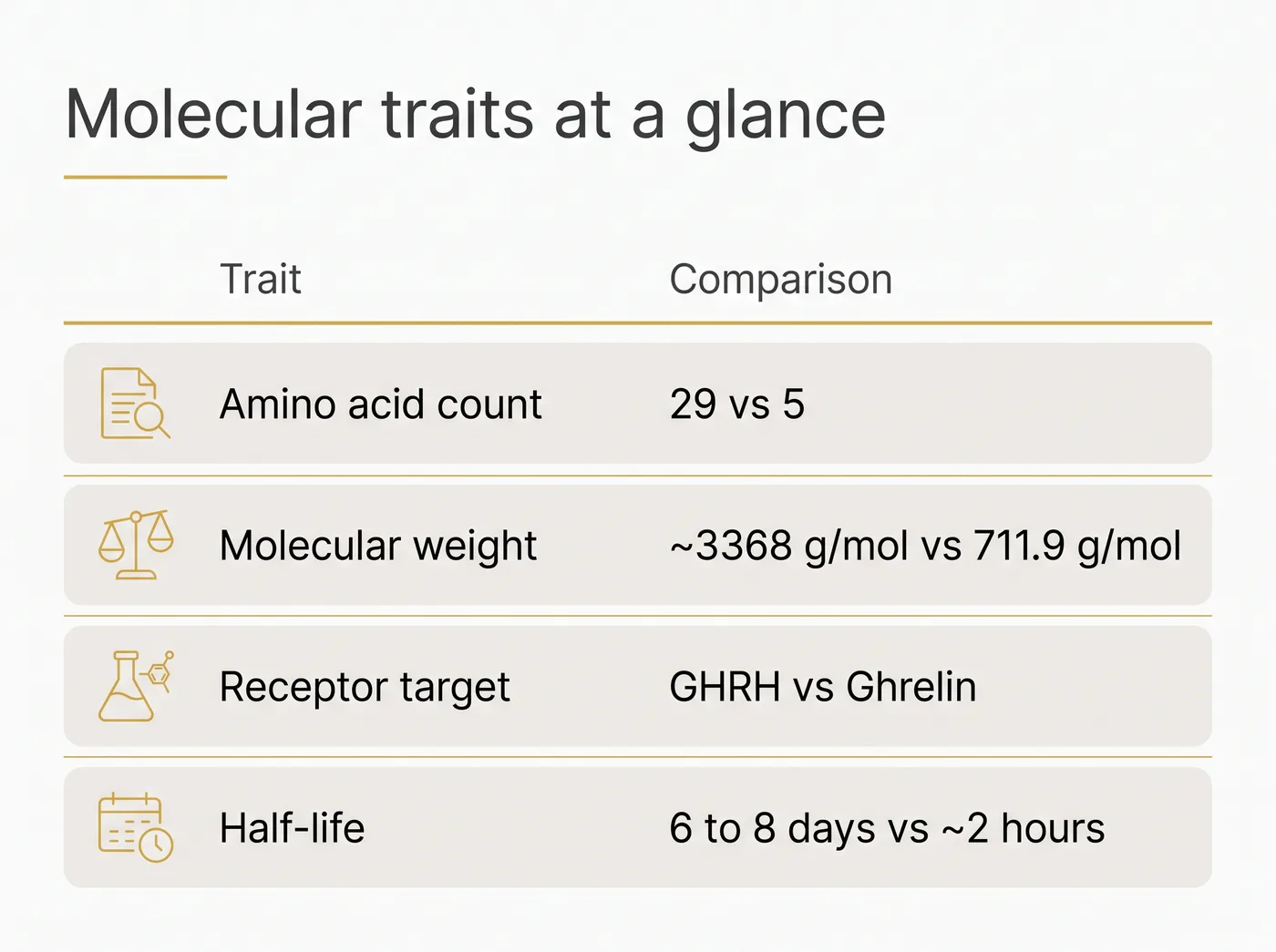
| Trait | CJC-1295 | Ipamorelin |
|---|---|---|
| Amino acid count | 29 | 5 |
| Molecular weight | ~3368 g/mol | 711.9 g/mol |
| Receptor target | GHRH receptor | Ghrelin receptor (GHSR-1a) |
| Originator | ConjuChem Biotechnologies | Novo Nordisk |
| Half-life | 6 to 8 days | ~2 hours |
The half-life gap and the albumin trick
The defining feature of true CJC-1295 is a chemical modification called a Drug Affinity Complex. The DAC is a reactive group attached to the peptide chain designed to perform a very specific trick the moment it enters the bloodstream: it forms a covalent bond with blood albumin. Albumin is a large, abundant protein that circulates in the blood for weeks.
By hitching a ride on albumin, CJC-1295 avoids being rapidly broken down by enzymes National Library of Medicine. This bioconjugation extends its half-life to between six and eight days. Without the DAC modification, the 29-amino-acid chain would degrade in minutes. A non-DAC version exists, accurately called Mod GRF 1-29, which is structurally similar but lacks this albumin-binding capability.
Ipamorelin does not possess a Drug Affinity Complex or any mechanism for binding to transport proteins. Because it floats freely in the bloodstream, it is highly susceptible to enzymatic degradation. Its half-life in humans is roughly two hours. In laboratory studies, this results in a rapid, brief spike of activity at the ghrelin receptor, contrasting sharply with the sustained, week-long presence of the bioconjugated GHRH analogue.
What the human trials actually investigated
Despite the volume of noise online, the formal clinical history for both molecules is surprisingly short. Both advanced to phase 2 clinical trials, but they were investigated for completely different conditions, and neither trial resulted in a commercial drug. To see how trial history and regulatory status diverge for a derivative molecule, explore the differences between PT-141 and Melanotan II.
CJC-1295 was studied in human trials for growth hormone deficiency and lipodystrophy. However, those phase 2 trials were terminated early following the death of a trial subject. While the attending physician attributed the event to asymptomatic coronary artery disease and plaque rupture, the trial was halted as a standard and absolute precaution National Library of Medicine. It has not returned to large-scale clinical development since.
Ipamorelin advanced to phase 2 clinical trials sponsored by Helsinn. The researchers were not looking at body composition; they investigated it for the management of postoperative ileus in bowel resection patients. Postoperative ileus is a condition where the intestines temporarily stop moving after surgery. The trial was eventually discontinued without reaching its primary endpoint.
What the evidence does not show
When you sift through the published literature, the gap between the actual research and online forum chatter is vast. Neither CJC-1295 nor ipamorelin has large-scale, long-term human trial evidence.
The 2026 compounding policy
The regulatory status of these compounds is stark. Neither CJC-1295 nor ipamorelin is an FDA-approved drug for any human indication. For years, they sat in a grey area of pharmacy compounding, but the regulatory framework shifted drastically heading into 2026.
The FDA regulates which bulk substances can be used by compounding pharmacies under Section 503A exemptions. As of September 2024, the FDA removed ipamorelin from the 503A Category 2 list after its nomination was withdrawn. The following month, the FDA Pharmacy Compounding Advisory Committee voted unanimously against adding ipamorelin to the approved bulks list. CJC-1295 was similarly removed from Category 2 after its nomination was withdrawn.
In 2026, neither peptide resides on the FDA approved bulks list, meaning they do not qualify for routine compounding U.S. FDA. Additionally, the FDA has flagged ipamorelin acetate for potential risks regarding immunogenicity and peptide-related impurities. Any pharmacy offering these compounds today is operating outside the standard 503A enforcement discretion policy.
Reading the lab reports
Because these molecules are no longer routinely compounded, researchers source them from synthetic peptide suppliers. This makes analytical testing the only barrier between a laboratory and a contaminated experiment. A certificate of analysis is the vial's passport, but only if it comes from an independent, accredited testing facility.
When evaluating what is in a CJC-1295 + Ipamorelin vial, you are looking for High-Performance Liquid Chromatography results. The chromatogram is a race where every impurity has to cross the finish line in public. Because the two molecules have vastly different molecular weights, their peaks on the graph should be widely separated and distinct. If the peaks bleed into each other, the separation method was poor, and the purity percentage is meaningless.
A rigorous report will list the exact purity of each peptide separately, alongside a mass spectrometry graph confirming the atomic mass of both 3368 g/mol and 711.9 g/mol. Check the lot numbers against the current inventory to ensure the test matches the vial in front of you. You can verify the current batch purity and availability for NuuVive's CJC-1295 + Ipamorelin directly in the catalogue.
Questions
Is Mod GRF 1-29 the same as CJC-1295?
No. Mod GRF 1-29 is a 29-amino-acid peptide that lacks the Drug Affinity Complex. Without the DAC, it cannot bind to blood albumin and degrades rapidly, whereas true CJC-1295 has a half-life of several days.
Why are these two compounds frequently studied together?
Researchers often investigate them in tandem because they target different pituitary receptors. One targets the GHRH receptor and the other targets the ghrelin receptor, allowing scientists to observe how the dual pathways interact in laboratory models.
Are CJC-1295 and ipamorelin legal to buy?
They are not FDA-approved drugs and do not qualify for routine human compounding under current 503A regulations. However, they are legally permitted to be sold and purchased strictly as bulk chemicals for laboratory research use only.
How can a lab verify both compounds are in the same vial?
An independent laboratory must use mass spectrometry to identify the unique molecular weights of both compounds. A standard HPLC test will show two distinct peaks, but only mass spectrometry confirms that those peaks correspond to the 3368 g/mol and 711.9 g/mol masses.
Sources
- pubmed.ncbi.nlm.nih.gov. National Library of Medicine
- fda.gov. U.S. FDA
- pubchem.ncbi.nlm.nih.gov. National Library of Medicine
- pubchem.ncbi.nlm.nih.gov. National Library of Medicine
- Activation of the GH/IGF-1 axis by CJC-1295, a long acting GHRH analog, results in serum protein profile changes in normal adult subjects. National Library of Medicine