
Compounds explained
What is GLOW? The GHK-Cu, BPC-157 and TB-500 blend explained
NuuVive Journal · · 7 min read

Short answer
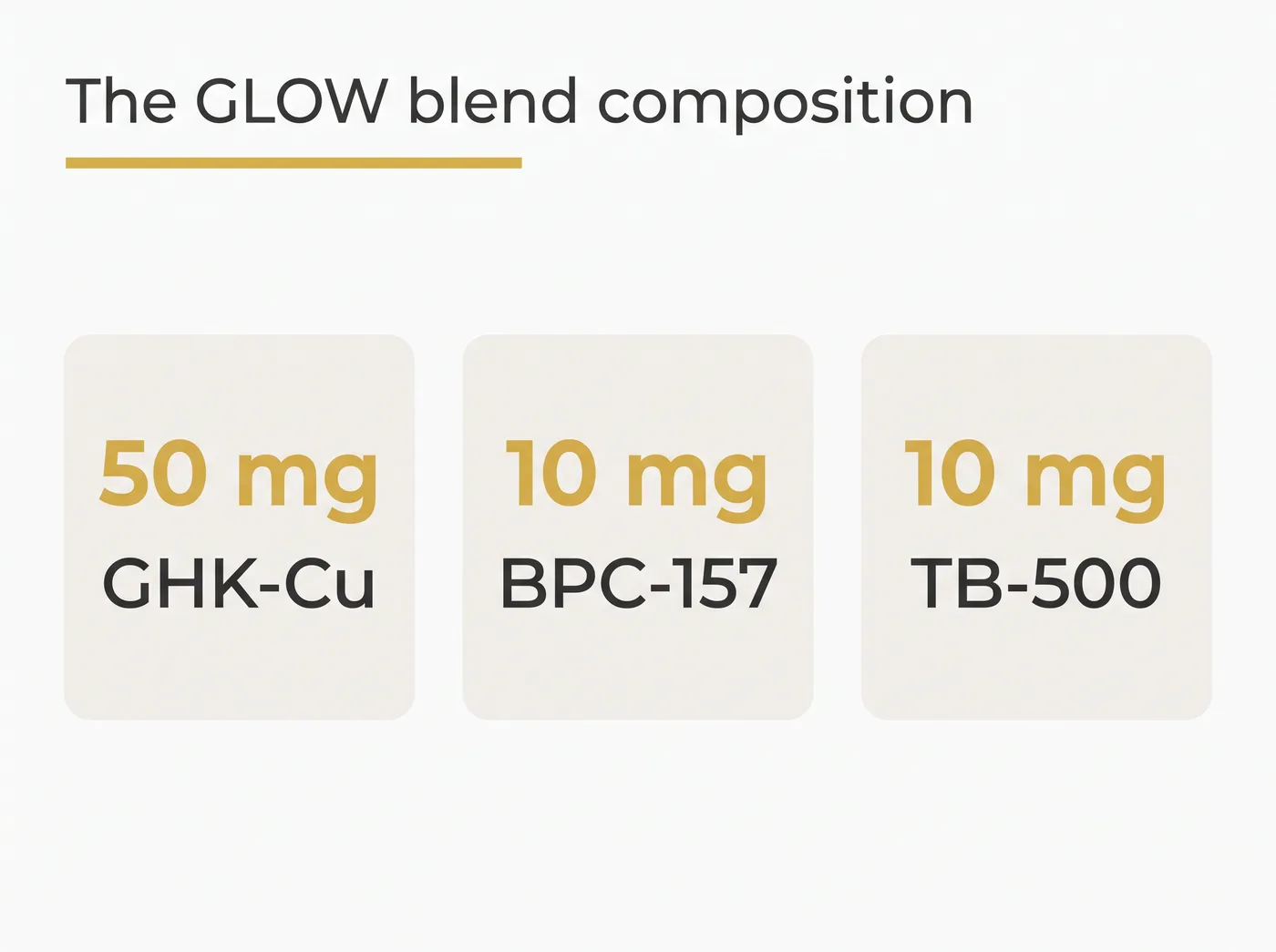
GLOW is a research blend combining three distinct compounds in a single vial. It contains 50 milligrams of GHK-Cu, a copper-binding tripeptide; 10 milligrams of BPC-157, a synthetic 15-amino-acid sequence; and 10 milligrams of TB-500, a synthetic 7-amino-acid fragment. These molecules have been investigated independently in animal and cell models of wound, tendon, and cell migration research, but they remain unapproved for human use.
Key takeaways
- GLOW is a 70-milligram lyophilized research blend containing three synthetic peptides in a single vial.
- The composition consists exactly of 50 milligrams of GHK-Cu, 10 milligrams of BPC-157, and 10 milligrams of TB-500.
- BPC-157 and TB-500 are synthetic sequences studied in animal models of tissue and tendon injury, while GHK-Cu is a copper-binding tripeptide investigated in cell cultures for collagen synthesis.
- None of the three compounds are approved by the FDA, and large phase 3 human trials are missing across the entire evidence base.
- A valid laboratory certificate for a blended vial must quantify the exact mass and purity of all three components independently.
The three occupants of the glass
Look at a vial containing a single research compound, and the math is straightforward. You have one molecule, one purity percentage, and one peak on a lab test. But look at a blended vial, and the complexity multiplies. A blend is not a new molecule; it is a very specific roommate agreement between distinct chemical structures. The documentation has to catch all of them crossing the finish line simultaneously.
GLOW is a catalogue identifier for a pre-mixed, lyophilized vial containing exactly three active ingredients. The total mass of the active material is 70 milligrams. That mass is strictly divided into 50 milligrams of GHK-Cu, 10 milligrams of BPC-157, and 10 milligrams of TB-500. There is no chemical reaction happening between them in the powder state; they simply share the same physical space. If you are wondering how this formula sits alongside other catalogue mixtures, you can explore the differences between Wolverine, GLOW, and KLOW.
Understanding this blend requires looking at the isolated history of each component. These are molecules that emerged from entirely different decades and distinct areas of scientific inquiry, only to be grouped together by modern researchers looking to study multiple pathways in the same in vitro or animal models. To see how researchers approach three distinct receptors with a single sequence, you can explore the retatrutide trial history. For a clearer picture of how scientists scale these targets, check out how single, dual, and triple agonists compare.
GHK-Cu: The copper complex
The heaviest contributor to the vial by mass is GHK-Cu. This is a naturally occurring tripeptide composed of the amino acids glycine, histidine, and lysine, which are bound to a copper (II) ion. It carries a molecular weight of approximately 404 grams per mole in its complexed form. The molecule was first discovered and isolated from human plasma in 1973 by Dr. Loren Pickart 1.
For decades, GHK-Cu has been studied in cell cultures, primarily using fibroblasts, and in animal models including rats, mice, pigs, and rabbits. In these preclinical models, researchers investigate it for collagen synthesis, angiogenesis, and granular tissue development 2. There are also a handful of small human facial trials that have evaluated the topical application of the peptide for cosmetic parameters like skin thickness, hydration, and elasticity.
That is where the clinical evidence stops. There are no large-scale, randomized, controlled phase 3 human trials investigating systemic disease applications for GHK-Cu. It is not an FDA-approved drug, and while it is widely used as a topical cosmetic ingredient under the name Copper tripeptide-1, it remains an unapproved substance.
BPC-157: The gastric derivative
The second occupant is BPC-157, a synthetic pentadecapeptide consisting of 15 amino acids. It has a molecular weight of 1,419.5 grams per mole. Unlike GHK-Cu, this sequence does not exist naturally in the human body. Instead, it is a laboratory-made fragment derived from a larger protective protein originally found in human gastric juice. It was first described in the scientific literature in 1993 by researchers at the University of Zagreb 3.
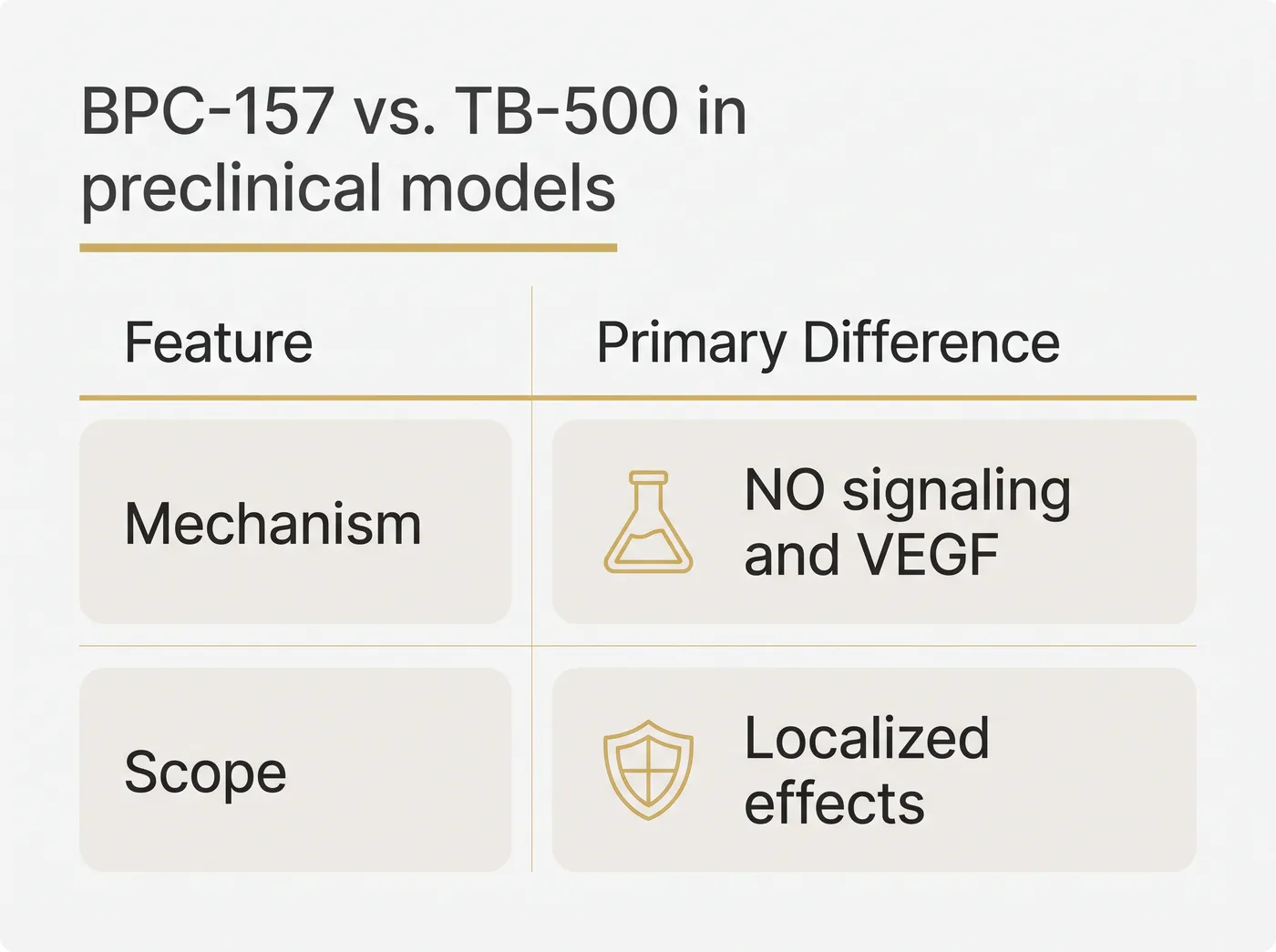
If you search the literature for this compound, you will find extensive animal models. Rats and mice have been used to evaluate BPC-157 in the context of Achilles tendon injury, muscle crush injuries, bone fractures, and NSAID-induced gastric ulcers 4. Researchers investigate it for nitric oxide signaling modulation and vascular endothelial growth factor (VEGF) upregulation.
Despite the volume of rodent data, human evidence is exceptionally thin. There is no high-quality, large-scale, placebo-controlled human trial investigating tendon injury or inflammatory bowel disease. The human data is limited to a few tiny phase 1 and pilot studies, such as a localized retrospective study involving a dozen patients. If anyone tells you this compound is broadly tested in humans, they are inventing the data.
TB-500: The cellular migration fragment
The final 10 milligrams belong to TB-500. This is a synthetic heptapeptide, meaning it consists of just 7 amino acids. With a molecular weight of 889.0 grams per mole, it is an active fragment corresponding to amino acid positions 17 through 23 of the larger Thymosin Beta-4 protein 5. While the parent protein was isolated in the 1960s, the synthetic TB-500 fragment began appearing in research literature around 2003.
TB-500 has been investigated in in vitro and animal studies evaluating actin polymerization. Actin is a cellular structural protein, and researchers study it for actin regulation in the context of cell shape changes and tissue migration 6. In animal models, this mechanism is explored for its potential role in the growth of new blood vessels in damaged soft tissue.
The human clinical data for this specific synthetic fragment is nonexistent. While the full-length 43-amino acid Thymosin Beta-4 protein has been evaluated in some human wound trials, the FDA's 2026 regulatory review noted that there are zero published clinical trials testing the standalone TB-500 fragment in humans. It is an unapproved substance and, like BPC-157, is banned by WADA at all times.
BPC-157 vs. TB-500: How the mechanisms differ
Because both BPC-157 and TB-500 are often studied in the context of tissue injury models, people frequently assume they do the same thing. In the preclinical literature, their theoretical mechanisms are entirely distinct. You can explore the independent details further in how BPC-157 is studied or the TB-500 lab results.
| Feature | BPC-157 | TB-500 |
|---|---|---|
| Mechanism of Action | Studied for nitric oxide (NO) signaling modulation and growth factor (VEGF) upregulation. | Studied for actin regulation, a cellular process facilitating structural changes and cell migration. |
| Scope of Activity | Investigated in preclinical models for localized effects concentrated closely on specific injury sites. | Studied for systemic reach and cellular migration signaling across broader networks. |
| Biological Origin | Synthetic sequence modeled off a localized protective gastric juice protein. | Synthetic fragment of an intracellular protein (Thymosin Beta-4) that exists in nearly every cell type. |
These distinct pathways are the reason researchers occasionally study the molecules simultaneously in animal models, attempting to observe localized angiogenesis alongside broader cellular migration mechanisms. To see exactly how their origins and trial histories part ways, read the full comparison between BPC-157 and TB-500.
The 2026 HHS compounding policy
The regulatory environment for synthetic peptides is not static, and late 2026 brought significant changes. The HHS released a draft enforcement discretion policy on October 30, 2026, which dictates when state-licensed 503A pharmacies may compound specific substances.
Earlier in the year, BPC-157 had been removed from the FDA's Category 2 bulks list. However, following a non-binding 8-6 recommendation by the FDA's Pharmacy Compounding Advisory Committee (PCAC) in July 2026, both BPC-157 and TB-500 were included in Appendix A of the new HHS policy. This inclusion means HHS does not intend to pursue enforcement action against permitted 503A pharmacies compounding these specific unapproved substances under strict patient-specific conditions.
GHK-Cu, despite its prevalence in cosmetic research, is not listed on this October 30, 2026, HHS enforcement discretion draft policy. It sits outside this specific conditionally permitted pathway.
Reading the lab report for a blended vial
Every lot number is the vial's passport. When a vial contains three active compounds, analytical chemistry requires the chromatograph to resolve three distinct peaks. A careless seller hopes you will see "99%" randomly stamped on a website and look no further. You must look for the math. For a deeper look at verifying independent reports, you can review how to read a lab test.
For the GLOW blend, the stated mass is 70 milligrams. The third-party measurement must confirm the exact ratios. Janoshik report #85193 confirms the physical presence of the components, measuring 46.38 milligrams of GHK-Cu, 11.29 milligrams of BPC-157, and 10.05 milligrams of TB-500. This confirms the vial is loaded exactly as promised.
The purity of a blended vial is always dictated by its lowest performing component. GHK-Cu achieved 99.846% purity (Janoshik #89872), BPC-157 achieved 99.825% (Janoshik #85186), and TB-500 registered at 99.402% (Janoshik #92009). The blend therefore carries a measured purity floor of 99.402%, ensuring that every impurity had to cross the finish line in public. To view the current pricing, stock levels and the independently verified laboratory documents, visit NuuVive's GHK-Cu + BPC-157 + TB-500 blend.
Questions
Is GLOW an FDA-approved medication?
No. None of the three components in the blend are approved by the FDA. They remain unapproved substances limited to laboratory research and, under specific conditions, compounding.
Why are BPC-157 and TB-500 studied together?
In preclinical animal models, researchers investigate BPC-157 for its localized angiogenesis and growth factor modulation, while independently studying TB-500 for its systemic cellular migration properties via actin regulation.
What is the molecular weight of the compounds in the blend?
GHK-Cu is approximately 404 g/mol as a copper complex, BPC-157 is an exact 1,419.5 g/mol, and the TB-500 fragment is 889.0 g/mol.
Are these compounds permitted in athletic competition?
No. Both BPC-157 and TB-500 are expressly banned by the World Anti-Doping Agency (WADA) at all times under the non-approved substances category.
Sources
- pubchem.ncbi.nlm.nih.gov. National Library of Medicine
- pubmed.ncbi.nlm.nih.gov. National Library of Medicine
- pubchem.ncbi.nlm.nih.gov. National Library of Medicine
- pubmed.ncbi.nlm.nih.gov. National Library of Medicine
- pubchem.ncbi.nlm.nih.gov. National Library of Medicine
- pubmed.ncbi.nlm.nih.gov. National Library of Medicine