
Legal status
Is BPC-157 legal in the US? Origin, research and FDA status
NuuVive Journal · · 5 min read
Short answer
BPC-157 is not an FDA-approved drug and sits outside standard approval pathways. A 2023 FDA directive banned compounding pharmacies from making it, but in late 2026, HHS introduced an enforcement discretion policy. This policy allows pharmacies to compound BPC-157 under specific conditions without federal penalty, though it does not constitute FDA approval.
Key takeaways
- BPC-157 is a 15-amino-acid synthetic peptide derived from a protein found in human stomach juice.
- Research is mostly limited to animal models of tendon, gut and nerve injuries, with almost no human clinical data.
- It is not an FDA-approved drug, but a late-2026 HHS policy allows compounding pharmacies to supply it conditionally.
- The World Anti-Doping Agency (WADA) bans its use in all sports at all times.
- A credible lab report should confirm a purity of at least 99% using independent testing.
What is BPC-157?
Run a quick search for this compound and you will hit two very different worlds. One is a loud parade of forum threads and vendor blogs making wild claims. The other is a quiet collection of laboratory papers, heavily focused on rats, authored by a tight circle of researchers over three decades. Only the second world deals in facts.
At its core, this compound is a 15-amino-acid fragment that researchers first mapped out in the early 1990s. While it is produced synthetically in a lab, its structure mirrors a short sequence of a naturally occurring protein originally isolated from human gastric (stomach) juice. The sequence is Gly-Glu-Pro-Pro-Pro-Gly-Lys-Pro-Ala-Asp-Asp-Ala-Gly-Leu-Val, and it carries a molecular weight of 1419.556 g/mol PubChem.
Researchers often call it PL-14736, PL-10 or Bepecin. The "BPC" stands for Body Protection Compound, a name that tells you more about the optimism of its discoverers than any established mechanism. It was first isolated by a team of Croatian researchers, led by Predrag Sikirić, who were studying gastrointestinal stress responses.
What has BPC-157 been studied for?
The evidence base for BPC-157 is almost entirely built on preclinical cell and animal models. The literature is wide, but it remains firmly inside the laboratory.
In musculoskeletal research, it has been studied in rat Achilles tendon rupture models, muscle crush injuries and bone fracture models to observe cell movement and collagen organization. In these animal models, investigators look at markers of tissue remodeling and the expression of specific growth factors to understand the underlying cellular mechanics. In the digestive system, researchers have used human intestinal cell lines and rat models to investigate its interaction with gastric and duodenal ulcers induced by NSAIDs and stress. These studies often measure the integrity of the mucosal lining and the inflammatory response in the presence of the peptide.
Cellular investigations have focused on how the peptide interacts with the nitric oxide pathway and vascular endothelial growth factor (VEGF) receptors, looking at angiogenesis (blood vessel formation) in isolated tissue samples National Library of Medicine.
The FDA, compounding, and the 2026 HHS policy
BPC-157 is not an FDA-approved drug. It sits outside the traditional pharmaceutical pathway and lacks the long-term human data required for approval. For a clear look at a compound firmly planted in human trials, read about the clinical history of retatrutide.
In 2023, the FDA placed BPC-157 on its Section 503A Category 2 list of bulk drug substances. This category is for substances with "significant safety risks", in this case, concerns over immunogenicity and a lack of human data. That designation effectively banned compounding pharmacies from making it.
Then the rules shifted. In late 2026, under Secretary Robert F. Kennedy Jr., HHS introduced an enforcement discretion policy National Library of Medicine. This policy conditionally permits compounding pharmacies to supply BPC-157 without facing federal penalty.
This is a regulatory workaround, not a seal of approval. The HHS policy allows access, but it does not mean the FDA has declared the peptide an approved drug.
BPC-157 vs. TB-500: Two different tools
BPC-157 is often grouped with TB-500 in research discussions, but they are structurally and functionally distinct. If you want the full story on how their laboratory mechanisms actually differ, read a complete comparison of BPC-157 and TB-500.
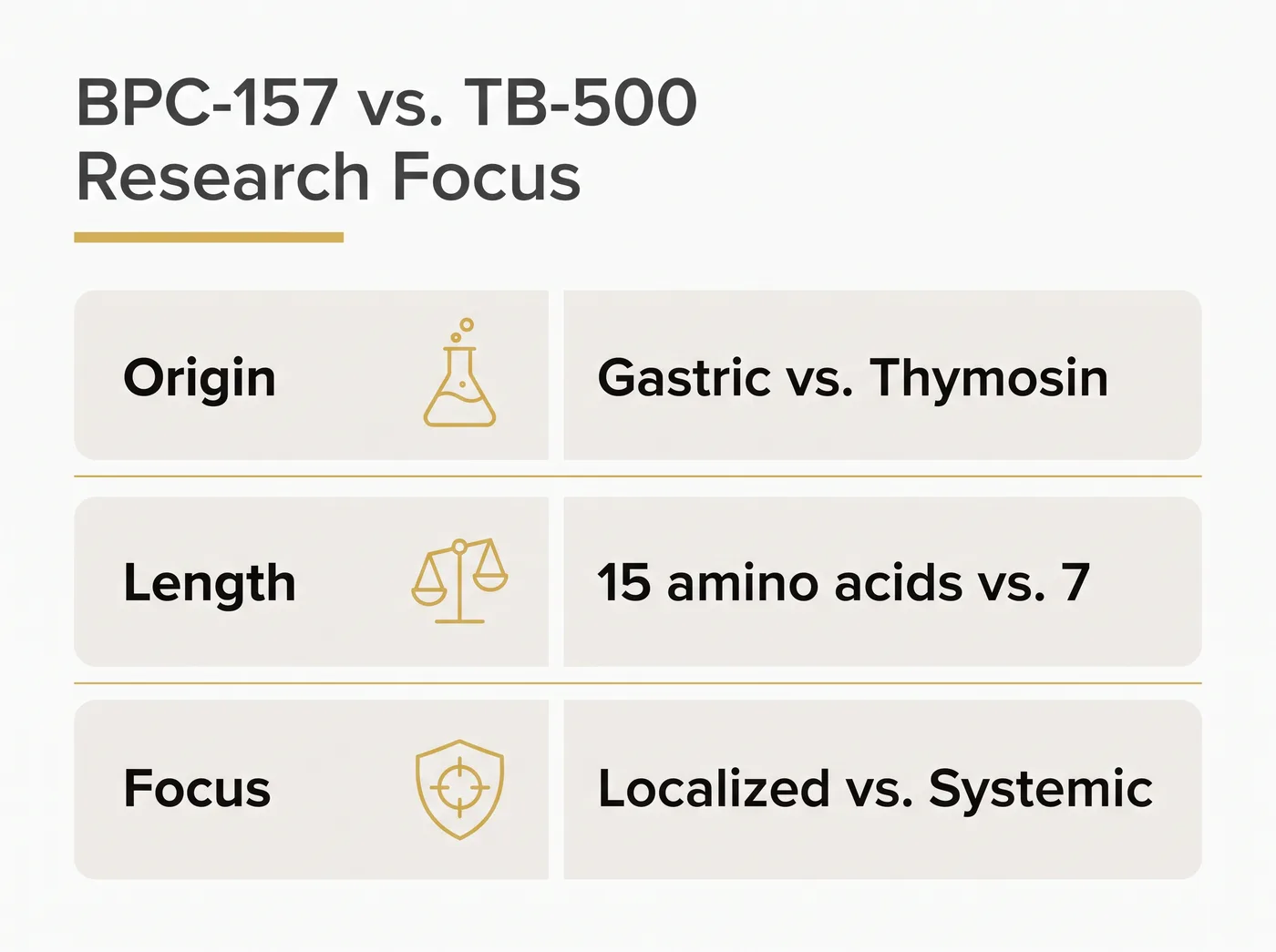
TB-500 is a 7-amino-acid synthetic fragment of thymosin beta-4, a protein found in almost all human cells. Where BPC-157 research focuses on localized signaling pathways (like nitric oxide signaling) directly in tissue models, TB-500 is studied for its systemic effects, specifically its interaction with actin, which is investigated in models of cell migration across the body to damaged tissues PubChem. If you want to see how these two are sometimes grouped with a copper peptide in the laboratory, read the science behind the GLOW blend. For a clear look at the laboratory history of that thymosin fragment, check out the dedicated TB-500 explainer.
| Feature | BPC-157 | TB-500 |
|---|---|---|
| Origin | Derived from gastric juice protein | Fragment of thymosin beta-4 |
| Structure | 15 amino acids | 7 amino acids |
| Research focus | Localized pathways (nitric oxide, VEGF) | Systemic cell migration (actin regulation) |
Reading the lab report
If you are purchasing a research peptide, the vial's passport is its lab report. Without an independent Certificate of Analysis (CoA), you have no way to verify what is in the vial.
A rigorous lab report will show a chromatogram, a graph where every impurity has to cross the finish line in public. You want to see a clean, sharp peak indicating the primary compound, rather than a messy cluster of secondary peaks that suggest poor synthesis or degradation. Look for a purity of ≥99%. For instance, the BPC-157 lab results at NuuVive show a measured purity of 99.825% (Janoshik report #85186), with a measured mass of 10.89 mg per 10 mg vial. Checking these exact figures against the vendor's claims is the only way to ensure the documentation matches the physical product.
Questions
Is BPC-157 banned in sports?
Yes. The World Anti-Doping Agency (WADA) classifies BPC-157 as a non-approved substance. Its use is strictly prohibited in all sports at all times, both in and out of competition.
Can you patent BPC-157?
Because BPC-157 is a copy of a naturally occurring sequence, standard patenting rules make it difficult to secure exclusive intellectual property rights. This lack of exclusivity is a primary reason why pharmaceutical companies have not funded large-scale trials.
Why are there no large human trials?
Large randomized controlled trials cost millions of dollars. Without patent exclusivity, pharmaceutical companies lack the financial incentive to push BPC-157 through the multi-phase FDA approval process.
How is BPC-157 synthesized?
Like most modern research peptides, BPC-157 is manufactured using solid-phase peptide synthesis. This laboratory technique builds the amino acid chain step by step on a porous resin, allowing chemists to create exact copies of the target sequence. Once the chain is complete, it is cleaved from the resin and purified using high-performance liquid chromatography to remove incomplete fragments.
Sources
- pubchem.ncbi.nlm.nih.gov. National Library of Medicine
- pubchem.ncbi.nlm.nih.gov. National Library of Medicine
- Multifunctionality and Possible Medical Application of the BPC 157 Peptide—Literature and Patent Review. National Library of Medicine
- Regeneration or Risk? A Narrative Review of BPC-157 for Musculoskeletal Healing. National Library of Medicine