
Compounds explained
What is BPC-157? Origin, chemistry and research areas
NuuVive Journal · · 6 min read
Short answer
BPC-157 (Body Protection Compound-157) is a synthetic 15-amino-acid peptide derived from a protein naturally found in human gastric juice. First described in 1993, it has been studied extensively in animal and cell models of tendon, ligament, and gastrointestinal injury. Human research remains extremely scarce, limited to small pilot studies, and it is not an approved drug. Since late 2026, it falls under a specific HHS enforcement discretion policy for compounding pharmacies.
Key takeaways
- BPC-157 is a laboratory-synthesised pentadecapeptide consisting of a 15-amino-acid chain.
- It has been studied extensively in rat and dog models of musculoskeletal and gastrointestinal injury.
- Human evidence is limited to tiny pilot studies, with no large-scale clinical trials completed.
- It is not an FDA-approved drug for any condition.
- A late-2026 HHS policy established specific conditions under which pharmacies may compound BPC-157 acetate.
Where did BPC-157 come from?
Look up this compound online and you are immediately buried in an avalanche of acronyms and sweeping promises. The reality is far less flashy, but much more interesting to an analytical chemist. Behind the marketing fog is a string of fifteen amino acids that a small cluster of researchers has quietly investigated for three decades.
To understand what BPC-157 actually is, you have to look at the chemistry of human digestion. The name stands for Body Protection Compound-157. It is a synthetic pentadecapeptide, which is simply a laboratory term for a chain of fifteen amino acids linked together National Library of Medicine. In the early 1990s, scientists identified a naturally occurring protective protein in human gastric juice and modelled this specific sequence on it MDPI.
However, the BPC-157 sequence itself does not float around in nature. The exact sequence, Gly-Glu-Pro-Pro-Pro-Gly-Lys-Pro-Ala-Asp-Asp-Ala-Gly-Leu-Val, exists only because a chemist synthesises it in a facility. It carries a molecular weight of 1419.5 g/mol as a free base, and the industry tracks it under the CAS registry number 137525-51-0 National Library of Medicine.
Researchers first published on this peptide and its underlying mechanisms back in 1993. The early research was spearheaded by investigators such as Predrag Sikirić, who studied the peptide in experimental gastric injury models National Library of Medicine. For a molecule that generates so much internet noise today, its origins trace back to decades of quiet bench research on gastric fluids.
What has BPC-157 been studied for?
The bulk of the published literature focuses on systemic injury models, soft tissue research, and gastrointestinal models. In a laboratory setting, biochemical and cell-culture studies have investigated the peptide in relation to the VEGFR2-Akt-eNOS pathway, which is a mechanism involved in blood vessel formation National Library of Medicine. Scientists have also evaluated its interactions with fibroblast cell movement, growth-hormone receptor expression, and inflammatory signalling pathways such as ERK1/2.
When it comes to animal models, the list of injury types researchers have looked at is long. BPC-157 has been studied in rat and dog models involving tendon transection, bone fractures, ligament tears, muscle damage, and peripheral nerve injuries National Library of Medicine. Gastroenterology researchers have investigated it in animal models of chemically induced gastric and duodenal ulcers, inflammatory bowel disease, and NSAID-induced digestive tract damage.
When evaluating human trials, the clinical literature is remarkably thin. The published record is limited to a retrospective pilot study of 12 patients investigating the peptide for chronic knee pain, a small study examining it in interstitial cystitis, and a tiny 2025 Phase I pilot assessing pharmacokinetics in just two adult participants National Library of Medicine. These handful of patients represent the entirety of the published human evidence base.
BPC-157 vs TB-500: The chemical difference
Researchers and buyers often see BPC-157 discussed in the same breath as TB-500, another synthetic peptide investigated in tissue models TB-500 identity: structure, molecular weight and form. While they frequently appear in the same experimental setups and blends What is in a Wolverine (BPC-157 + TB-500) vial?, their structures and research targets are fundamentally different. To see exactly how their laboratory mechanisms and clinical evidence compare side by side, read the full BPC-157 and TB-500 breakdown.
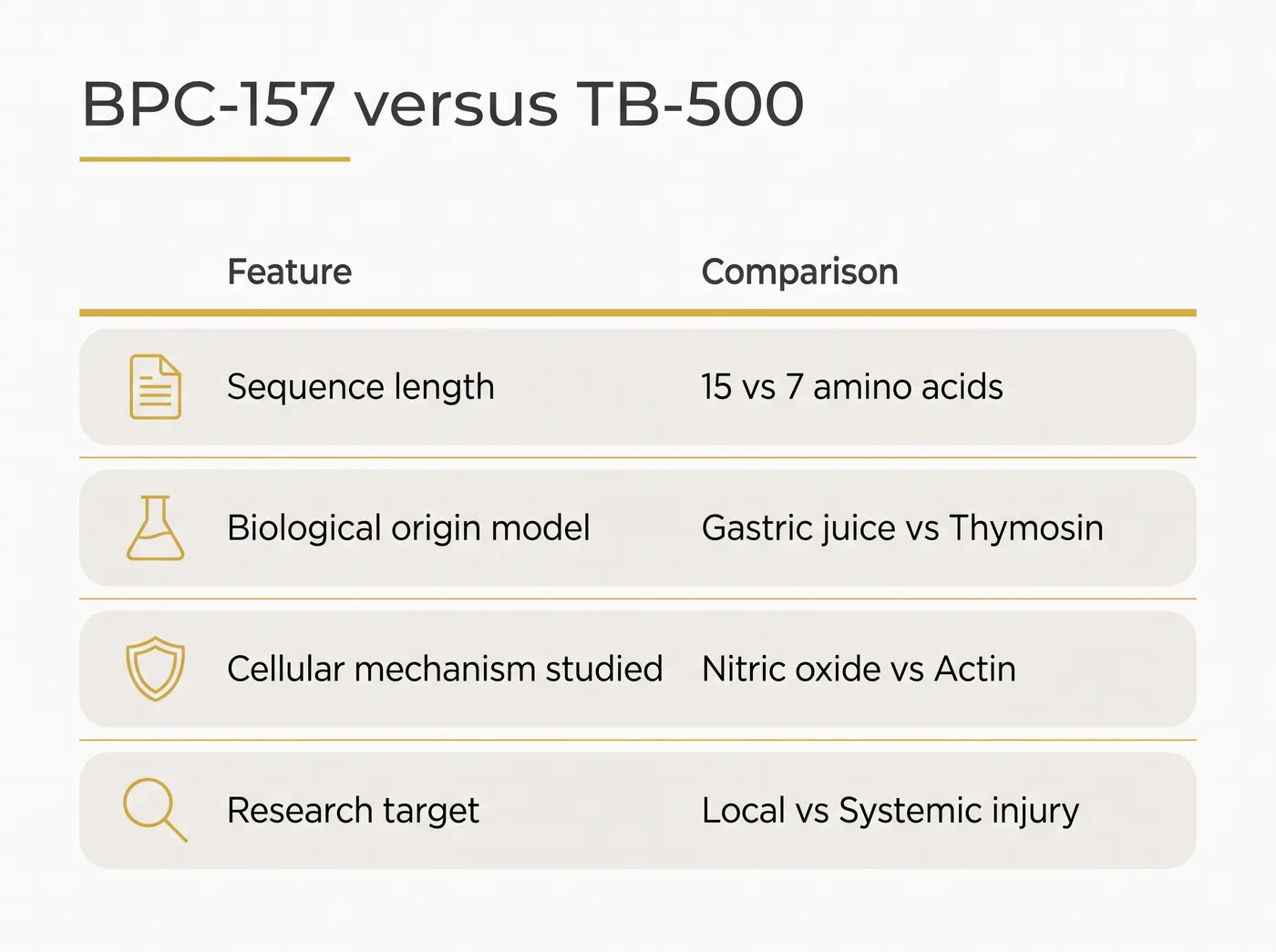
| Feature | BPC-157 | TB-500 |
|---|---|---|
| Origin model | Localised gastric juice protein | Thymosin Beta-4 (found systemically) |
| Sequence length | 15 amino acids | 7 amino acids (N-acetylated) |
| Research focus | Nitric oxide signalling and local injury models | Actin regulation and systemic cell migration |
BPC-157 is a 15-amino-acid sequence modelled on a localised gastric protein, whereas TB-500 (Ac-LKKTETQ) is a synthetic, 7-amino-acid N-acetylated fragment of a 43-amino-acid protein found throughout virtually all mammalian cells. In theoretical models, researchers study BPC-157 for localised activity at specific tendon junctions or the gut lining, while TB-500 research targets whole-body cell migration and broad angiogenesis. They are distinct tools designed to probe entirely different cellular pathways. If you see GHK-Cu added to that mix, you can read about the resulting three-part combination in the GLOW blend breakdown. For a clearer picture of these multi-compound combinations, read the breakdown of the Wolverine, GLOW and KLOW blends.
The regulatory saga: Is BPC-157 legal?
Is BPC-157 legal? Yes, as a research chemical, but its path through the pharmacy compounding world has been a bureaucratic rollercoaster. BPC-157 is not an FDA-approved drug for any human medical condition, nor is it a component of any FDA-approved medication Why most research peptides are not FDA-approved: follow the money.
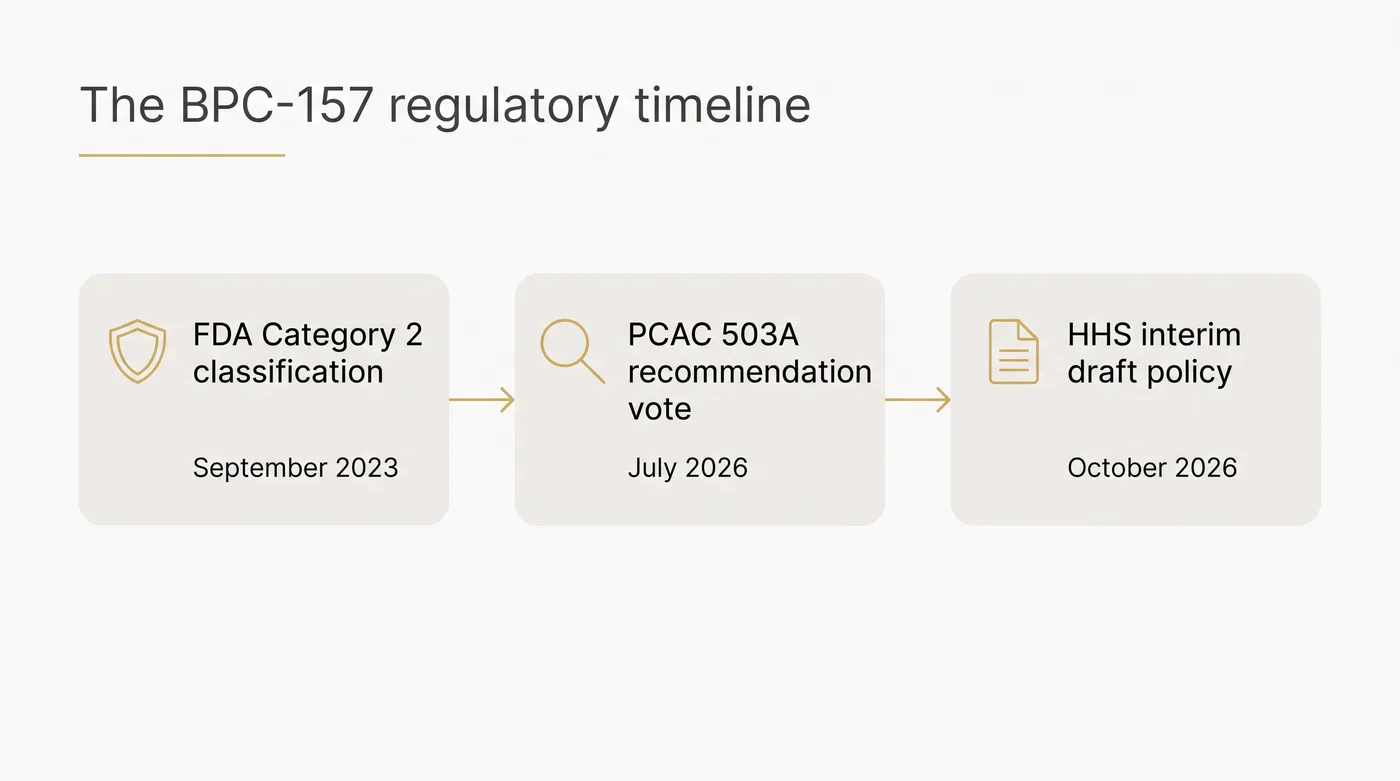
In September 2023, the FDA classified BPC-157 as a Category 2 bulk drug substance. This category is reserved for substances with significant concerns, specifically highlighting immunogenicity and peptide-related impurities. That classification effectively banned 503A compounding pharmacies from legally preparing medications containing the peptide, shutting down the supply for many clinics.
Then the bureaucratic wind changed direction. In July 2026, the FDA's Pharmacy Compounding Advisory Committee (PCAC) voted 8-6 in a non-binding decision to recommend BPC-157 for the 503A bulks list. They made this recommendation even though FDA staff scientists formally opposed the move, highlighting the friction between clinical demand and regulatory caution.
By October 2026, HHS stepped in with an interim draft policy extending enforcement discretion to certain peptides HHS's new peptide policy: what changed for BPC-157, TB-500 and 4 more. BPC-157 acetate is covered under Appendix A of this policy. Under this directive, compounding pharmacies may supply BPC-157 acetate provided it is compounded from an active pharmaceutical ingredient accompanied by a valid Certificate of Analysis, meeting specific lot-level testing and purity conditions. It was a rare moment of regulatory clarity in an otherwise murky market. If you want to follow every twist of this bureaucratic maze, read the full breakdown of BPC-157 legality and FDA status.
Reading a BPC-157 lab report
When sourcing peptides for laboratory use, a lot number is the vial's passport. If a supplier cannot provide an independent, third-party lab report linking directly to the batch you are holding, you are buying expensive mystery dust.
The document you want is a Certificate of Analysis (CoA) BPC-157 lab report: what to check. A proper CoA will show a chromatogram, which is essentially a chemical race where every impurity has to cross the finish line in public. You do not have to be an analytical chemist to read the highlights, but you do have to know what to look for.
- Mass spectrometry: This confirms the molecular weight is exactly 1419.5 g/mol, proving the sequence inside is actually GEPPPGKPADDAGLV.
- HPLC purity: Look for a purity of ≥99%. Anything less means the synthesis process left behind truncated sequences or synthesis reagents.
- Measured net content: This confirms the actual peptide mass in the vial, completely separate from the buffer salts and moisture remaining from the freeze-drying process.
A clean test from a respected analytical laboratory removes the guesswork and protects the integrity of the research. For example, the current batch of NuuVive's BPC-157 measures at 99.825% purity with 10.89 mg of actual peptide in the vial (Janoshik report #85186).
Questions
Is BPC-157 an FDA-approved drug?
No, BPC-157 is not an FDA-approved drug for any human medical condition. It remains an experimental research compound.
What does pentadecapeptide mean?
Pentadecapeptide is a chemical classification meaning a peptide consisting of exactly 15 amino acids linked together in a specific sequence.
Why is BPC-157 acetate mentioned in the 2026 HHS policy?
Peptides are typically manufactured as salts for stability. The 2026 HHS enforcement discretion policy specifically covers BPC-157 acetate, provided it meets strict active pharmaceutical ingredient testing requirements.
Does BPC-157 occur naturally in the body?
No. While its sequence was modelled on a protective protein found in human gastric juice, the 15-amino-acid BPC-157 sequence itself is synthetic and must be manufactured in a laboratory.
Sources
- Regeneration or Risk? A Narrative Review of BPC-157 for Musculoskeletal Healing. National Library of Medicine
- mdpi.com. MDPI
- pubchem.ncbi.nlm.nih.gov. National Library of Medicine
- pubmed.ncbi.nlm.nih.gov. National Library of Medicine
- pubmed.ncbi.nlm.nih.gov. National Library of Medicine