
Legal status
Is retatrutide legal in the US?
NuuVive Journal · · 5 min read

Short answer
Retatrutide is not FDA-approved and cannot be legally dispensed or sold as a medication in the United States. It remains an investigational new drug currently undergoing phase 3 clinical trials. The FDA prohibits pharmacies from compounding retatrutide because it lacks a standard formulation monograph and is not an active ingredient in any approved drug. It is strictly available for laboratory research use only.
Key takeaways
- Retatrutide is a synthetic 39-amino acid triple-receptor agonist currently undergoing phase 3 human trials.
- It is not an FDA-approved drug and cannot be legally dispensed by commercial pharmacies.
- Federal regulatory policy explicitly excludes the peptide from traditional pharmacy compounding exemptions.
- Multi-year cardiovascular outcome data and long-term bone density studies do not yet exist for this compound.
The architecture of a triple agonist
Before wading into the regulatory details, you need to know what exactly is sitting in the vial. Retatrutide (development code LY3437943) is a synthetically engineered 39-amino acid single-chain peptide National Library of Medicine. Produced via solid-phase peptide synthesis, it is a complex piece of molecular architecture derived from a glucose-dependent insulinotropic polypeptide (GIP) backbone.
To prevent rapid degradation in testing environments, chemists introduced specific non-coded amino acid substitutions. These include α-aminoisobutyric acid at positions 2 and 20, alongside 2-methylleucine at position 13. The compound features a prominent lipidation modification: a C20 fatty diacid moiety attached via a linker to a lysine residue. This gives retatrutide a molecular weight of approximately 4,731.3 g/mol National Library of Medicine.
This structure places retatrutide in the incretin mimetic class, operating as a first-in-class triple hormone receptor agonist. It is designed to simultaneously target the glucagon-like peptide-1 (GLP-1), glucose-dependent insulinotropic polypeptide (GIP), and glucagon (GCGR) receptors. While other molecules target one or two of these pathways, binding to all three simultaneously requires a precise conformational balancing act. If you want to explore other receptor targets, check out why cagrilintide is not a GLP-1 agonist.
What the research actually looks like
First described in the scientific literature around 2022, retatrutide was developed by the pharmaceutical corporation Eli Lilly. The molecule did not skip straight to human testing; it was initially evaluated in cellular and in vitro models to measure receptor binding affinity and cAMP accumulation across human and murine GLP-1, GIP, and glucagon pathways. From there, it was studied in murine (mouse) models to evaluate physiological responses relating to gastric emptying and metabolic activity National Library of Medicine.
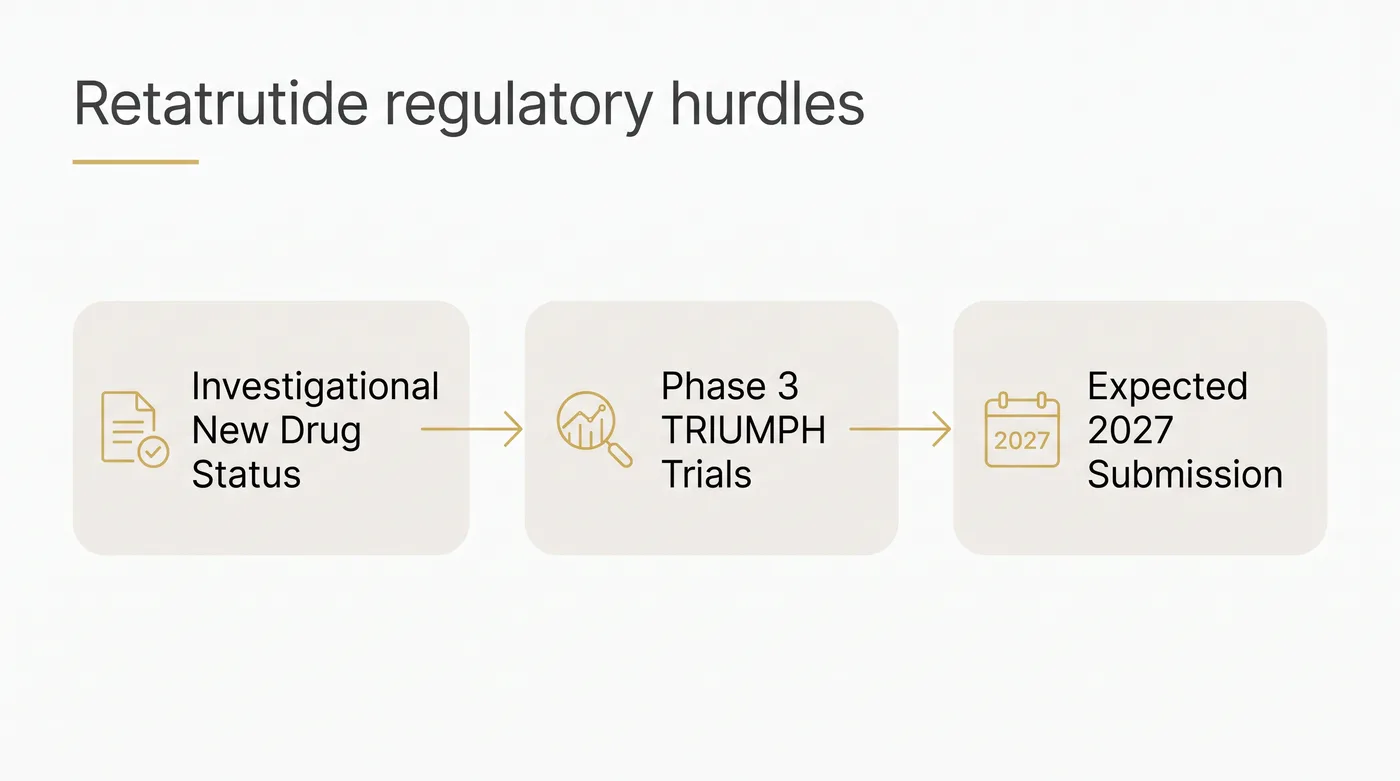
The compound eventually progressed to human clinical trials, where it is currently being investigated in phase 1, phase 2, and phase 3 studies. The phase 3 registrational program, known as the TRIUMPH trials, evaluates the peptide in thousands of participants. TRIUMPH-1 assesses the peptide in non-diabetic adults with overweight profiles, TRIUMPH-2 explores its activity in populations with type 2 diabetes, and TRIUMPH-3 studies the compound in patients with established cardiovascular disease. A separate suite, the TRANSCEND trials, specifically investigates the compound in type 2 diabetes populations. It has also been evaluated in human subjects for its impact on moderate-to-severe sleep apnea, knee osteoarthritis pain, and liver steatosis The BMJ.
If someone tells you a compound is fully understood just because it is in phase 3, they are leaving out half the story. While human trials have been conducted over periods of up to 80 weeks, substantial gaps in the evidence remain. Multi-year, long-term cardiovascular outcome studies (CVOTs) assessing the drug's impact on major adverse cardiovascular events over extended durations do not yet exist. Additionally, multi-year data concerning bone density or rare oncological risks are completely absent due to the compound's investigational status.
FDA status and compounding legalities
As of late 2026, retatrutide is legally classified strictly as an Investigational New Drug (IND). It holds no Food and Drug Administration (FDA) approval for any medical condition in the United States. This means it is legally unavailable for clinical prescription or commercial sale outside of registered, FDA-authorized clinical trials. A licensing or new drug application is projected to be submitted to the FDA in the first quarter of 2027, but until that is reviewed and approved, the compound remains experimental. You can read more about where retatrutide stands in FDA trials.
The gray market often tries to bypass these restrictions using compounding pharmacies, but federal regulators have firmly closed that door. Retatrutide is entirely excluded from the 2026 HHS and FDA Section 503A enforcement discretion policies. Pharmacies operating under Section 503A (traditional compounding) or Section 503B (outsourcing facilities) of the Federal Food, Drug, and Cosmetic Act are legally prohibited from compounding retatrutide. If you are curious how this exact same 2026 policy hits other compounds, check out the legal breakdown for MOTS-c.
The compound fails to meet the statutory exemptions for compounding because it does not have an applicable United States Pharmacopeia (USP) or National Formulary (NF) monograph, it is not an active pharmaceutical ingredient in any currently FDA-approved drug, and it has not been placed on the FDA's 503A Bulks List. The FDA has actively distributed warning letters to entities attempting to circumvent these rules by selling compounded retatrutide. If you want to see how these exact same federal rules apply elsewhere, check out the legal breakdown for KPV.
How retatrutide differs from tirzepatide
Because they are both incretin-based peptides developed by the same corporation, retatrutide is frequently compared to tirzepatide. If you want a deeper dive into the incretin family, you can explore Semaglutide vs tirzepatide vs retatrutide: the differences explained. The most concrete difference between them lies in their fundamental mechanism of action and regulatory standing.
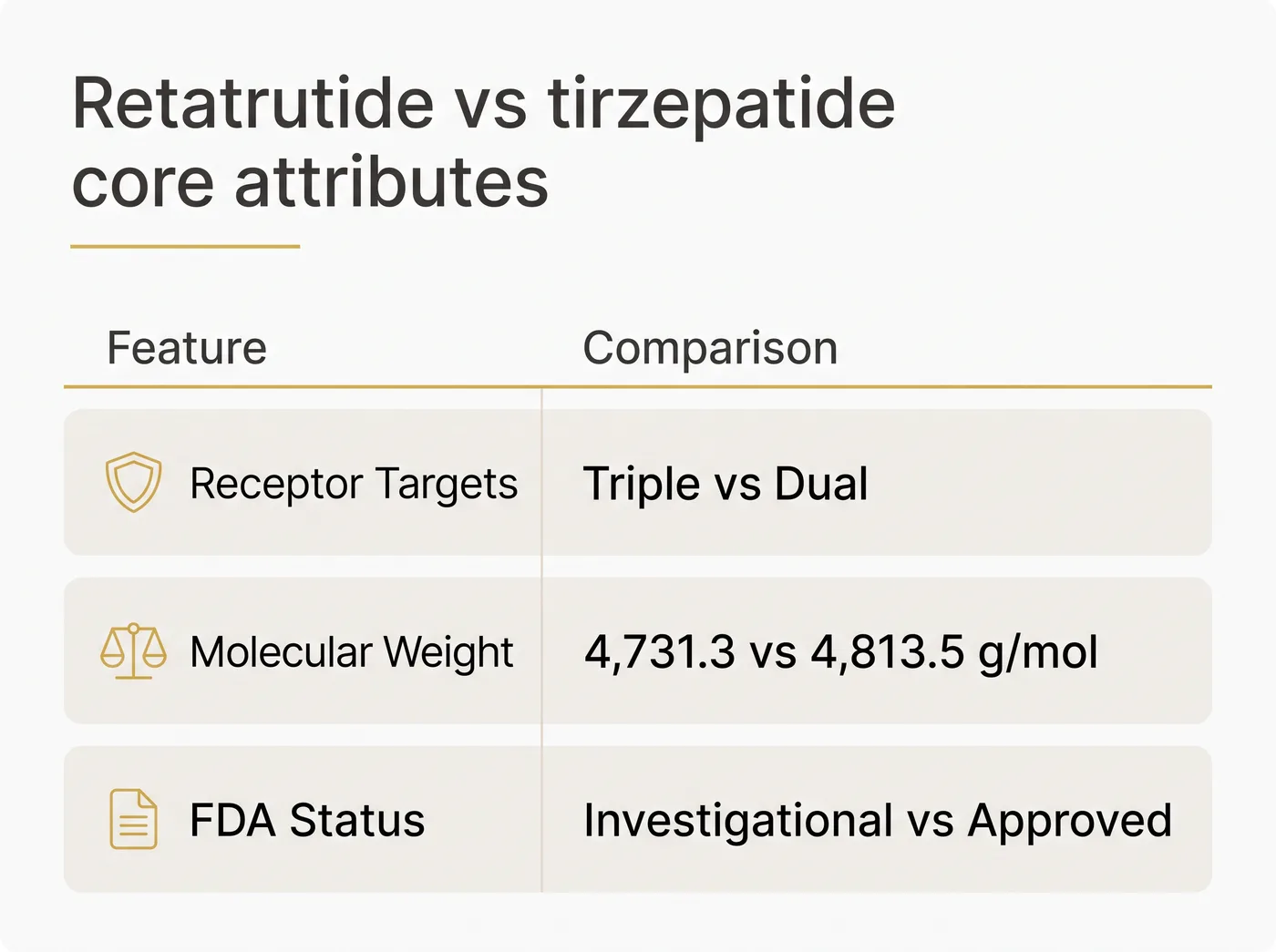
| Feature | Retatrutide | Tirzepatide |
|---|---|---|
| Receptor Targets | Triple agonist (GLP-1, GIP, GCGR) | Dual agonist (GLP-1, GIP) |
| Molecular Weight | 4,731.3 g/mol | 4,813.5 g/mol |
| Amino Acid Chain | 39-amino acid linear synthetic | 39-amino acid linear synthetic |
| Regulatory Status | Unapproved, Investigational New Drug | Fully FDA-approved medication |
While Tirzepatide targets two receptors and has completed the regulatory gauntlet to become a fully FDA-approved medication, retatrutide targets three and remains strictly experimental National Library of Medicine. Both compounds feature a C20 fatty diacid moiety, but tirzepatide has a slightly heavier molecular mass of 4,813.5 g/mol compared to retatrutide's 4,731.3 g/mol National Library of Medicine. If you are curious about a synthetic GLP-1 analogue instead, you can read the complete explainer on semaglutide.
Reading the lab report
When sourcing unapproved compounds for laboratory use, the marketing copy is meaningless. The only thing that separates a legitimate research chemical from a mystery powder is a verified Certificate of Analysis (COA) from an independent third-party analytical laboratory.
A proper lab report is the vial's passport. You are looking for high-performance liquid chromatography (HPLC) data that confirm purity, ideally exceeding 99%, and mass spectrometry (MS) data that proves the molecular weight matches the 4,731.3 g/mol standard for retatrutide. A chromatogram is a race where every impurity has to cross the finish line in public; if the peaks are blurry or the report lacks a verifiable tracking number, the document is worthless.
Researchers requiring verified, high-purity compounds for in vitro or animal models must rely strictly on these analytical metrics. For current stock, pricing, and third-party laboratory reports, you can view NuuVive's Retatrutide.
Questions
Can my local pharmacy compound retatrutide for me?
No. Retatrutide is explicitly excluded from the FDA's Section 503A traditional compounding exemptions. It lacks a standard USP monograph and is not an active ingredient in any approved drug, meaning pharmacies are legally barred from dispensing it.
When will retatrutide receive FDA approval?
Retatrutide currently holds no FDA approval. A new drug application is projected to be submitted for review in early 2027, but the timeline and outcome of that review remain entirely up to federal regulators.
What makes retatrutide a triple agonist?
It is structurally engineered to bind to three distinct metabolic receptors simultaneously. The peptide targets the glucagon-like peptide-1 (GLP-1), glucose-dependent insulinotropic polypeptide (GIP), and glucagon (GCGR) receptors.
Are there long-term studies on retatrutide?
Not yet. While phase 3 clinical trials are ongoing, multi-year cardiovascular outcome studies and extended bone density data are completely absent due to the compound's current investigational status.
Sources
- pubchem.ncbi.nlm.nih.gov. National Library of Medicine
- pmc.ncbi.nlm.nih.gov. National Library of Medicine
- pubmed.ncbi.nlm.nih.gov. National Library of Medicine
- pubchem.ncbi.nlm.nih.gov. National Library of Medicine
- pubchem.ncbi.nlm.nih.gov. National Library of Medicine
- www.bmj.com. The BMJ